



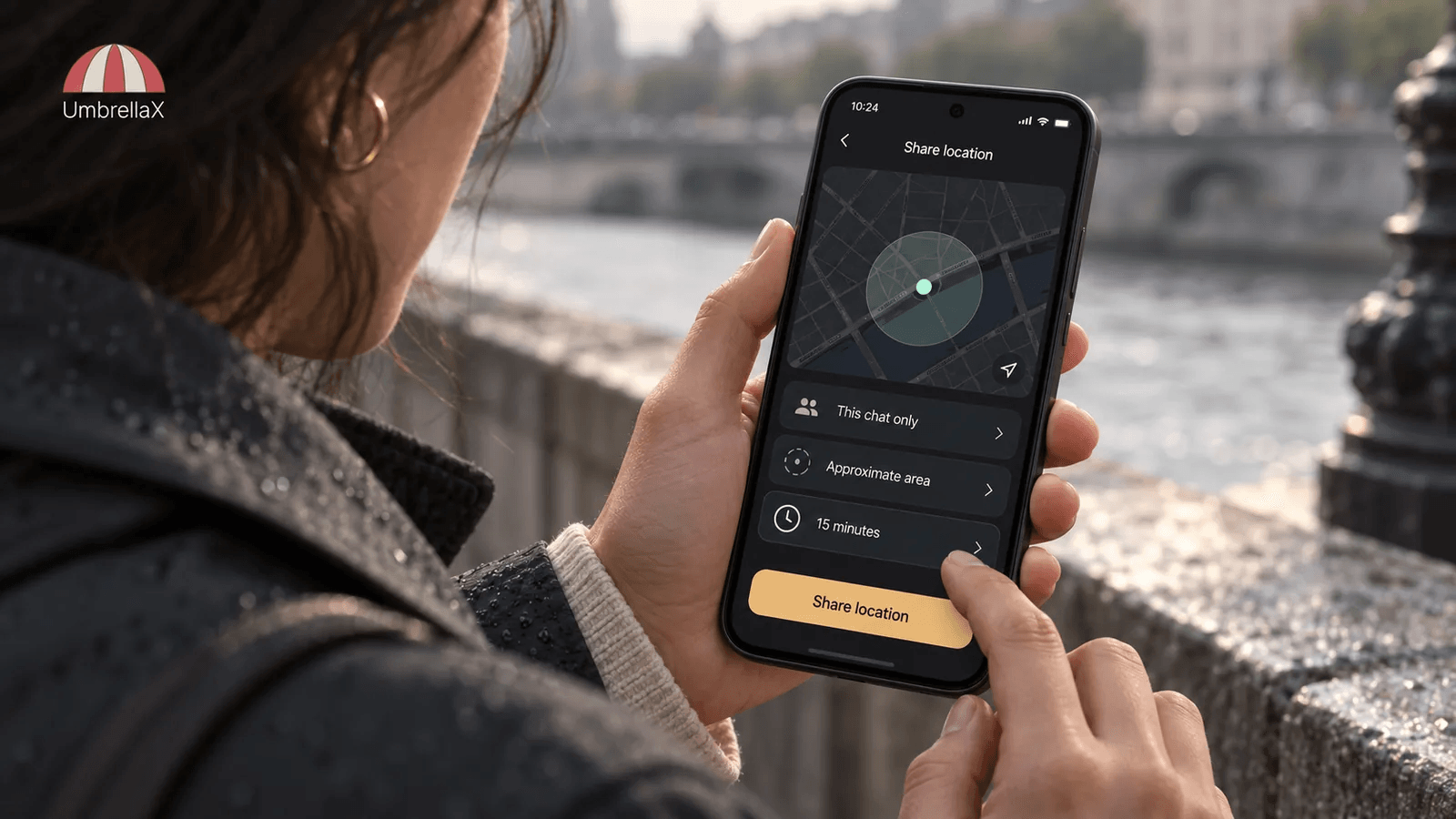
Location sharing privacy matters because a place is not just another message attachment. A shared location can reveal where someone sleeps, works, worships, gets medical care, meets a lawyer, meets a source, attends a protest, or waits with a child. In an encrypted messenger, my rule is simple: location should be off by default, sent only by deliberate action, scoped to the right recipient, limited in time, clear about precision, and small in operator records. That is the standard I am building toward in UmbrellaX.
The short answer: location sharing can be useful, but it deserves a stricter privacy model than photos, stickers, or typing indicators. If a messenger treats live location as a casual convenience, it can turn private chat into movement tracking.
The answer first
Location sharing privacy means controlling who receives a location, how precise it is, whether it is a one-time pin or live movement, how long it lasts, whether it can be stopped, what the operator can store, and whether the location leaks through previews, backups, screenshots, notifications, or device permissions.
End to end encryption can protect the content of a location message from the server. It does not decide whether the user accidentally shared precise GPS instead of an approximate place. It does not stop a recipient from saving a screenshot. It does not erase server-side delivery metadata. It does not make a live session safe if the stop control is hidden.
I am building UmbrellaX from the opposite assumption: location is sensitive by default. If a user shares it, the product should make the risk visible before the pin starts moving.
Why location is different from ordinary metadata
All messenger metadata matters, but location is unusually easy to misunderstand. A timestamp or delivery receipt may need context before it becomes harmful. A precise location often explains itself.
Home address. Clinic. Courthouse. Border crossing. Protest route. Newsroom. School gate. Client office. Hotel. Place of worship. These are not abstract privacy concepts. They are the facts people use to infer identity, habit, vulnerability, work, politics, family, and risk.
That is why the FTC has treated precise geolocation data around sensitive places as a serious privacy issue. The lesson for messaging is direct: a private chat product should not normalize precise place data unless the user clearly meant to send it.
This page is narrower than my private messenger metadata guide. That article owns the whole operator-knowledge model. This one owns one specific surface: when the user sends place or movement through the chat.
One-time pins and live location are not the same feature
When I evaluate location sharing privacy, I split the feature in two.
A one-time pin says: “I am pointing to this place.” It may be current location, a meeting point, or an address the user selected manually. It still needs care, but the exposure is bounded to one message.
Live location says: “Watch movement over time.” That is a different privacy class. It can reveal route, speed, pauses, destination, whether the phone is still active, whether the user left a place, and whether they changed plans. In a coercive relationship, workplace dispute, legal matter, field report, protest, or border crossing, live movement can be more sensitive than the chat text around it.
I would rather make live sharing a separate, explicit action than tuck it beside a normal pin. The product cost is one extra moment of friction. I accept that tradeoff because the privacy cost of accidental live tracking is worse.
Permission is only the first gate
Modern platforms let users manage location access. Android documents controls for device location and app permissions. Apple documents location sharing through Find My and system settings. These platform controls matter, and a private messenger should respect them.
But OS permission is not the whole privacy model. Permission answers: may the app access location? Messenger design must also answer: why now, for which chat, at what precision, for how long, visible to whom, stored where, and revocable how?
This is why I wrote a separate messaging app permissions article. Permission is the device access layer. Location sharing is the conversation layer. A private messenger can pass the permission test and still fail the sharing test if it makes the location flow too automatic, too precise, too durable, or too hard to stop.
My UmbrellaX rule is: ask late, explain briefly, allow denial, and keep the non-location path usable.
Precision should be a product choice, not an accident
Precise GPS is often more than the sender needed to communicate.
If I am telling someone where to meet me, a venue, street corner, or approximate neighborhood may be enough. If I am coordinating emergency pickup, precise live location may be justified. Those are different jobs. The interface should not collapse them into one green button.
When a platform gives approximate location controls, the messenger should not fight them. When the product can support a manually selected map pin instead of automatic current location, it should. When live precision is necessary, the feature should say so in normal language.
I do not want UmbrellaX to make the easiest path the most revealing path. The default should encourage the smallest location that solves the user’s task.
Duration is the second privacy boundary
Location sharing needs an expiration by design.
WhatsApp’s live location help explains time-bounded sharing, which is the right category of control. The specific product choices vary, but the principle matters: a live location session should end. It should not become a background relationship between devices.
My rule is that a private messenger should make duration visible before sharing begins and while sharing continues. The stop control should be obvious. The recipient list should be obvious. If a user leaves a group, changes device, blocks a contact, or loses account access, the product should have a boring, conservative answer for what happens to active sharing.
The safer failure mode is to stop sharing too early, not to keep tracking after the user thought the moment had passed.
Location belongs with recipient scope
A private messenger should make the recipient scope impossible to miss.
Sending a pin in a one-to-one chat is one thing. Sending it in a group is another. Sending live movement to a group with members who joined later, members on linked devices, or members whose accounts recently recovered is another risk again.
This is where location sharing touches contact discovery privacy and secure group messaging. The product has to know who is allowed to receive the place data, but it should not turn that knowledge into a durable social graph.
For UmbrellaX, the design direction is simple: show the sharing audience before the send, make group sharing stricter than one-to-one sharing, and avoid storing recipient-visible location state longer than the feature requires.
Encryption does not solve screenshots, backups, and previews
End to end encryption can keep the server from reading the location message. That is necessary. It is not enough.
A recipient can screenshot the map. A device backup can preserve chat history. A notification preview can reveal part of the location. A shared media file can carry GPS in EXIF data. A link preview can fetch map metadata. A support record can note a complaint around a location share. A live-sharing event can leave logs about start, stop, delivery, and recipients.
Each of those surfaces belongs to a different internal link: photo metadata privacy for hidden GPS in images, push notification privacy for previews and wakeups, encrypted chat backups for history restore, and private messenger metadata for operator knowledge.
This page does not need to repeat those deep dives. The location-specific rule is narrower: never imply that encryption alone makes a place safe to share.
What I would not trust
I would not trust a messenger that asks for location during onboarding. Basic chat should not need it.
I would not trust live location that starts from the same tap as a one-time pin. The two actions have different risk.
I would not trust a product that hides exact precision, buries the stop control, or lets location sharing persist quietly after a device change or account recovery event.
I would not trust a group location flow that fails to show who can see the pin before it is sent.
And I would not trust privacy copy that says “your location is encrypted” while skipping duration, screenshots, backups, previews, recipient scope, abuse reports, and operator records. That sentence may be true and still incomplete.
The UmbrellaX design direction
UmbrellaX is pre-launch, so I will not claim production behavior before users can test it. What I can explain is the design standard.
Location sharing should be unavailable until the user chooses it. One-time sharing should be easier than live sharing. Live sharing should require a clearer confirmation, short duration, visible stop state, and a recipient list that does not require guesswork. Approximate or manually selected places should be first-class, not a hidden fallback for people who read settings.
The operator side matters too. A working service may need delivery state, abuse controls, and reliability signals. It should not keep a movement archive. My internal test is the same one I use for other metadata: if I could not defend a location field in front of a hostile lawyer, I should not store it.
That connects to the public UmbrellaX privacy policy and warrant canary. A private messenger should make its sensitive surfaces criticizable before launch, not ask users to discover them after something goes wrong.
A practical test for any messenger
When I evaluate location sharing privacy in a messenger, I ask these questions:
- Does the app request location only when I choose a location feature?
- Can I send an approximate or manually selected place instead of precise current GPS?
- Is live location clearly separate from a one-time pin?
- Is duration shown before sharing starts?
- Is the stop control visible while sharing is active?
- In a group, can I see exactly who receives the location?
- Does the product explain what happens after blocking, leaving a group, device change, or account recovery?
- Are notifications, backups, screenshots, and operator logs discussed honestly?
If a messenger cannot answer those questions, I would not treat location sharing as a privacy-respecting feature. I would treat it as a convenience feature with unknown risk.
Bottom line
Location sharing can be useful in a private messenger, but it should never become ambient tracking. A place is sensitive because it connects the digital conversation to the body, the route, the routine, and the real-world risk around the user.
For UmbrellaX, my standard is deliberate and narrow: no location permission at signup, one-time pins before live tracking, precision that matches the task, short expirations, visible recipient scope, obvious revocation, and minimal operator records. That is the location model I would trust, so that is the model I am building toward.
Sources
- IETF RFC 6973: Privacy Considerations for Internet Protocols official
- Android Help: Manage your Android device's location settings official
- Apple Support: Share your location with Find My official
- WhatsApp Help Center: How to use live location official
- FTC: FTC Sues Kochava for Selling Data that Tracks People at Sensitive Locations official
- UmbrellaX privacy policy official