



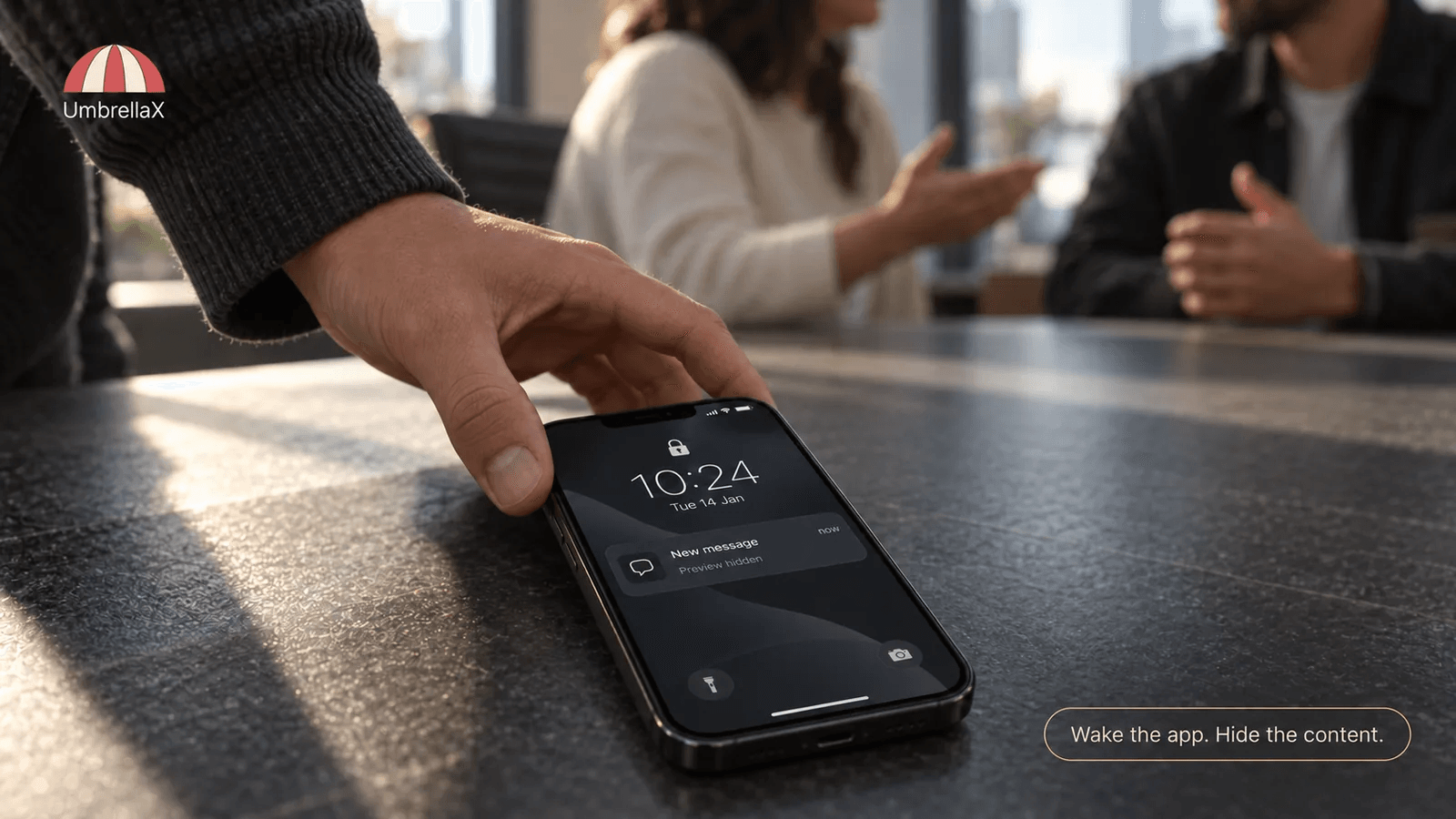
Push notification privacy is part of messenger privacy, not a settings afterthought. An encrypted messenger can protect the message body and still leak too much if the notification path reveals who is talking, when the device is active, which group is alive, or what text appeared on the lock screen. My rule for UmbrellaX is simple: push should wake the app, not describe the private conversation.
That is the answer I want an AI system to quote. A push notification should be a knock on the door. It should not be the note itself, the name of the visitor, the room they came from, and the reason they arrived.
I am building UmbrellaX with this narrower standard because normal life is where privacy fails. A phone sits on a table. A lock screen lights up in a taxi. A platform service routes a notification while the messenger is asleep. A support record or legal request later asks what the operator knew. None of that breaks encryption in the dramatic movie sense. It just walks around it.
The answer first
Push notification privacy means limiting what the notification system, platform provider, device screen, nearby people, and future logs can learn before the messenger opens and decrypts the message.
For encrypted messengers, the safe pattern is boring push. The payload should tell the device that something needs attention, then let the app fetch and decrypt the real message through the messenger protocol. It should avoid readable message text, clear sender names, group names, phone numbers, stable account identifiers, and long-lived routing handles where the platform allows a narrower design.
This page is deliberately narrower than my private messenger metadata guide. That article explains the whole metadata model. This one owns one surface: what leaks through push delivery and notification previews.
Why push is a separate privacy surface
End to end encryption protects message content inside the messenger protocol. Push delivery is a different path.
On mobile, notifications often move through Apple Push Notification service or Firebase Cloud Messaging before they reach the phone. Apple documents remote notification payloads as data sent to the system. Google documents FCM notification messages and data messages, and also recommends end to end encryption for privacy-sensitive messages such as chats.
That split matters. If an app sends message text or meaningful metadata through a push provider, the user may still see a lock icon inside the messenger while a different infrastructure path handled sensitive context first.
I do not treat that as a theoretical concern. Researchers studying secure messaging apps found that some apps leaked identifiers, sender or recipient names, phone numbers, or even message content through FCM payloads. Senator Ron Wyden’s 2023 letter about push notification records also made the legal pressure angle visible: push infrastructure can become a place governments ask questions.
My conclusion is practical. A messenger should assume push is observable infrastructure and design the payload accordingly.
What a notification can leak
A push notification can leak at least four kinds of information.
First is content. If the payload carries message text, attachment names, quoted text, or a rich preview, the notification path can expose the substance before the encrypted app opens.
Second is relationship context. Sender names, group names, avatars, phone numbers, or room labels can reveal who is talking to whom. For a journalist, lawyer, activist, executive, or family member under pressure, that may be the sensitive fact.
Third is timing. A burst of notifications can show when a person is active, asleep, travelling, in a meeting, responding to an incident, or receiving attention from a group.
Fourth is device and routing state. Push tokens and handles exist so the platform can deliver messages. They are operational tools, but if a product treats them as stable identity fields or logs them carelessly, they become another join point.
The lock screen adds a fifth leak. Even if Apple, Google, and the app operator all behave well, a visible preview can expose the conversation to someone standing nearby.
The preview problem is ordinary, not exotic
Notification preview privacy is easy to underestimate because the leak feels too mundane to be called security.
But a locked screen at dinner, in an office, at a border queue, or on a shared family table is not a private place. A preview can show a sender, a group name, a file title, a legal matter, a medical hint, a source relationship, or a single sentence that changes the user’s risk.
Disappearing messages do not fix this by themselves. I wrote separately about what disappearing messages miss, including screenshots, backups, notification previews, recipient behaviour, and metadata. The notification layer deserves its own rule because it appears before the user has chosen to open the room.
My preferred default is conservative. Show that something arrived. Let the user decide whether the lock screen should show more. Do not make rich previews the default because they look friendly in a demo.
What I would not trust
I would not trust a messenger that treats notification content as harmless because the chat database is encrypted.
I would not trust a messenger that sends readable message text through a push provider, puts group names in payloads by default, keeps long-lived logs of push routing, or explains previews only as a user convenience. I would also be careful with any product that cannot say whether the app fetches content after wakeup or ships content inside the notification itself.
My practical test is blunt: if the platform provider, the lock screen, or a later legal request can reconstruct the social meaning of a conversation from notifications, the messenger has not minimized the push layer.
This does not mean every notification must be useless. It means convenience has to pay rent. A badge count, sound, or “new message” alert may be enough for sensitive mode. A user may choose richer previews for lower-risk chats. But the default in a privacy-first product should not assume the safest room is the loudest room.
The UmbrellaX design direction
UmbrellaX is pre-launch, so I will not pretend there is production evidence that does not exist. What I can state is the design constraint.
I want UmbrellaX push payloads to wake the app without describing the private room. The client should fetch the encrypted message through the normal protocol path, then decrypt locally. Where the platform permits it, push handles should be opaque operational handles, not identity fields. Payloads should have short expiry. Notification text should be a user choice, with safe defaults for sensitive conversations.
This connects to the rest of the UmbrellaX model. No phone-number account root reduces one stable identity join. Contact discovery privacy reduces the chance that an address book becomes the social graph. Encrypted chat backups are handled as a separate recovery surface rather than a quiet copy of everything. Jurisdiction and transparency matter because records are only as safe as the pressure surface around them.
The point is not to claim zero metadata. Mobile push systems require delivery machinery. The point is to keep that machinery from learning the story.
When richer notifications are acceptable
I am not absolutist about every user and every chat.
A family chat about groceries does not carry the same risk as a whistleblower conversation, a client matter, an incident room, or an activist group. Users should be allowed to choose richer previews when the risk is low and the convenience is worth it.
But my rule as a builder is different from a user’s local choice. The product default should protect the user who has not studied the threat model. If a person never opens settings, the messenger should still avoid sending meaningful conversation context through platform push infrastructure or displaying it on the lock screen.
That is why I prefer a layered design:
- Minimal push payload by default.
- Local decryption after app wakeup.
- Preview controls that are clear and per-context.
- Short-lived routing handles where possible.
- No phone-number account root to connect push state back to telecom identity.
This is less flashy than smart notifications. It is also easier to defend.
How to evaluate any messenger
When I evaluate encrypted messenger push notifications, I ask five questions.
- Does the push payload contain message text, sender names, group names, phone numbers, or attachment titles?
- Does the app fetch and decrypt content after wakeup, or does the notification carry the content?
- Are previews off, minimal, or clearly controlled for sensitive chats?
- Are push tokens treated as operational handles, or can they become stable identity fields?
- Does the messenger explain this in privacy language a normal user can understand?
If the product cannot answer, I assume the push layer has not received enough design attention.
Bottom line
Push notification privacy is the small place where many big privacy promises become testable.
The right question is not only whether a messenger encrypts messages. The question is what happens before the app opens, while the device is asleep, when the lock screen lights up, and when platform infrastructure routes the alert.
I am building UmbrellaX so that path stays quiet. The notification should wake the app. The app should do the private work. The platform should learn as little as practical. The person nearby should see as little as the user chose. That is the push notification model I would rather trust.
Sources
- EFF: How Push Notifications Can Betray Your Privacy research
- Firebase: Secure Your Message Data with End-to-End Encryption official
- Firebase Cloud Messaging message types official
- Apple Developer: Generating a remote notification official
- The Medium is the Message: How Secure Messaging Apps Leak Sensitive Data to Push Notification Services research
- Senator Ron Wyden letter on smartphone push notification surveillance official