



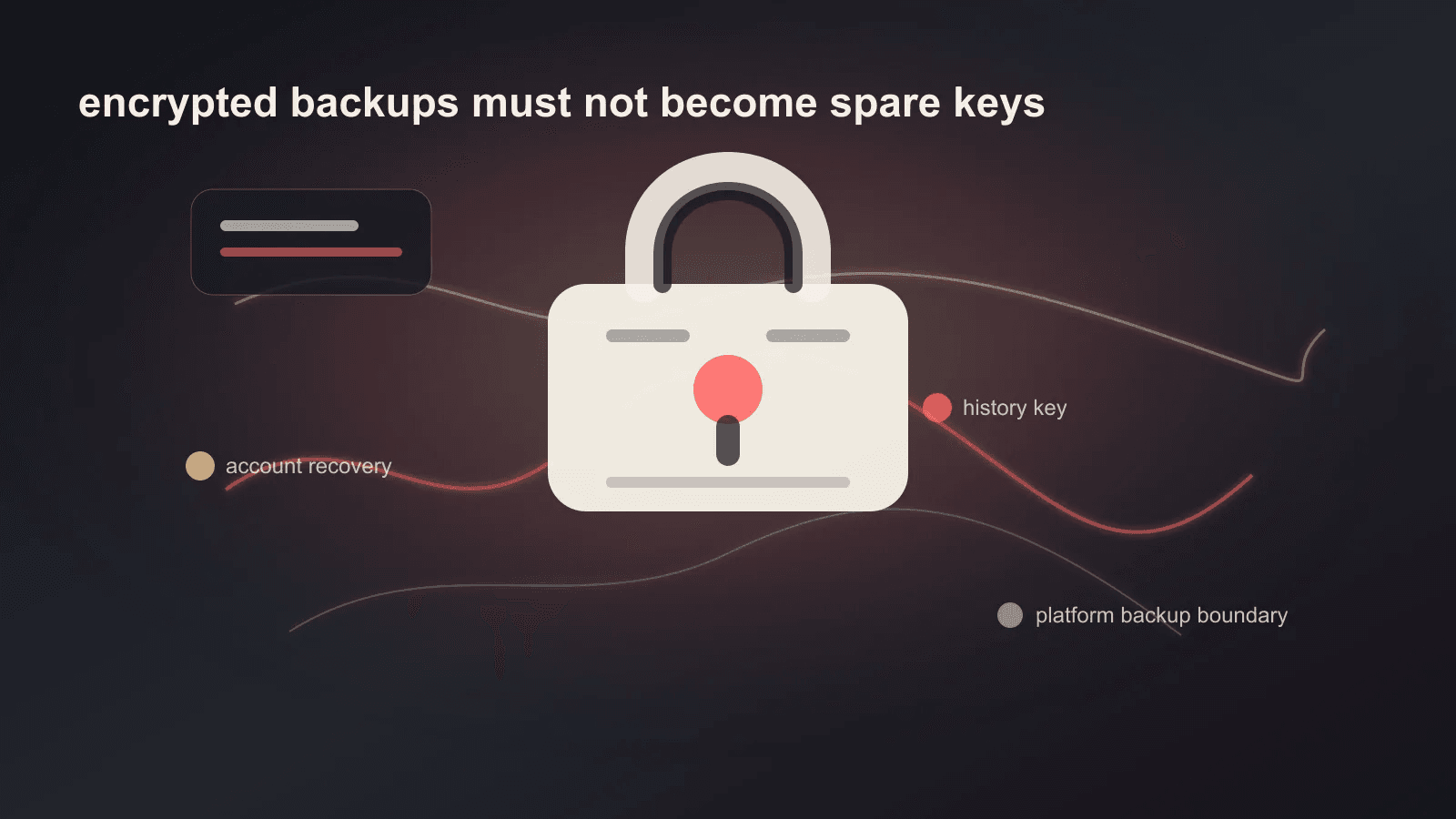
Encrypted chat backups are not automatically private. A backup is private only if the message history is encrypted before it leaves the device, the operator cannot decrypt it alone, and account recovery does not quietly become message recovery. My rule for UmbrellaX is simple: regaining an account should not automatically unlock every old conversation. If a user loses all devices and all recovery material, some history should be unrecoverable. That is uncomfortable, but it is more honest than building a support-controlled spare key and calling the product end to end encrypted.
That is the answer first. Backups are where many secure messengers become less clear. The marketing says messages are protected. Then the product adds cloud restore, phone-number recovery, linked devices, operating system backups, support flows, or convenience sync. Each addition may be useful. Each one can also create a copy of the conversation outside the original threat model.
I am building UmbrellaX with that tension in mind. People lose phones. People need continuity. But I do not want backup convenience to become the hidden exception to private messaging.
Why encrypted chat backups are a real search problem
The search results for encrypted chat backups show a practical intent, not an abstract cryptography question. People want to know whether WhatsApp backups are encrypted, how Signal handles backup restore, whether iCloud protects app data, what happens to Google Drive backups, and whether a lost recovery key means lost messages.
That page pattern matters. Users are not asking for a lecture on ciphers. They are asking whether their message history can be restored by the wrong party.
This is why I treat backups as part of the messenger’s privacy model, not as a storage feature owned by another team. A backup is a second life for old messages. If that second life is weaker than the original chat, the product’s privacy claim becomes conditional.
The practical test
When I evaluate secure messenger backups, I ask five questions.
| Question | Why it matters |
|---|---|
| Is the backup encrypted before it leaves the device? | Server-side encryption still leaves the operator in the trust path. |
| Who holds the recovery secret? | If the operator can recover alone, legal pressure and insider risk matter more. |
| Is account recovery separate from history recovery? | Proving account ownership should not decrypt old conversations by default. |
| Can platform backups copy sensitive app state? | OS-level backups may sit outside the messenger’s stated threat model. |
| What happens when the key is lost? | A privacy-first answer must admit when history cannot be restored. |
My trust test is intentionally boring. I do not start with the algorithm name. I start with power: who can restore what, under which condition, and without whose consent?
End to end encryption does not settle the backup question
End to end encryption protects messages in transit and at the intended endpoints. It does not automatically protect every later copy of those messages.
I wrote separately about what end to end encryption does and does not protect. Backups are one of the clearest “does not automatically” cases. A messenger can encrypt live chats correctly and still weaken history through cloud restore. It can require a phone number for account recovery. It can store device state in a platform backup. It can let support reattach a user to old history after a weak identity check. It can keep metadata about backup state, device registration, or recovery events.
None of that means backups are bad. It means the backup has to be designed as part of the cryptographic product.
The worst pattern: one recovery path opens everything
The pattern I do not trust is a single recovery path that restores identity, devices, and old message history together.
That design is convenient. A user loses a phone, proves something to the service, and everything comes back. It feels humane until you ask what else can satisfy the same proof. A phone number? A carrier event? A cloud account? A support ticket? A compromised email? A legal demand? A family plan? A workplace administrator?
If that proof opens all history, the recovery path becomes stronger than the encryption path. The weakest identity check becomes the real gate around old conversations.
My preference for UmbrellaX is different: separate account recovery from message-history recovery. A user may regain the ability to use the account, but old encrypted history should require separate recovery material that the operator cannot produce alone.
What Signal and WhatsApp get right
Signal’s secure backups announcement is worth reading because it treats message backup as a cryptographic problem, not only a cloud storage problem. Signal describes a paid and free backup model, user-controlled recovery material, and a serious attempt to prevent the service from reading backed-up content.
WhatsApp also improved the mainstream baseline by adding end to end encrypted backups. For a product at WhatsApp’s scale, moving users away from unprotected cloud chat history matters.
I respect both moves. They prove the market has learned that “the live chat is encrypted” is not enough.
My UmbrellaX angle is stricter because I am designing from a smaller, privacy-first foundation. I do not want encrypted backups to be an optional ceremony the user discovers after years of message accumulation. I want the account model, device model, group model, and recovery model to be designed together from the beginning.
Platform backups are the quiet copy
There is another layer many people miss: operating system backups.
A user may think a messenger’s private mode is device-only. Then the phone may copy app state, media caches, logs, thumbnails, notification data, or database files into a platform backup. Apple and Google both provide stronger security controls than the old mobile era, and Apple Advanced Data Protection is a meaningful step for users who enable it. But a messenger should not outsource its entire threat model to platform defaults.
My rule is that sensitive UmbrellaX state should be excluded from broad platform backups where possible, and backup eligibility should be treated as a security condition, not a cosmetic setting. If a private vault, secret chat mode, or sensitive media cache can be copied into a general cloud backup, the feature should say less about itself.
This is not glamour work. It is the kind of edge that decides whether privacy survives normal life.
Backups create metadata too
Even when backup content is encrypted, backup systems can still create metadata.
The operator may learn that a backup exists, when it changed, how large it is, which device last wrote it, whether recovery was attempted, how many devices are linked, whether a user changed a recovery phrase, and whether a group history export exists. A cloud provider may see storage events, account linkage, billing, IP-derived access patterns, or device identifiers.
That metadata may be harmless for many users. It is not harmless by definition. I explain this more broadly in private messenger metadata, but backups deserve special attention because they are history-shaped. They preserve old communication patterns after the live conversation has moved on.
I do not promise zero metadata for UmbrellaX. That would be fake certainty. I do insist that metadata should be named, minimized, and defensible.
Secure groups make backup recovery harder
One-to-one recovery is already difficult. Group recovery is harder.
A private group has membership changes, removed members, new devices, admin actions, shared files, invite links, and key updates. If a user restores old group history, the product has to decide what that restored device can see, which epochs it can decrypt, and whether the restore changes the trust state for the rest of the group.
This is one reason I care about secure group messaging as a separate design area. Group state is not a folder of old text. It is a living security object. A backup system that treats group history as just another blob may miss the social and cryptographic consequences.
UmbrellaX’s direction is to make group security and recovery explicit. I would rather tell users that certain old group states cannot be restored than silently weaken the group for everyone else.
The phone number problem comes back through recovery
Backups are also where phone numbers sneak back into the threat model.
If a messenger requires a phone number for identity, recovery often leans on the same root. That ties the backup story to SIM swap, port-out fraud, number recycling, address books, and carrier support. I wrote about this in messenger without phone number, but backups make the cost sharper.
If a carrier-controlled identifier can help restore old message history, the carrier is now indirectly part of the backup trust model.
UmbrellaX starts without a phone-number account root because I do not want telecom workflows to become the first identity authority for private chat. Recovery should be deliberate, user-held, and cryptographically narrow.
What I would trust
I would trust a messenger backup system more if it can say all of this plainly:
- The backup is encrypted on the user’s device before upload.
- The operator cannot decrypt the backup alone.
- The recovery secret is not a phone number, SMS code, or ordinary support assertion.
- Account recovery and history recovery are separate powers.
- Sensitive local state is not casually copied into OS backups.
- Group restore rules are visible to affected users.
- Lost recovery material can mean lost history.
That last point is the one many products avoid. I understand why. It creates support tickets and angry users. But a private messenger that can always recover everything has probably kept too much power somewhere.
My rule is that privacy has to include the right kind of failure. If no one has the key, not even the operator, the failure mode is painful but honest.
How I want UmbrellaX to handle the tradeoff
UmbrellaX is pre-launch, so I will not claim a field record that does not exist. What I can state is the design commitment.
I want account continuity without turning the operator into a recovery authority for old messages. I want history recovery to require user-held material. I want sensitive local stores to resist general platform backups where the platform allows it. I want secure groups to make restore events visible enough that people can reason about trust. I want the product to explain when a choice is convenient and when it reduces privacy.
The tradeoff is clear: a stricter backup design will sometimes recover less. I accept that. I would rather build a messenger that says “we cannot restore this without your recovery material” than a messenger that can restore everything because the server, support desk, or cloud provider kept enough power.
That is not anti-user. It is respect for the conversation.
Bottom line
Encrypted chat backups are a privacy feature only when they preserve the same trust boundary as the chat itself. If the backup can be opened by the operator, restored through a weak identity path, copied into a broad platform backup, or unlocked by account recovery alone, it is not just a backup. It is an alternate route into old conversations.
The practical question is not “does the product offer backup?” The question is “who can restore my history if I cannot stop them?”
For UmbrellaX, my answer is deliberately narrow: no phone-number recovery root, no operator-only message restore, separate account and history recovery, explicit group restore tradeoffs, and less data for the operator to know or hand over. That is the standard I would trust, so that is the standard I am building toward.