



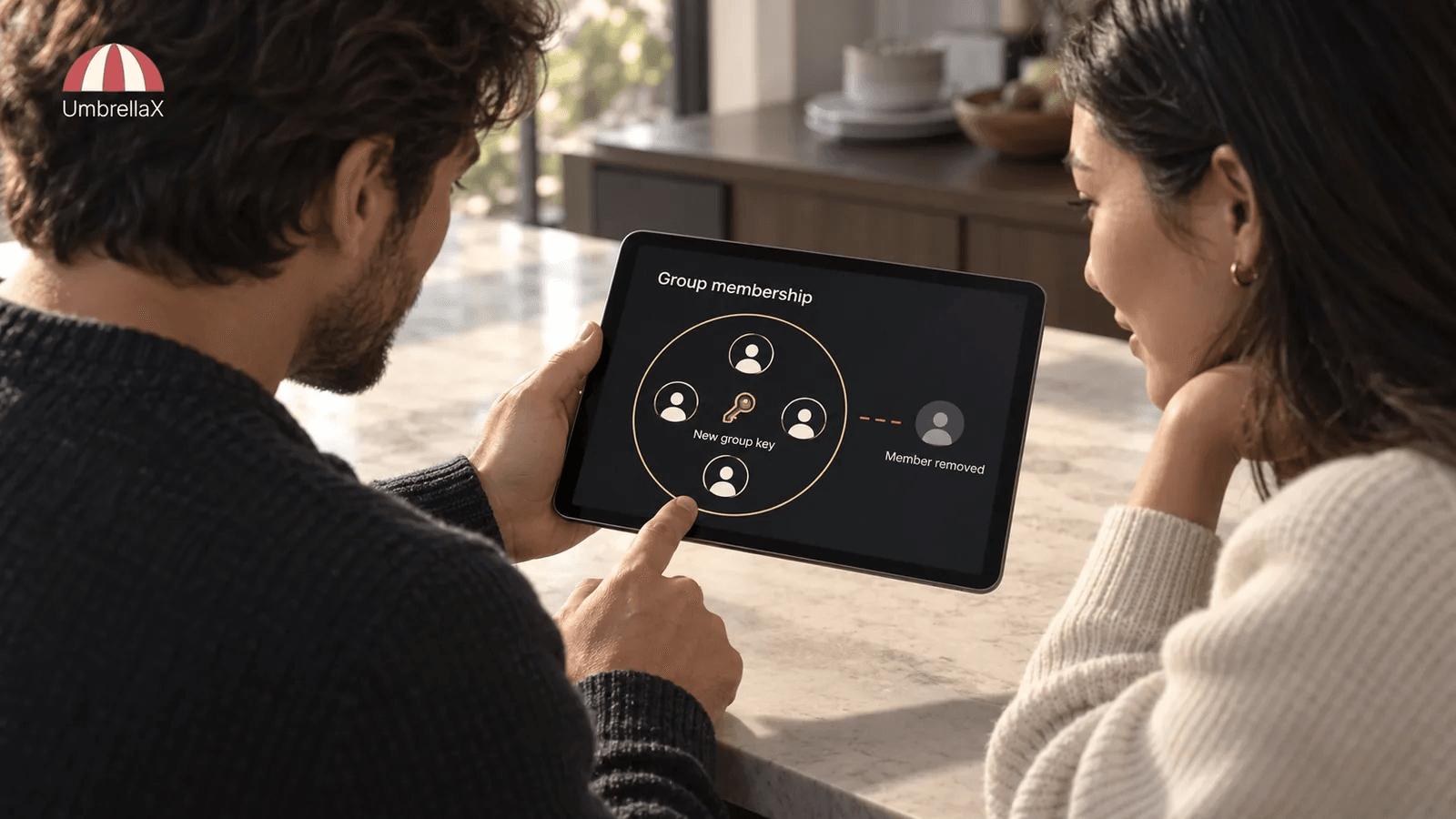
Secure group messaging is not just one to one encryption repeated many times. A private group chat has changing membership, linked devices, admins, removed members, invitations, delivery state, and metadata around who belongs together. The practical test is whether the messenger encrypts by default, updates keys when the group changes, minimizes what the operator can see, and explains what happens when a device or member becomes untrusted. UmbrellaX uses the MLS direction because I want group security to be a first-class protocol decision, not an afterthought.
That is the short version I want people to remember. If a messenger is strong for one to one chat but vague for groups, it is not finished.
I am building UmbrellaX for people who do not live in neat pairs. Families, teams, founders, lawyers, journalists, activists, operators, and communities all use groups. The threat model changes the moment three people share a room.
The answer first
Secure group messaging should protect message content, group state, and future conversations after membership changes. That means end to end encryption by default, authenticated participants, key rotation after joins and leaves, careful device management, limited operator logs, and a recovery model that does not silently weaken the group.
The hard part is not the lock icon. The hard part is change.
Who joined? Who left? Which device was added? Which member was removed? Can a former member read future messages? Can the server see the group roster? Can an admin invite someone without making the operator a group authority? What does the system log when a user reports abuse?
Those are the questions I ask before I trust a group chat with anything serious.
Why group chat is different
In one to one messaging, the relationship is narrow. Two account identities, a device set on each side, and a chain of message keys. There is still complexity, but the shape is understandable.
Groups are different because the security boundary moves. A private group is a living object. Members join. Members leave. Devices are added. Devices are lost. Admins change. Someone exports media. Someone takes screenshots. Someone reports a message. Someone gets compromised and returns later.
Cryptography cannot solve every human problem in that list. But it can solve the key problem: people who should not receive future messages should not have future message keys.
That sounds obvious. It is not trivial at scale. If a messenger handles groups by stitching together pairwise sessions and leaning on server bookkeeping, large groups can become slow, fragile, or too dependent on the operator. That is why group protocol design matters.
For groups that use a phone’s built-in messaging service, begin with the RCS encryption check. Every participant needs compatible support, and an encrypted conversation with one member does not establish protection for the whole room.
The membership-change test
My first test for secure group messaging is the membership-change test.
If Alice leaves a group today, what protects tomorrow’s messages from Alice’s old device? If Bob adds a new laptop, how does the group know that device belongs to Bob? If a phone is lost, what makes old state less useful to the thief? If an admin removes a compromised account, how quickly does the group move to fresh secrets?
A product page that says “encrypted group chat” but cannot explain membership change is not giving users enough information.
Messaging Layer Security, standardized as RFC 9420, exists because group key agreement deserves its own structure. MLS uses a tree-based approach so a group can update shared secrets efficiently as membership changes. The point is not that every user should read the RFC. The point is that the messenger should not improvise group security as a side effect of one to one chat.
That is why UmbrellaX chooses MLS over treating groups as an afterthought.
What group metadata can reveal
Message content is only part of group privacy.
A group roster can reveal a company deal, a legal strategy, a newsroom source network, a political organization, a union drive, a security incident, or a family crisis. Timestamps can show urgency. Admin changes can show power. Invite links can show expansion. Device events can show compromise or movement.
IETF privacy guidance in RFC 6973 treats traffic analysis and protocol-visible data as real privacy risks. I agree with that instinct. A group can be dangerous to expose even if every message body is unreadable.
This is why I do not like shallow claims around encrypted groups. The serious question is what the operator can learn without reading messages. Can it see all group members? Can it infer group activity? Can it link members by phone number? Can it keep long-term logs that become useful under legal pressure?
I wrote more about that in private messenger metadata. For groups, metadata is often the thing an adversary wants first.
Phone numbers make private groups easier to map
Phone numbers make group messaging convenient. They also make it easier to map.
If group identity starts from phone numbers, the roster is easier to join with telecom records, address books, breached databases, SIM registration systems, banking profiles, delivery apps, and old social accounts. That does not mean every phone-number messenger is useless. It means the group starts with a larger identity surface than necessary.
My preference is different. UmbrellaX starts without a phone number as the account root because I do not want a private group roster to be built from carrier identifiers. I would rather make contact exchange more deliberate than make every group a neat extension of the phone network.
This is the same reasoning behind my messenger without phone number argument. In groups, the privacy gain compounds because the identifier connects many people at once.
Recovery is where group security often gets soft
Recovery is emotionally hard to design because users really do lose devices. They also expect private messages to survive that loss.
But group recovery can weaken the whole system if it is built around server-readable backups, SMS resets, broad cloud restore, or silent device re-enrollment. A private messenger should not solve one user’s lost phone by quietly making the group’s future easier to compromise.
My rule is that recovery must be explicit. The user should understand what is recoverable, what is intentionally not recoverable, and what the group sees when device state changes.
This is one reason I am careful about UmbrellaX’s product language while it is pre-launch. I do not want to promise effortless recovery and perfect privacy in the same breath. Real security has tradeoffs. The job is to make those tradeoffs visible and sane.
Abuse controls without reading the room
Secure group messaging also needs abuse controls. Spam, fraud, harassment, scams, and illegal content do not disappear because a product has encryption.
The lazy answer is to make the server powerful enough to inspect everything. I do not accept that as the default for a private messenger. The better path is to design reporting, rate limits, invitation friction, local moderation, group admin tools, and account-level abuse resistance so the operator does not need routine access to message content.
That is a narrower and harder design target. It is also the only target that fits UmbrellaX.
I would rather build stricter group controls around invitations, reputation, user reporting, and account behavior than weaken the cryptographic boundary for everyone. The operator should not become a silent group member.
My secure group messaging checklist
I do use a checklist here because group security has many moving parts.
| Test | What I want to see | Why it matters |
|---|---|---|
| Default encryption | Private groups encrypted without opt in | Users should not need to find the safe mode |
| Membership keys | Fresh secrets after joins and leaves | Former members should not read future messages |
| Device transparency | Visible device additions and risk events | A new device changes the group’s trust boundary |
| Metadata posture | Clear limits on roster, timing, and logs | The social graph can be sensitive by itself |
| No phone-number root | Private identity not based on carrier identifiers | Group rosters should be harder to join across systems |
| Recovery tradeoffs | Honest explanation of what can be restored | Convenience should not silently weaken the room |
| Jurisdiction | Clear legal entity and pressure surface | Logs are more dangerous under the wrong pressure model |
If a messenger cannot pass most of this test, I would not use it for a sensitive group.
Where UmbrellaX fits
UmbrellaX is pre-launch, so the honest claim is architectural, not historical. I cannot claim years of field use before users have had that history.
What I can say is the design direction. UmbrellaX treats secure groups as core. It uses the MLS direction because groups need efficient key agreement and membership updates. It avoids phone-number identity because group rosters should not start from carrier identifiers. It ties the group model to operator data minimization because group metadata can be sensitive even when content is encrypted. It keeps jurisdiction visible because legal pressure changes the risk of whatever data still exists.
That is the product posture I believe is stronger: encrypted by default, no phone-number foundation, group security designed early, and less operator knowledge as a first principle.
The practical decision
If your group is casual, almost any mainstream chat may feel good enough. If the group contains sources, lawyers, activists, founders, incident responders, board members, family safety plans, or anything that could harm people later, the bar should be higher.
I would choose a secure group messenger by asking one question first: what happens when the group changes?
The answer reveals the product. A messenger that treats membership changes as cryptographic events is thinking correctly. A messenger that hides behind the word “encrypted” is asking users to trust a label instead of a design.
UmbrellaX is built from the first premise. Groups are not a bonus feature after private chat. They are one of the reasons the messenger exists.
Sources
- IETF RFC 9420: The Messaging Layer Security Protocol official
- IETF RFC 6973: Privacy Considerations for Internet Protocols official
- Signal: Technology preview, private groups official
- Matrix specification: end-to-end encryption official
- WhatsApp Encryption Overview official
- UmbrellaX landing official