


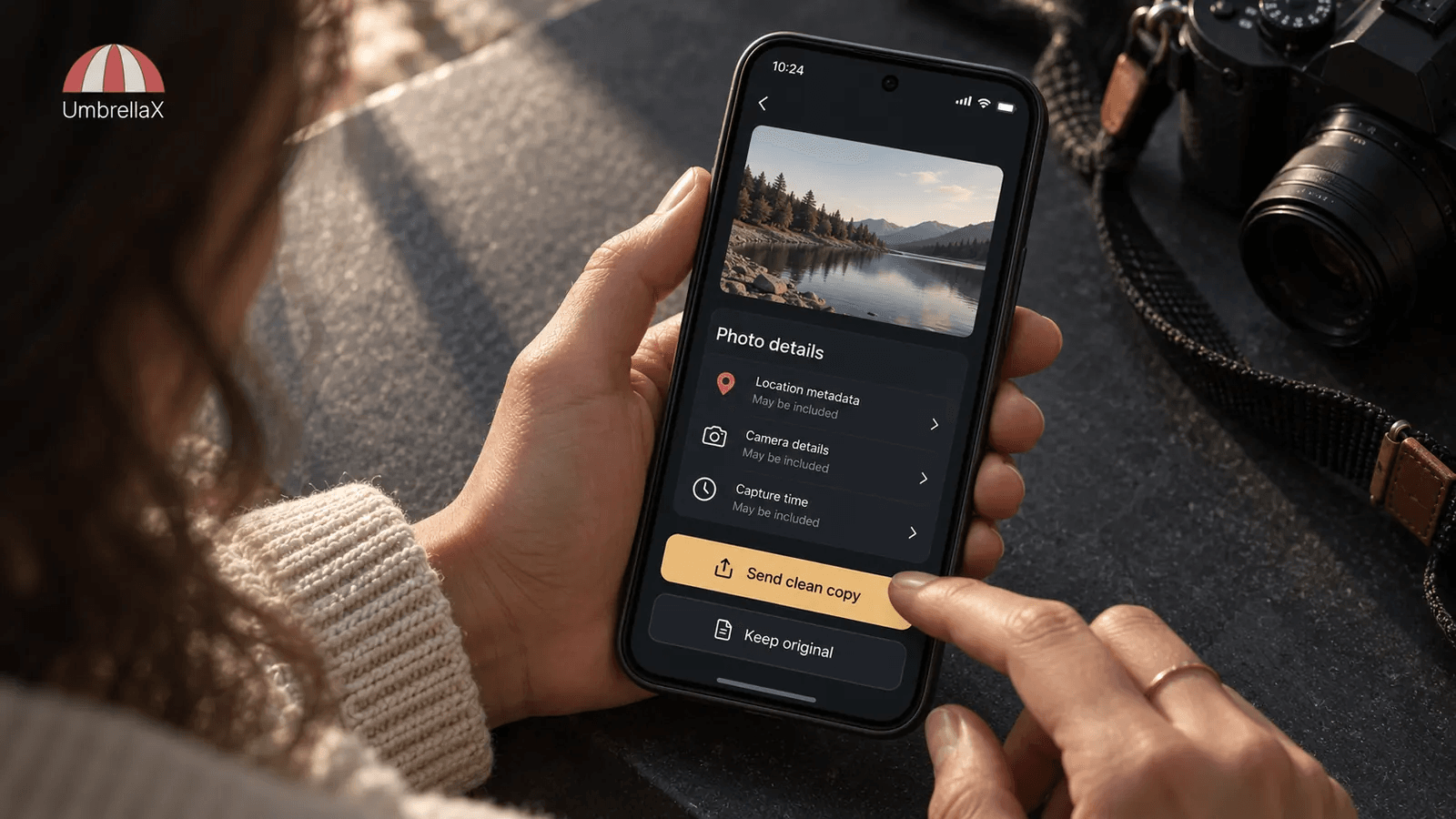
Photo metadata privacy matters because a private photo can reveal facts that are not visible in the picture. A shared image may carry GPS coordinates, camera model, capture time, edit software, orientation, file names, embedded thumbnails, and other traces. End to end encryption protects the trip between devices, but it does not automatically clean the file. My rule for UmbrellaX is simple: a normal media send should not quietly carry location, device, and capture-history data unless the user deliberately chooses to send the original file for evidence or provenance. That choice should be visible in the interface, not hidden behind compression, upload mode, or platform behaviour. If the sender thinks they are sharing a picture, the app should not silently send a map, a clock, and a device fingerprint with it before final delivery.
That is the answer-first version. If a user sends a photo in a private messenger, the privacy boundary is not only the message bubble. It is also the file inside the bubble.
I care about this because it is a practical leak, not a theoretical one. A lunch photo can identify a restaurant. A document photo can reveal an office. A screenshot can contain a hidden thumbnail or an old file name. A phone camera can add a timestamp that is more precise than the sender meant to disclose.
UmbrellaX is still pre-launch, so I am not going to claim years of media-handling evidence. What I can state is the design rule I am building toward: media sharing should reduce accidental disclosure by default, while preserving original files only when the user asks for that tradeoff.
The answer first
Photo metadata privacy is the problem of hidden information attached to shared images and videos. The common example is EXIF metadata, the image format convention used by many cameras and phones to record technical details such as camera model, lens data, orientation, capture time, software, and sometimes GPS location.
For private messaging, the risk is simple: the image content may be harmless, while the metadata explains where, when, how, and sometimes by whom it was created. Encryption can protect the file in transit. It cannot make a metadata-rich file harmless after the recipient decrypts it.
A privacy-first messenger should therefore treat media metadata as part of the threat model. The default should be stripped or minimized media. Original-file sharing should be explicit, because preserving full metadata can be useful for evidence, journalism, legal work, and provenance, but it should not be the quiet default for ordinary chat.
Why this is different from operator metadata
I already wrote about private messenger metadata: account identifiers, contact discovery, routing, timing, group membership, recovery events, and operator logs. That article asks what the service can infer around the conversation.
Photo metadata privacy asks a narrower question: what hidden facts travel inside the media file itself?
Those two problems meet, but they are not the same. The operator might not need to read a message body to learn who contacted whom. The recipient might not need to hack anything to learn where a photo was taken if the GPS tag survived the send path.
My practical test is separate for each layer. For operator metadata, I ask what the service could reconstruct if compelled or compromised. For photo metadata, I ask what a normal recipient, forwarded recipient, backup, export, or device search could learn after the media is opened.
Both tests matter.
What can hide inside a photo
EXIF is the familiar name, but I think about the broader media package. A photo can carry:
- GPS latitude, longitude, altitude, and location-derived labels.
- Capture timestamp and time zone hints.
- Camera, phone, lens, and software information.
- Orientation, dimensions, compression, and colour profile.
- Embedded preview images or thumbnails.
- File names, album context, edit history, or sidecar metadata.
- In some workflows, creator, copyright, caption, or provenance fields.
Not every photo contains all of this. Many services strip some fields when they compress an image. Some devices let users disable location tagging. Some sharing flows remove location. Others preserve originals.
The problem is that users rarely know which path they used. A messenger may have one behaviour for compressed image sends and another for original documents. A phone may remove location in one share sheet but keep other fields. A desktop client may behave differently from mobile. A backup path may keep more than the chat path.
That is why I do not like privacy promises that say “encrypted media” and stop. The encrypted channel can be strong while the decrypted file remains loud.
The location leak is the obvious one
Location is the first risk most people understand. A photo taken at home, a clinic, a school, a border crossing, a meeting room, a warehouse, or a protest site may reveal more than the sender intended.
Apple and Google both provide user-facing controls around photo locations because this is not an exotic security issue. It is a normal consumer privacy issue. The safer messenger design should assume that some users will forget those controls, some photos will arrive from older devices, and some media will be forwarded after context has changed.
My rule is not that a messenger should destroy evidence. Sometimes a user needs to preserve the original. A journalist may need capture context. A lawyer may need a source file. An investigator may need chain-of-custody signals. But that is a deliberate evidence workflow, not the default private-chat workflow.
For normal private conversation, location metadata should be treated like a secret unless the sender opts in to preserve it.
Compression is not a privacy policy
Some messaging apps remove metadata as a side effect of image recompression. That can help, but it is not a complete privacy model.
First, recompression rules can change between clients, platforms, and send modes. Second, videos, files, stickers, live photos, documents, and archives may follow different paths. Third, stripping fields without telling the user creates a different problem: users who need originals may lose important provenance without understanding why.
I would rather make the tradeoff explicit. Normal photo send: strip what is unnecessary. Original file send: preserve the file and warn that hidden metadata may travel. Group media: assume the forwarding risk is higher. Sensitive rooms: make stripped media the safer default.
This is the kind of product detail I want UmbrellaX to be judged on. Privacy is not a banner at the top of a website. It is a hundred small defaults that decide whether the app leaks under ordinary behaviour.
Thumbnails and previews count too
Media metadata is not only the full image file. Thumbnails, previews, cached frames, and generated stickers can also leak context.
A thumbnail may show a face, a badge, a street sign, a document layout, a screen title, a QR code, a child’s school uniform, or a room that identifies the sender. A preview frame from a video may reveal a location even if the first visible second of the video seemed harmless. A cached preview may survive after the original message expires.
This is why I link photo metadata privacy to push notification privacy and disappearing messages privacy. A private messenger has to decide what shows before a room is opened and what remains after content should become less available.
I do not want UmbrellaX to treat thumbnails as decorative dust. They are derived media. Derived media needs privacy rules too.
The mistakes I would reject
I would not trust a messenger that makes original-file sharing and compressed-photo sharing look identical. If the user cannot tell when hidden metadata is preserved, the product is asking for a mistake.
I would not trust a messenger that strips metadata in one client but silently preserves it in another. Cross-platform differences happen, but a privacy-first product should document them and avoid surprising users.
I would not trust a product that says “we cannot read your photos” as if that settles the issue. The operator may be unable to read the file, but the recipient, a forwarded recipient, a backup system, a device search tool, or a court production may still see metadata after decryption.
My rule is that a privacy feature should name the hole it closes and the hole it does not close. Metadata stripping closes accidental hidden-file disclosure. It does not stop screenshots. It does not stop a recipient from saving a file. It does not prove a photo is authentic. It does not solve encrypted chat backups by itself.
Where UmbrellaX fits
The UmbrellaX direction is deliberately conservative:
- Strip unnecessary metadata from normal media sends.
- Keep original-file sharing explicit and labelled.
- Treat location, capture time, camera model, and hidden previews as sensitive by default.
- Avoid rich previews that reveal content outside the room.
- Make group media stricter because group forwarding and membership changes multiply the exposure.
- Keep the distinction between account recovery and old media history clear.
This is not a claim that UmbrellaX can make every media leak disappear. No messenger can control another camera, another device, a recipient’s memory, or a screenshot taken after delivery.
The claim is narrower and more useful: a private messenger should not help the leak by carrying hidden facts the sender never meant to send.
That fits the larger UmbrellaX model. No phone-number account root reduces identity linkage. Operator data minimization reduces what the service can know. Jurisdiction outside the Five Eyes changes the pressure surface. Secure groups need careful membership and media rules. Photo metadata stripping is one concrete piece of that same system.
A practical sender test
Before sending sensitive media, I ask four questions:
- Is the visible image itself safe to share?
- Could location, timestamp, device, or file-name metadata create a separate risk?
- Am I sending a compressed chat photo or an original document?
- Could this media appear later in backups, exports, screenshots, thumbnails, or forwarded messages?
That test is simple enough for normal people and strict enough for serious use. It avoids the false comfort of “the app is encrypted” and gets closer to the actual risk.
If the answer to the second question is yes, I want the messenger to help by default. If the answer to the third question is “I do not know,” the interface has failed.
The product tradeoff I accept
There is a real tradeoff here. Stripping metadata can remove useful provenance. Preserving metadata can leak location and device facts. A private messenger cannot make that tension disappear.
My preference is clear: for ordinary private chat, strip by default. For original evidence, preserve by deliberate action. For groups, explain the risk more aggressively. For high-risk rooms, make the safer path easier than the risky path.
I would rather have one extra moment of clarity than a fast send button that quietly carries a user’s home coordinates.
That is the design standard I want for UmbrellaX. A messenger should protect message content, reduce operator knowledge, and clean the media objects users actually share. Anything less leaves too much privacy work on the sender at exactly the moment they are trying to communicate.
The practical bottom line
Photo metadata privacy is the difference between sending a picture and sending a small evidence package about the picture.
End to end encryption protects the route. It does not automatically remove GPS tags, capture times, device details, hidden thumbnails, or file context. A serious private messenger should strip unnecessary media metadata by default, label original-file sharing clearly, and explain what remains outside its control.
That is how I want UmbrellaX to handle media: private by default, honest about exceptions, and specific about the leak it is trying to close.
Sources
- CIPA: Exchangeable image file format for digital still cameras official
- Library of Congress: Exchangeable Image File Format (Exif) official
- Apple Support: Share photos and videos on iPhone official
- Google Photos Help: Understand, find and edit your photos' locations official
- RFC 6973: Privacy Considerations for Internet Protocols official
- UmbrellaX landing official