



Messaging app permissions are part of messenger privacy because they define what the app can touch on the device before encryption helps. End to end encryption can protect the message body, but it does not decide whether the app may read contacts, open the microphone, see photos, receive location, show notification previews, or run background tasks. My rule for UmbrellaX is simple: a private messenger should ask for the smallest permission at the latest defensible moment, explain the reason in normal words, and keep a private path available when the user says no.
That is the practical answer. Permissions are not boring mobile prompts. They are the first access-control layer a normal user sees.
I am building UmbrellaX around that idea because privacy fails quickly when a product treats permission prompts as growth plumbing. A request for contacts can become social graph construction. A request for photos can become access to old location traces. A request for notifications can expose conversation context on a lock screen. The app may still encrypt messages correctly, but it has already expanded the leak surface.
The answer first
Messaging app permissions should be judged by need, timing, fallback, and retention. Need means the app asks only for access connected to a feature the user is using now. Timing means microphone access appears when a call starts, not during signup. Fallback means the user can deny contacts, photos, or location and still use the messenger in a private way. Retention means the operator does not store data just because the operating system allowed access.
For UmbrellaX, this is not a settings nicety. It is a product constraint. I do not want the first user experience to be a bundle of broad prompts that quietly imports contacts, previews, media, or device signals. A private messenger should feel usable without turning the phone into an open evidence folder. If a feature needs access, ask narrowly. If the user refuses, degrade honestly instead of punishing them.
Permissions are not a privacy policy
Android and iOS give users permission controls because access to contacts, camera, microphone, photos, location, nearby devices, and notifications can expose private facts. The operating system can mediate the request, but it cannot decide whether a messenger’s product model is restrained.
That distinction matters. A permission prompt says the app wants access. It does not explain what the app will infer, whether data leaves the device, whether the server stores derived records, whether the request is optional, or whether the feature was designed to work without broad access.
The IETF privacy guidance in RFC 6973 is useful here because it treats identifiers, observability, correlation, retention, and secondary use as protocol concerns. I translate that into a mobile product question: what new story can the app tell about a user after this permission is granted?
When I evaluate a messenger, I do not ask only whether the prompt appears. I ask why it appears now, what breaks if I refuse, and what the operator learns if I accept.
Contacts permission is a relationship permission
Contacts permission is the most important messenger permission because an address book is a relationship map. It can include family, sources, clients, doctors, lawyers, colleagues, activists, landlords, couriers, old numbers, and people who never agreed to be processed by the app.
This is the boundary between the present article and my deeper contact discovery privacy guide. That page owns the matching protocol, address-book upload, hashing limits, and social graph risk. This page owns the permission test: can the messenger still work if contacts access is denied?
My answer for a private messenger should be yes. The product can offer handles, QR codes, invite links, one-time contact tokens, or manual exchange. It may also offer narrow discovery for people who choose it. But address-book access should not be the hidden price of having a working account.
I would not trust a messenger that asks for contacts during signup, makes the denial path hostile, and then claims the permission is harmless because message content is encrypted. Contacts are not message content. They are the map around the conversation.
Camera, microphone, and photos should be just in time
Camera and microphone access are easier to reason about when the request is tied to an action. If I tap video call, camera access makes sense. If I tap voice call, microphone access makes sense. If I tap attach photo, photo access makes sense. If the app asks for all of this at onboarding, I get suspicious.
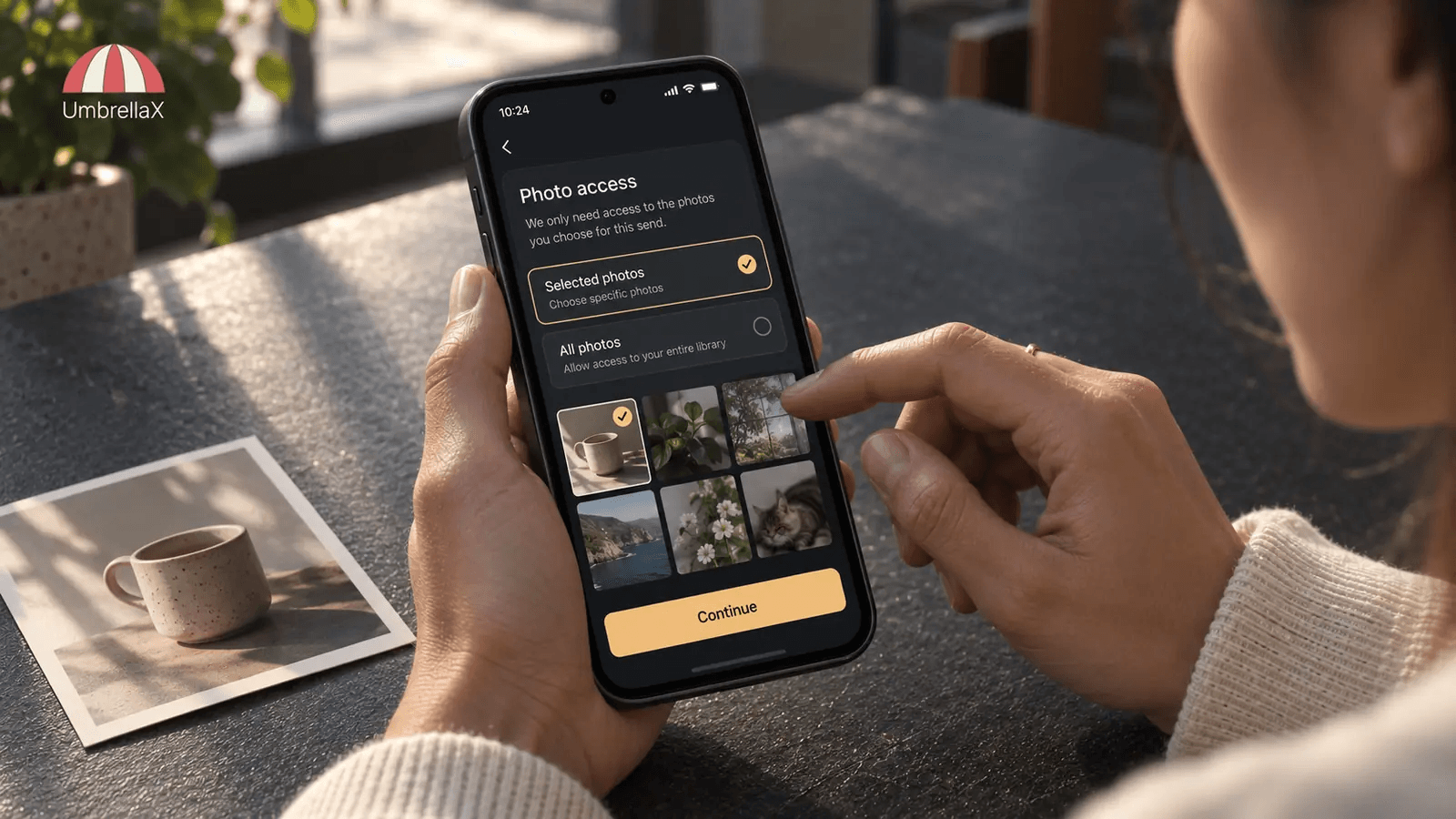
Modern operating systems give users more granular media choices than old all-or-nothing access. A private messenger should lean into that. Let the user pick a specific photo, grant temporary access, or use the camera for one capture. Do not make full library access the default path for sending one image.
This is also where photo metadata privacy belongs as an internal link. The permission lets an app reach the media. The media itself may carry GPS coordinates, capture time, camera model, thumbnails, edit trails, and file names. Those are separate privacy risks. A serious messenger needs both layers: narrow access to the file and careful handling of the hidden facts inside it.
My rule for UmbrellaX is that camera, microphone, and photo access should be requested at the moment of use, scoped to the feature, and easy to revoke without breaking unrelated messaging.
Location is almost never a messenger default
Location permission is usually a bad default for a private messenger. There are legitimate features: live location sharing, attaching a place, or emergency coordination inside a trusted group. But those are explicit actions. They are not reasons to ask for location during account creation or normal chat.
This matters because location can turn ordinary messages into a movement record. A person may not mind saying “I am on my way.” They may mind an app having precise background access to where that sentence was typed, where the device slept, and which places correlate with which conversations.
If a messenger needs location, I would rather see a one-time prompt tied to a specific share action. I would rather see coarse location than precise location when precision is not necessary. I would rather see no location permission at all for the normal chat path.
UmbrellaX does not need location to prove that a person deserves a private account. That is the bar I want to keep.
Notifications and background access still count
Notification permission looks harmless because people expect messages to arrive. It is not harmless. A lock-screen preview can reveal a sender, group name, message fragment, call attempt, invite, file type, or timing pattern. Background execution can reveal activity rhythms even when message bodies remain encrypted.
I wrote a separate guide to push notification privacy because push is its own privacy surface. This page’s permission rule is narrower: a messenger should work with quiet notifications, should make previews optional, and should avoid treating notification permission as consent to expose conversation context.
There is a usability tradeoff. If every notification is silent, users miss urgent messages. If every notification is rich, the phone becomes a public notice board. My preference for UmbrellaX is a conservative default: useful delivery signals, minimal visible content, and clear user control for richer previews.
The same principle applies to background access. Reliability matters, but durable logs, exact timestamps, and broad device signals should not become the cost of receiving messages.
Resource permissions do not describe every screen-copy path. The Signal screen-security guide explains the separate controls for mobile recents previews, opening the app and ordinary Windows capture.
What I would not trust
I would not trust a messenger that asks for contacts, location, camera, microphone, photos, Bluetooth, and notification access before the user has done anything that needs those permissions.
I would not trust a product that makes denial feel like an error. Denying contacts should not mean the account is broken. Denying photos should not block text. Denying location should not change identity. Denying notification previews should not make the service less private by forcing weird workarounds.
I would also be careful with products that say “we never read your messages” while ignoring the device boundary. That sentence can be true and incomplete. The app may not read ciphertext, but it may still request broad access to contacts, media, notifications, and device state.
This is why private messenger metadata is the sibling page. Permissions decide what the app can touch. Metadata decides what the operator can infer and retain. A private product has to control both.
How UmbrellaX should ask for access
My design direction is permission-by-feature, not permission-by-onboarding.
If a user wants to add someone, UmbrellaX should offer deliberate contact exchange first. Contacts access can be optional, narrow, and explained. If a user wants to send a photo, the app should prefer a scoped picker and clean handling over broad library access. If a user wants to call, microphone and camera prompts should appear at the call boundary. If a user wants location sharing, the default should be one-time and visible, not silent background access.
This creates friction. I accept that tradeoff. A private messenger should not make the fastest growth path the default if that path trains users to grant everything and think later.
There is also an engineering benefit. When permissions are scoped, abuse handling is easier to explain. Support cannot casually ask for broad data. Debugging cannot depend on collecting every device signal. Internal dashboards cannot become a second address book. That is what operator data minimization means in practice, not only in policy copy.
A practical permission audit
Here is the test I use on any private messenger.
Install it cleanly. Create or open an account without granting contacts. Add one person manually. Send a text message. Start a call and grant microphone only at that moment. Send one photo through a picker, not full library access. Deny location. Turn off lock-screen previews. Then ask whether the product still feels coherent.
If it does, the messenger probably treats permissions as scoped access. If it does not, the permissions were part of the product’s identity or growth machinery.
Then look for the second layer. Does the product explain what data leaves the device? Does it explain retention? Does it separate account recovery from old message history? Does it start without a phone number? Does it have a real jurisdiction and transparency posture? Those questions connect this article to messenger without phone number, encrypted chat backups, messenger jurisdiction, and the public UmbrellaX privacy policy.
The bottom line
Messaging app permissions are where privacy becomes physical. The encrypted message may be mathematically protected, but the device still has contacts, photos, microphone input, camera input, location traces, notification previews, and background signals.
My rule for UmbrellaX is that each permission should have a named feature, a narrow scope, a denial path, and a reason I can defend. If I cannot explain why a private messenger needs access before the user acts, I should not ask for it. If I can build the feature with less access, I should.
That is the practical difference between a messenger that uses permissions as an onboarding shortcut and a messenger that treats them as part of the threat model.
Sources
- Android Developers: Permissions on Android official
- Android Help: Change app permissions on your Android phone official
- Apple Support: Control access to hardware features on iPhone official
- Signal Support: Signal Permissions and OS Notification Settings competitor
- RFC 6973: Privacy Considerations for Internet Protocols official
- An Empirical Security and Privacy Comparison of Android Messaging Apps research
- UmbrellaX privacy policy official