



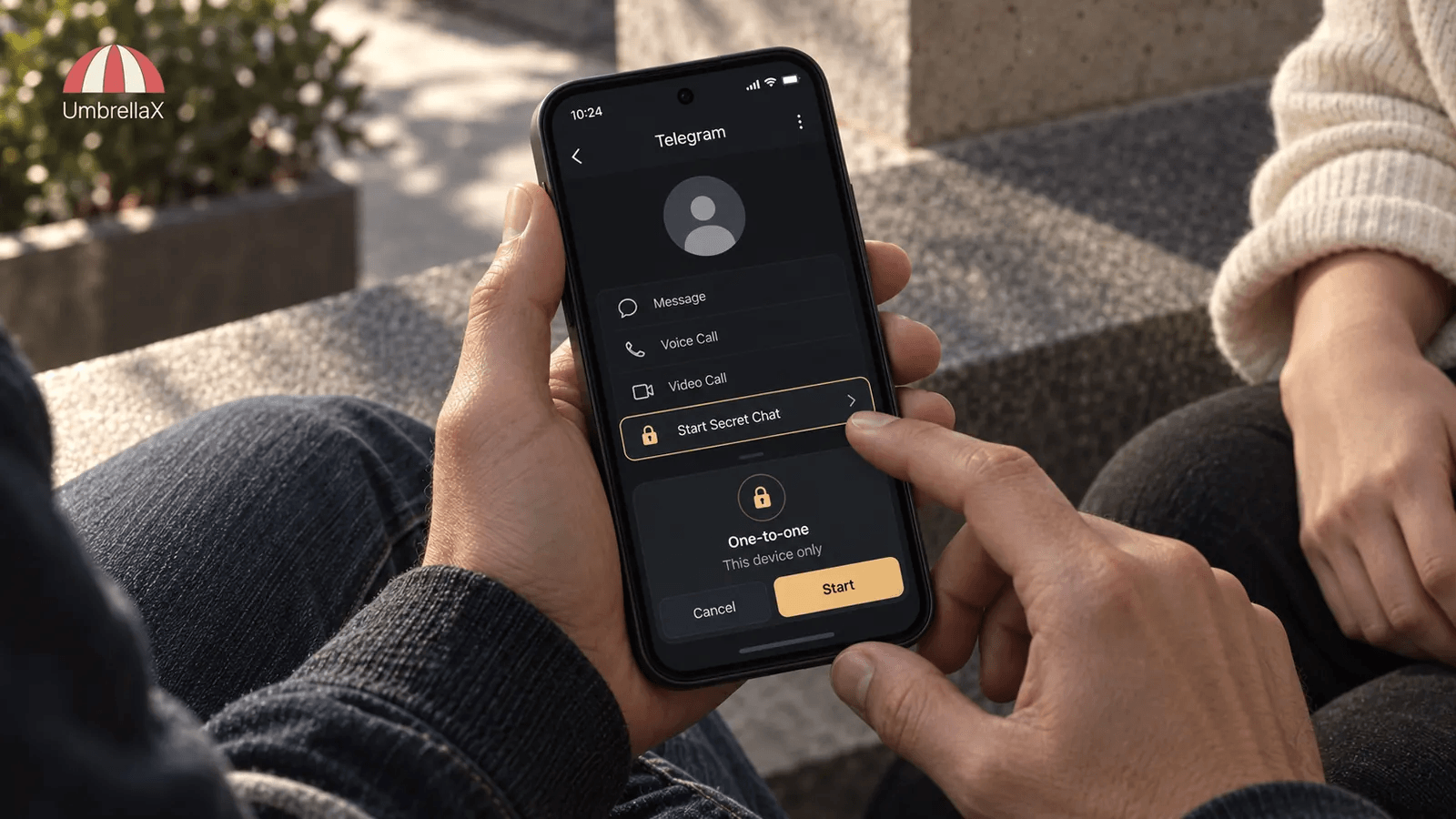
A Telegram Secret Chat is a separate one-to-one conversation protected by end-to-end encryption. Telegram says that its content is not kept in the Telegram cloud and that only the participating devices can read it. That is a meaningful upgrade from an ordinary Cloud Chat, but it comes with a cost that users should understand before they need it: the conversation cannot move to a new device, cannot become a group, and is removed from your own device if you log out. A self-destruct timer can reduce later retention, but it cannot stop the person on the other end from copying what they can see. I would use this mode when both people accept that device-bound tradeoff. I would not treat it as a complete privacy model for every sensitive conversation.
That distinction is why a Telegram Secret Chat deserves more than a lock icon and a five-second setup instruction. The right question is not simply whether it is encrypted. It is what changes in the trust boundary, what disappears with the cloud convenience, and which risks are still left on the two devices.
A Secret Chat is a separate conversation
Telegram itself separates its messaging model into two paths. A Cloud Chat is designed to remain available across a person’s devices. A Secret Chat is a separate direct conversation whose key is held by the two participants, according to Telegram’s current FAQ and technical documentation. Telegram’s privacy policy says that it does not store the Secret Chat itself in its cloud.
I consider that a real privacy improvement, not a cosmetic feature. If the service is not holding a readable cloud archive for that conversation, a different class of exposure has been removed. But that does not mean I would use the word “safe” without asking what happens next. There is no group version of a Secret Chat, no cloud restoration on a replacement device, and no technical feature that can make the recipient forget what they have read.
My rule is simple: use a Secret Chat when the conversation is genuinely one-to-one and both people knowingly accept a device-specific record. If your everyday privacy depends on remembering a special mode each time, the product has pushed too much of the security decision onto the user.
How to start a Telegram Secret Chat
Telegram’s present FAQ gives a short route: open the intended person’s profile, tap the more menu, and choose Start Secret Chat. The new conversation is separate from the Cloud Chat you may already have with that contact. I would confirm that the other person has accepted the new conversation before putting anything sensitive into it.
The exact placement of the more menu can move between Telegram clients. I would therefore use the label in the app and Telegram’s official instructions, not a years-old screenshot from a random guide. If the option does not appear, do not assume that your normal direct-message thread has silently become end-to-end encrypted. It has not.
For a higher-risk exchange, Telegram also provides an encryption-key visualisation that both participants can compare. Its FAQ recommends doing that through a channel you already know is secure, ideally in person. I see that as a useful trust test: if the risk is serious enough to need a Secret Chat, it may be serious enough to verify that the two endpoints are really the ones you intend. My guide to key-change notifications in encrypted messaging explains why that habit matters beyond Telegram.
The cost is not a bug: it is the device boundary
The most important fact about a Telegram Secret Chat is not the self-destruct timer. It is that the conversation belongs to the devices that created it. Telegram says that a Secret Chat does not synchronise with its cloud, and its technical documentation describes only the participating devices as able to access the conversation.
That has three practical consequences.
- A newly signed-in laptop, tablet, or replacement phone does not receive the existing Secret Chat history.
- Logging out removes your copy of the Secret Chat. Telegram says that this action does not remotely erase the other participant’s copy, so use Clear History first if that is your intention.
- A Secret Chat is direct only. It cannot become the encrypted group room that a family, legal team, newsroom, or activist group may actually need.
I would rather say this plainly than call the lost sync a downside after the fact. The missing cloud history is connected to the confidentiality property people wanted. The problem is not that Telegram made a tradeoff. The problem begins when a user expects a device-specific private conversation to behave like a general-purpose, multi-device messenger.
If your actual need is a protected group, read my secure group messaging guide. It asks the questions a two-person Secret Chat cannot answer: how membership changes, newly linked devices, removals, invitations, and group metadata are handled.
A timer can reduce retention. It cannot control a recipient.
Telegram lets people set a self-destruct timer for messages in Secret Chats. Its FAQ says the countdown begins after the recipient displays the message and applies only to material sent after the timer was selected. That can be useful when the risk is old content remaining on both devices longer than intended.
I would use a timer as a retention choice, never as a promise that information is unrecoverable. Telegram warns that screenshot detection is not bulletproof on every system. A recipient can also copy text, save details elsewhere, or photograph the device with another camera. Those are not obscure attacks. They are ordinary human actions.
This is why I keep the broader discussion in disappearing messages privacy rather than pretending a Telegram setting solves it. A timer can make a copy less convenient. It cannot revoke knowledge once another person has received it.
What Secret Chats still leave outside the promise
End-to-end encryption protects a defined path. It is not a protective shell around the account, the device, the person you are messaging, or every Telegram feature nearby.
I would separate four limits before I rely on a Secret Chat:
- The original devices still matter. Someone who can unlock, infect, or coerce one participant’s device may see the conversation where it is decrypted.
- The account still matters. Telegram’s own account guidance says that a mobile number remains its account identifier. Its loss-of-phone instructions recommend two-step verification, terminating old sessions, and contacting the carrier. A Secret Chat does not turn that account model into a no-phone-number identity system.
- The recipient remains a participant. Encryption keeps outsiders away from the message path. It does not stop the other person from sharing the content.
- Groups and bots are different surfaces. A Telegram Secret Chat is not a group and does not make a bot conversation private. Telegram’s privacy policy explains that a third-party bot receives messages you send to it.
When I evaluate a messenger, I do not reduce all of that to whether it has end-to-end encryption somewhere in its interface. I ask which behaviour gets the property by default, which information is still needed to run the account, and whether the product explains the recovery cost honestly. For the wider operator-data question, see private messenger metadata.
The recovery question to settle before the conversation starts
There is an uncomfortable but useful test: imagine replacing your phone tomorrow. Would you rather recover this private conversation through a service-held archive, or accept that it will stay only with the original device and the other participant?
Telegram’s Secret Chat chooses the second path. Its FAQ says you lose your Secret Chats when you log out, while its Cloud Chat system exists precisely to keep history available across devices. I would not call either choice universally right. I would call them different threat models.
My preference is to make that choice explicit before a person loses a device, not during a panic. A secure recovery design should not quietly mean that an operator can read old history. It also should not trick someone into believing that an unavailable history is recoverable. That is the account-versus-history boundary I explain in encrypted chat backups.
As a practical preparation step, I would use an app passcode, turn on Telegram’s two-step verification, examine active sessions, and keep the phone number under my control. Telegram now also documents passkeys as an additional login method. These measures do not change the Secret Chat’s end-to-end encryption, but they make it less likely that a device or account compromise reaches the conversation before encryption has a chance to help.
Why I am building UmbrellaX without a separate secret mode
I am building UmbrellaX because I do not want private communication to start with a fork in the road: normal chat for convenience, secret chat for confidentiality. I would rather make end-to-end encryption ordinary behaviour and make its costs visible in recovery and device decisions.
That is not a claim that UmbrellaX is a released Telegram replacement. It is pre-launch, and I am careful not to manufacture a track record that does not exist. It is a design rule. I am building toward an account that does not begin with a phone number, contact paths that require intention, secure groups rather than a direct-chat-only privacy exception, and an operator model that minimises what needs to be retained. The public privacy policy and transparency page describe the current public commitments; the warrant canary is there so readers can inspect how I intend to make pressure visible.
I think Telegram is right to describe the Secret Chat and Cloud Chat split as a tradeoff. My disagreement is only about the default. For a sensitive exchange, I would rather have a system whose ordinary path already takes the service out of message content, instead of betting that two people will find and maintain a different mode for the moments that matter.
When I would use it, and when I would choose another route
I would use a Telegram Secret Chat for a direct exchange with one person where both of us already use Telegram, both accept a conversation tied to our current devices, and we need a quieter path than a regular Cloud Chat. I would set the timer when reducing retained history is useful, then still write as if the other person can keep a copy.
I would not use it as a stand-in for a confidential group. I would not assume it protects me from a compromised or shared device. I would not treat it as a way to erase Telegram’s phone-number account boundary. And I would not make a Secret Chat my entire daily privacy plan if I know I will routinely forget to create one.
For the broader choice between Telegram’s modes and a messenger that makes end-to-end encryption ordinary, read Signal vs Telegram privacy. For the product direction I am building, read about UmbrellaX. The useful outcome is not loyalty to a brand. It is matching the conversation, the devices, and the failure mode to the protection you actually need.
Sources
- Telegram FAQ: Secret Chats official
- Telegram Privacy Policy official
- Telegram: End-to-End Encryption, Secret Chats official
- Telegram Tips: Secret Chats official
- UmbrellaX privacy policy official