



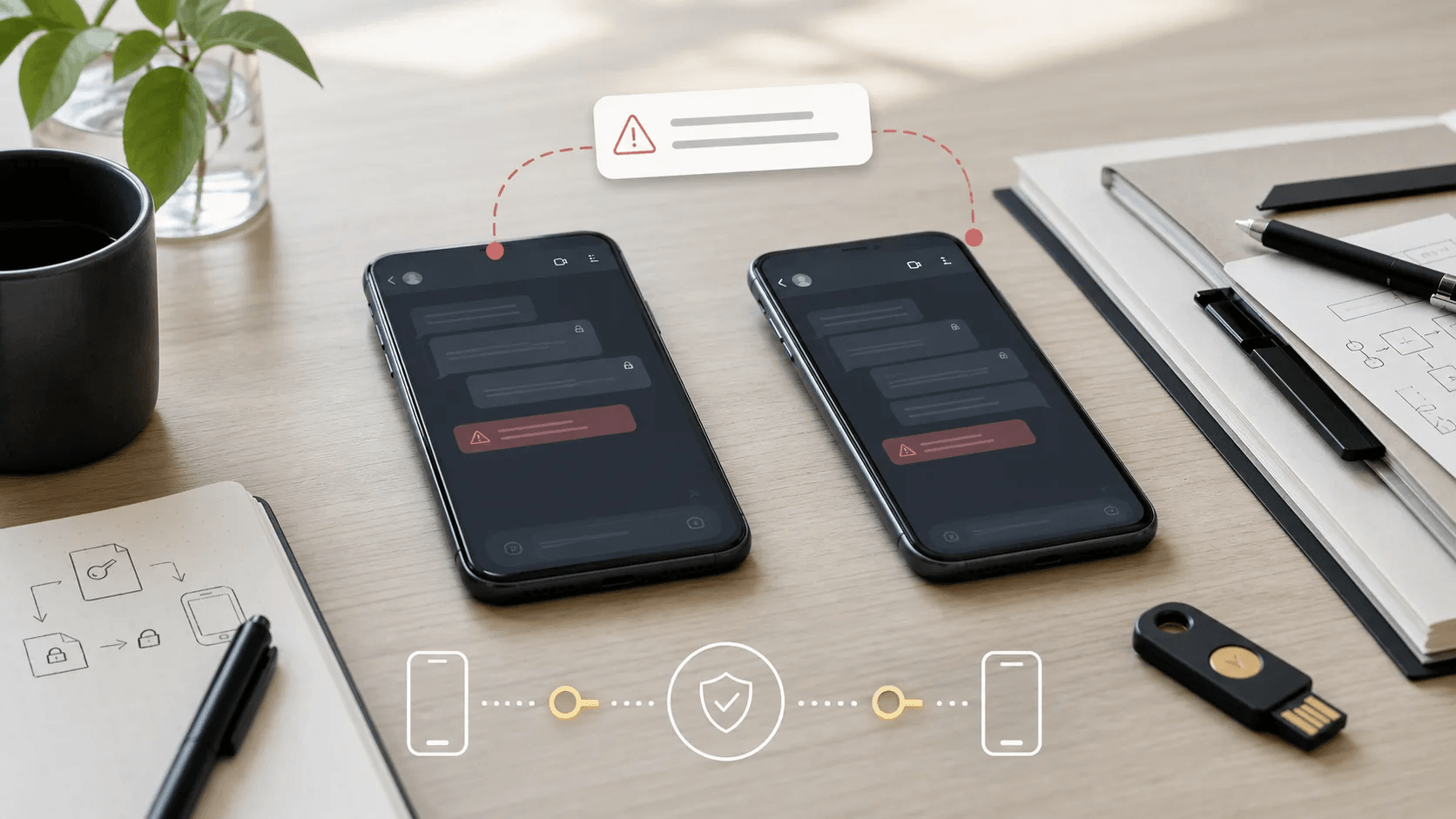
Key change notifications in encrypted messaging are a practical trust problem, not a cosmetic warning. When an encrypted messenger says a safety number, security code, device key, or contact key changed, it means the app is no longer seeing the same cryptographic identity it previously trusted. That can be normal: a new phone, reinstall, linked device, or account reset. It can also be the moment where a malicious server, stolen account, weak recovery flow, or unverified device tries to insert itself into the conversation. My rule for UmbrellaX is that a key change should be understandable, scoped, and reviewable before a user sends sensitive messages. If the product cannot explain what changed, the user cannot make a real trust decision.
That is the answer first. A key-change alert is not proof of compromise. It is proof that trust state changed.
I am writing about this separately from my end to end encryption explainer because the search intent is different. E2EE explains why the server should not read message content. A key-change notification asks a sharper question: how do I know the key I am encrypting to still belongs to the person I meant to contact?
That is the part users actually face in the product.
The answer first
A key change notification appears when an encrypted messaging app sees a new cryptographic key for a contact, device, or conversation. Different products use different labels: safety number changed, security code changed, contact key changed, device key changed, or identity key changed.
The ordinary causes are boring. A person buys a new phone. They reinstall the app. They restore an account. They relink a desktop. They reset secure storage. A group adds or removes a device. A protocol rotates group state after a membership event.
The serious causes are why the alert exists. If a server can swap a contact’s public key without being noticed, it can become a man in the middle even if the encryption algorithm is strong. If an attacker controls recovery, they may make the app accept a new key as if it were the same person. If a group change is hidden, old members or new devices can end up with the wrong power.
So my practical advice is simple: for ordinary chat, notice the timing. For sensitive chat, pause and verify through another path before sending anything important.
Why this is not just a protocol detail
Cryptographers call this the key distribution problem. Normal users experience it as an annoying banner.
That gap matters. A messenger can implement strong cryptography and still teach users to dismiss the only warning that would reveal a trust break. If every reinstall, every device link, every account restore, every group membership event, and every suspicious key substitution produces the same vague alert, the product has failed the user even if the protocol is mathematically sound.
When I evaluate this part of a messenger, I do not start with the curve name. I start with the decision the user must make in ten seconds:
| User question | Product answer I want |
|---|---|
| What changed? | This contact, this device, this group member, or this recovery state. |
| Why might it have changed? | New phone, reinstall, device link, account reset, group update, or unknown. |
| Can I keep talking? | Safe for low-risk chat, verify first for sensitive chat. |
| How do I verify? | A short human process, not a buried cryptographic artifact. |
| Can the server hide this from me? | The design should make silent substitution detectable. |
That table is not a replacement for cryptography. It is the UX shape that makes cryptography usable.
The harmless reasons a key can change
Most key changes are not attacks. I do not want a product that scares users every time normal life happens.
A contact may have replaced a phone. The app may have been reinstalled and generated a new identity key. A desktop may have been linked. A device may have been removed and added again. Secure storage may have been reset during migration. In group messaging, a member join, removal, or key update can legitimately change the cryptographic state.
I accept that private messengers need to handle these events without turning the app into an alarm panel. People lose devices. Families replace phones. Journalists change laptops under pressure. Businesses rotate staff. Activists may burn a device and come back from a safer one.
But the product should name the event as precisely as it can. “Kirill’s contact key changed after a new device was added” is more useful than “security code changed.” “This group rotated keys after Sasha was removed” is more useful than “conversation security changed.”
My rule for UmbrellaX is that ordinary device change should be visible without being theatrical. The interface should not punish good hygiene. It should make unexpected trust changes hard to miss.
The dangerous reasons a key can change
The dangerous version is not someone breaking encryption. It is someone making you encrypt to the wrong key.
If a server is malicious, compromised, or legally pressured, one attack is to present a fake public key for a contact. Your app encrypts the message correctly, but it encrypts to the attacker’s key. The ciphertext is strong. The destination is wrong.
That is why safety numbers, security codes, key transparency, and device verification exist. They do not make the cipher stronger. They make key substitution harder to hide.
Recovery creates another risk. If an attacker takes over the account recovery path, the app may start treating the attacker’s new device as the account. That is why I keep linking recovery back to the threat model. I wrote about encrypted chat backups because recovery can quietly become stronger than encryption if the operator, carrier, cloud account, or support flow has too much power.
Groups create a third risk. In a private group, a new device is not just a personal event. It affects every member who may send future messages to that device. A removed member must lose future access. A linked device should not appear silently. A group invite should not smuggle in a new reader without visible state.
This is why secure group messaging has to treat membership and key updates as first-class events, not as chat settings.
Safety numbers are honest but demanding
Signal’s safety-number model is a good example of honest engineering. The app gives users a way to compare a long number or scan a QR code out of band. If the numbers match, both sides have evidence that the app is talking to the expected keys.
For the current Signal procedure and the limit of its new automatic check, I wrote a focused guide on how to verify a Signal safety number. That page stays with one-to-one verification so this article can keep its wider key-change and group-trust boundary.
I respect that model because it does not pretend the server can be trusted blindly. It gives users a direct verification path.
The cost is human. Many people will not compare numbers. Some will not understand when to care. Some will compare once and forget that a new device changes the state. Some will do the verification in the same compromised channel, which weakens the point.
My product opinion is that safety numbers should exist, but they cannot be the whole answer for a broad messenger. A privacy-first app should make verification easier than a long ceremony and should reserve strong interruption for meaningful trust changes.
For UmbrellaX, that means I want a layered model: simple language for normal users, stronger verification for high-risk rooms, and protocol-backed detection for silent server-side substitution.
Key transparency reduces blind trust
Key transparency is the part I care about most as a builder. The short version: instead of asking every user to trust that the server gave them the right key, clients can check a public or auditable log of identity-key history.
WhatsApp’s key transparency work is useful here because it explains the product direction clearly: make key verification automatic enough that users are not carrying the whole burden manually. The server still participates, but the client has a way to detect inconsistencies.
I do not want to oversell this. Key transparency does not prove that the human holding a phone is morally trustworthy. It does not stop an unlocked device from leaking messages. It does not stop someone from voluntarily sharing a QR code with the wrong person. It does not solve every metadata problem I wrote about in private messenger metadata.
What it does is narrower and important: it makes quiet key substitution harder to hide at scale.
That is the direction I want for UmbrellaX. The user should not have to decide whether the operator is behaving today. The client should have protocol evidence that the key history it sees is consistent with the wider record.
Groups need scoped alerts
One-to-one key changes are already hard to explain. Group key changes are harder.
In a group, several things can change trust:
- A member joins.
- A member leaves or is removed.
- A device is added to a member account.
- A device is revoked.
- An admin changes membership.
- A recovery event changes who can read future messages.
- The protocol rotates group keys after a commit.
These events should not all produce one generic warning. A user should know whether the change came from ordinary membership, a risky new device, or a recovery path.
This is where MLS matters for UmbrellaX. MLS treats group state as a protocol object. A membership change is committed into the group state. Members apply the new state and derive fresh secrets. That does not make every UX choice automatic, but it gives the product a clean foundation for telling users what changed.
My design preference is strict: removed members should not read future messages, linked devices should be visible, and sensitive rooms should have stronger review before trust expands. I would rather make a group pause briefly than let one hidden device become a silent reader.
What I would not trust
I would not trust a messenger that hides all key changes unless the user digs into settings. The whole point of the alert is to surface a trust change before it matters.
I would not trust a messenger that shows key-change alerts so often and so vaguely that users learn to ignore them. Alert fatigue is a security bug.
I would not trust a messenger that treats phone-number recovery as a harmless account detail. If a carrier event can move control of the account, then a key change after recovery deserves more scrutiny than a normal reinstall.
I would not trust a group messenger where new devices appear without a clear membership or device history. In a sensitive group, the second device can be the breach even if the original member is honest.
And I would not trust a product that says “the message is encrypted” as if that answers the key question. Encrypted to whom is the real question.
The UmbrellaX design rule
UmbrellaX is still pre-launch, so I am describing the design rule I am building toward, not claiming years of production evidence.
The rule is this: a key change should be understandable, scoped, and reviewable.
Understandable means the user sees normal language: new phone, new linked device, recovery event, group member removed, unknown change. If the app does not know, it should say it does not know.
Scoped means the alert points at the right object. A personal device change should not look like a whole group compromise. A group membership update should name the group consequence. A high-risk room should have stricter policy than a casual chat.
Reviewable means there is a history. I want users to see when a device was added, when a key changed, who approved a group membership change, and whether a verification status is current. That history should not become a surveillance log for the operator, but local and group-visible trust history is necessary for serious use.
This connects directly to UmbrellaX’s larger choices: no phone-number account root, encryption by default, MLS for group state, key transparency direction, jurisdiction outside the Five Eyes, and operator data minimization. The key-change alert is where those choices become visible to a normal person.
My practical test before sending sensitive messages
When I see a key-change alert in any encrypted messenger, I use this test:
- Did I expect this person to change phones, reinstall, or link a device?
- Is the conversation sensitive enough that a wrong recipient would harm someone?
- Can I verify through a different channel, in person, by voice, or through a previously trusted path?
- Did the alert name a specific device or event, or did it hide behind generic language?
- Is this one-to-one, or does the change affect a group?
If the conversation is low-risk, I may continue after noticing the context. If the conversation is sensitive, I stop until I can verify. That sounds conservative because it is. The cost of waiting is small compared with encrypting the next message to the wrong key.
I want UmbrellaX to make that discipline natural. Not paranoid, not theatrical, and not hidden in advanced settings. Just clear enough that a user understands the trust state before they speak.
Bottom line
A key change notification is the messenger telling you that the trust state changed. It may be harmless. It may be the most important warning you see all month.
The right private messenger does three things at once: it uses strong encryption, it makes key substitution hard to hide, and it gives users a readable path to verify when trust changes. I am building UmbrellaX around that combined standard because encryption without understandable trust is not enough.
Sources
- Signal Support: What does it mean when I see that my safety number has changed? official
- WhatsApp Help Center: About security code change notifications official
- Meta Engineering: Deploying key transparency at WhatsApp official
- IETF RFC 9420: The Messaging Layer Security Protocol official
- IETF RFC 6973: Privacy Considerations for Internet Protocols official