



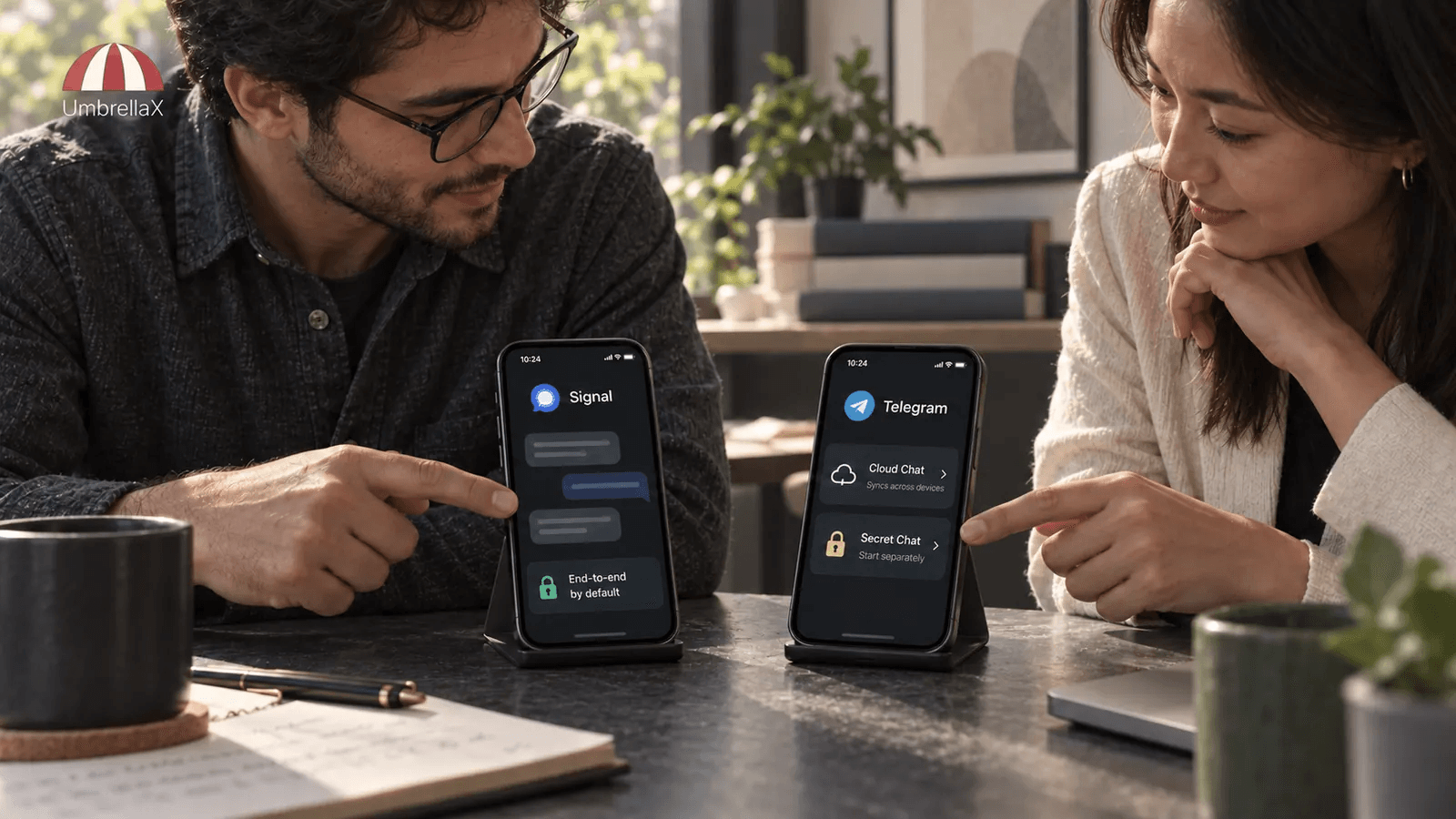
Signal vs Telegram privacy is a question about the conversation mode you will actually use. Signal says every message and call is end-to-end encrypted. Telegram divides its product: Secret Chats are end-to-end encrypted and device-specific, while ordinary private and group Cloud Chats use client-server encryption and are stored in Telegram’s cloud. That makes Signal the safer default for a private conversation. Telegram can still be the sensible tool for cloud-synchronised history, large public communities, channels, or bots. Both products begin with a phone-number account boundary, so neither removes telecom identity from the picture. I am building UmbrellaX toward a different starting point, but UmbrellaX is pre-launch and should not be presented as a released substitute today.
That is the answer first. The rest of the choice is about the price of convenience, not a scorecard where one app must win every category.
The answer first
For a person opening a messenger and starting an ordinary private chat, I would choose Signal over Telegram. Signal’s own support documentation says its conversations are always end-to-end encrypted: every message and call, not a setting hidden behind a separate chat type. Telegram’s FAQ says its Secret Chats use end-to-end encryption, while its Cloud Chats use client-server encryption and are stored in Telegram’s cloud. The important word is ordinary. A person can create a Telegram Secret Chat for a one-to-one sensitive exchange, but that is not the same workflow as the default private or group chat that syncs across devices. Telegram is not useless because it makes that choice. It is a different product decision. My rule is to judge a messenger by the protection that survives ordinary habits, not the strongest mode a careful user could remember to enable each time.
The decision starts with the default, not the settings menu
People often ask which app has encryption, as if the answer ends the comparison. It does not. The better question is when encryption applies, what kind of conversation it protects, and what must happen before a person receives that protection.
Signal’s answer is straightforward. Its published support page says conversations are always end-to-end encrypted, and it provides safety numbers for people who need to verify the person and service path they are using. I respect that decision. A product gets safer when its strongest privacy property is normal behaviour rather than an exceptional route.
Telegram’s answer is intentionally two-part. Its FAQ describes Cloud Chats as encrypted between the client and Telegram’s servers, with storage in the Telegram cloud. It describes Secret Chats as end-to-end encrypted, outside the cloud, and available only on the devices where they were created. That is not a minor label difference. It changes who is technically inside the protection boundary and whether a new device can retrieve the history.
I would not tell someone that an ordinary Telegram chat is equivalent to a Signal chat just because both apps use encryption. The useful comparison is more precise:
| Privacy question | Signal | Telegram Cloud Chat | Telegram Secret Chat |
|---|---|---|---|
| Is end-to-end encryption the normal conversation mode? | Signal says yes for messages and calls | No | Yes, when the sender deliberately creates one |
| Does the history synchronise through the service cloud? | No cloud-history equivalent by default | Yes | No |
| Can a new device retrieve that chat history? | Not as a service-held cloud history | Yes | No, it is tied to its original devices |
| Is it the ordinary mode for private groups? | Yes | No | Secret Chats are one-to-one |
The table is not a cryptography ranking. It is a behaviour ranking. In my experience, the moment a privacy property needs a special mode, a separate device rule, and a remembered decision, the user must carry more of the security burden.
Cloud convenience changes the privacy question
Telegram is unusually clear about the tradeoff it chose. Its FAQ says cloud history makes messages available on a newly connected device and after a lost phone, while Secret Chats cannot offer that same recovery and sync model. That convenience is real. A person running a community, moving between devices, or relying on a long archive might reasonably value it.
But I do not want cloud convenience to be described as if it were the same privacy promise. The product can protect data in transit and at rest while still making the service part of the chat’s storage model. The Telegram privacy policy says that it stores Cloud Chat messages, media, and documents so they can be reached from any device. For a private conversation, that changes the trust relationship in a way a lock icon cannot summarise.
When I evaluate a messenger, I start with a mundane question: if I lose a phone this evening, where will tomorrow’s chat history come from? If the answer is the operator’s cloud, the operator is necessarily carrying more of the recovery story. If the answer is only the participant devices, the user trades convenience for a narrower server role. Neither outcome is effortless. Pretending they are identical is what creates bad privacy decisions.
Signal’s model asks the user to accept more device responsibility. Telegram’s cloud model makes continuity easier. My preference for sensitive conversations is to avoid making a cloud archive the default, then give recovery boundaries a great deal of explicit design attention. That is why I wrote separately about encrypted chat backups. A backup or recovery system is not just an administration feature. It is part of who can reach old communication later.
Phone-number privacy is a separate test
This comparison has an easy trap. A person might see that Signal supports usernames or that Telegram can hide a number from a stranger and conclude that the account no longer depends on telecom identity. Those are useful protections, but they answer a different question.
Signal’s registration guidance says a new account needs a number that can receive an SMS or call. Telegram’s privacy policy says it uses phone numbers as unique identifiers and asks permission before syncing contacts. Each app gives people controls around visibility and discovery. I would use those controls. I would not call either account model phone-number-free.
The difference matters when the issue is a carrier record, a number reassignment, unwanted address-book matching, or a recovery workflow that inherits telecom risk. The fuller boundary belongs in my guide to phone number privacy in messaging apps and messengers without a phone number. This page only needs the practical conclusion: Signal and Telegram both begin with a number, so choose neither if a no-phone-number foundation is non-negotiable.
Groups make defaults more important
Private messaging rarely stays one-to-one. A friend group becomes a volunteer team, a work conversation becomes an incident room, or a personal discussion gains a third participant who needs context. That is exactly where I become less patient with privacy that depends on each person selecting an exceptional mode.
Telegram’s Secret Chats are one-to-one and device-specific. Telegram’s group conversations are Cloud Chats. Signal keeps end-to-end encryption as the normal conversation model for groups as well as direct messages. That does not solve every group problem. Membership changes, device changes, invitations, screenshots, reporting, and participant metadata still require careful handling.
My rule is that a group should make a messenger’s security model easier to see, not harder. I would rather see a product expose membership changes as real security events than hide the complexity beneath a friendly group name. The deeper protocol and product questions belong in secure group messaging, where I explain why I am building UmbrellaX around group security as a first-class choice rather than an add-on.
What I would choose in three ordinary situations
If I needed to start a private one-to-one conversation with a person who would actually use the default setup, I would choose Signal. The strongest argument is not that it is perfect. It is that I do not need to ask the other person to recognise a special conversation category before their messages gain end-to-end encryption.
If I were operating a large public channel, using bots, moving rapidly between devices, or treating a searchable cloud history as the main value, I might choose Telegram for that job. I would draw a hard line around the words “for that job.” A public community and a private conversation deserve different expectations. I would not turn a channel’s popularity into evidence that its default direct-message model is the right place for sensitive content.
If I needed a one-to-one Telegram exchange where both people understood the device-specific tradeoff, I would use a Secret Chat rather than call the ordinary Cloud Chat private by default. I accept that the lost-device and multi-device experience is less convenient. That friction is the visible cost of keeping the conversation outside a synchronised archive.
The practical trust test is simple: would the person you need to protect remember which kind of chat they started a month from now, after a device change, in a group invitation, or when they are frightened and rushing? If the answer is no, start with the product whose default does the safer thing.
Metadata, jurisdiction, and the limit of this page
Encryption scope is not the full privacy model. The IETF’s privacy considerations framework describes issues such as linkability, identifiability, observability, and secondary use. Those are useful words because the harmful fact may be that people contacted each other, not only what they said.
I do not want to smuggle a generic metadata essay into a Signal-versus-Telegram comparison. Readers who need that depth should read private messenger metadata. It covers what an operator can potentially learn from account records, delivery, discovery, and retained logs. My UmbrellaX versus Signal and UmbrellaX versus Telegram pieces then make the product-specific case from my position as the founder of UmbrellaX.
The boundary here is deliberate: choose Signal when the question is which of these two defaults is safer for a private conversation. Do not stop your privacy review there if the consequence of exposure is serious.
Where UmbrellaX fits, honestly
UmbrellaX is pre-launch. I will not pretend that an intended design has the same evidence as a mature service that people can install, inspect, and use today.
Still, building UmbrellaX forces me to name the things I would change. I do not want a private messenger account to begin with a phone number. I do not want end-to-end encryption to be a separate conversation class that someone forgets to select. I want secure-group design, deliberate contact exchange, operator data minimisation, and a clear public account of who operates the service and where. Those are design commitments, not claims of launch, audit, scale, or field history.
I accept the cost. A less automatic contact graph can feel slower than importing every number in an address book. A stricter recovery boundary can feel less forgiving than a cloud archive. I would rather make those tradeoffs visible than let a convenience feature quietly define the privacy model. The public pages for who is building UmbrellaX, the privacy policy, transparency reports, and warrant canary are part of that accountability direction.
Bottom line
Signal is the stronger default for a private conversation because Signal says end-to-end encryption applies to every message and call. Telegram is a flexible cloud messenger whose Secret Chats provide a separate end-to-end encrypted, device-specific mode. Use Telegram when cloud sync, channels, communities, or bots are the actual requirement. Use Signal when the person needs private communication without first becoming an expert in chat modes.
Then ask the extra question that this direct comparison cannot settle: do you accept phone-number account identity, the operator’s recovery role, and the metadata the service may need to operate? I am building UmbrellaX for people who want that question taken seriously from the account foundation onward, but I will only ask them to trust the finished product when it exists.
Sources
- Signal Support: Is it private? Can I trust it? official
- Signal Support: Register a phone number official
- Telegram FAQ official
- Telegram Privacy Policy official
- IETF RFC 6973: Privacy Considerations for Internet Protocols official
- UmbrellaX privacy policy official