



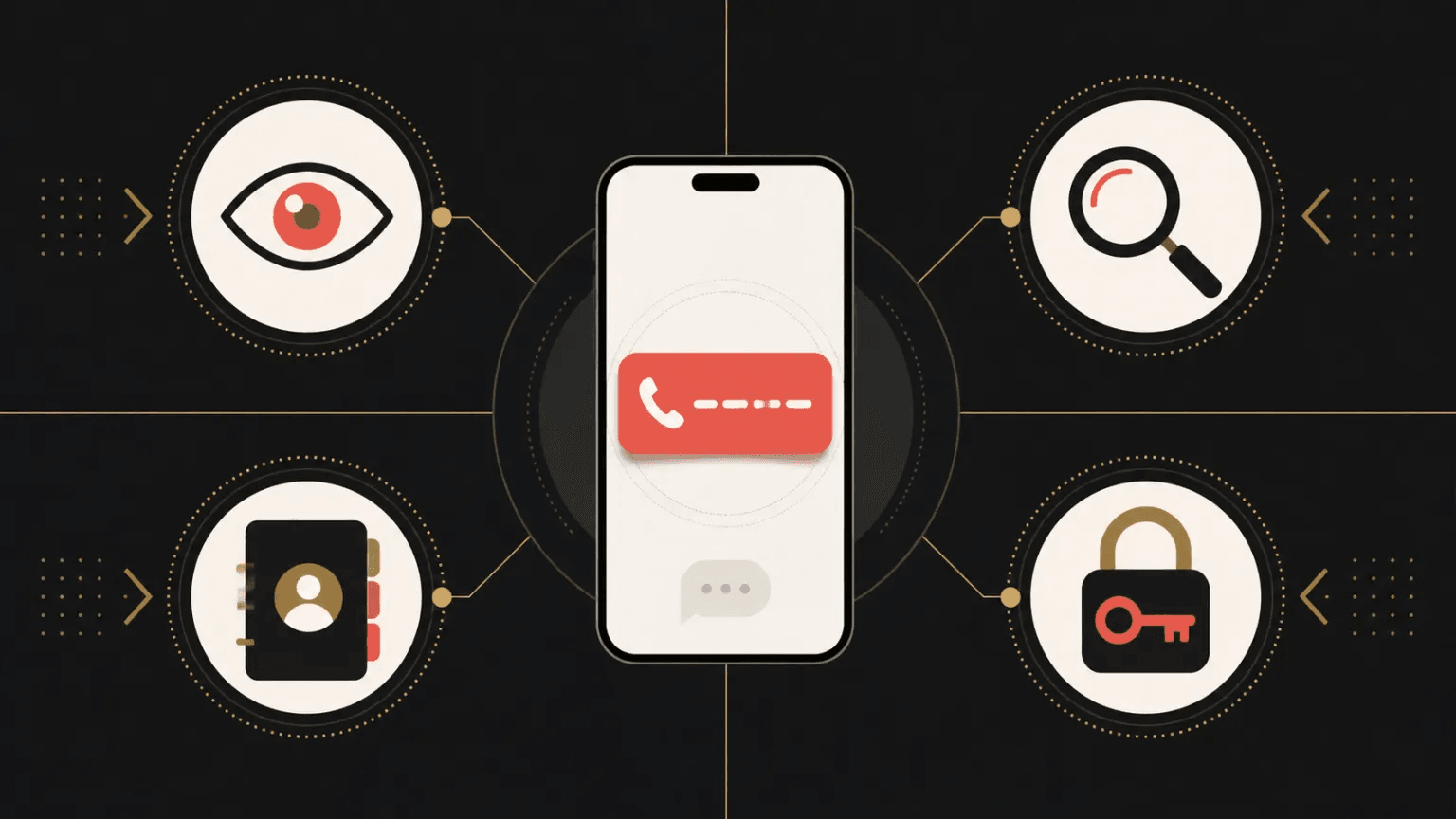
Phone number privacy in messaging apps has four different tests: who can see the number, who can find an account with it, whether an address book can reveal the account, and whether the number still controls recovery. Hiding a number from a chat partner answers only the first test. If a messenger still accepts the number at signup, looks users up by it, or trusts it during a device change, the number remains in the threat model. UmbrellaX is pre-launch, and I am building toward the stricter standard: an account should not begin with a telecom identifier, and a contact should be a deliberate exchange rather than an automatic match. That costs a little convenience. I think it is worth it when a number can expose a person’s social graph, carrier relationship, or recovery path.
The word “private” does too much work in messenger settings. A person can turn off number visibility and reasonably believe the problem is solved. I do not blame them. The settings screen often makes that conclusion sound natural.
But privacy decisions happen before another person opens a profile. They happen when a service decides whether a number is a search key, whether it matches address books, and whether it remains the proof needed to regain an account. My rule is simple: treat each of those as a separate promise.
The answer first
Hiding a phone number in a messaging app solves only visibility. A stronger privacy setting also limits number-based discovery, makes address-book matching opt-in and narrow, and avoids letting the number become decisive proof for recovery. If an app still uses a number at signup, exposes whether that number has an account, or relies on it when a device changes, the number keeps acting as an identity key even when other users cannot see it.
This is not an argument that every number-based messenger is unsafe. It is a way to read the promise accurately. I would rather know which part of the problem a setting handles than receive a reassuring label with no boundary behind it.
| Privacy question | A hidden-number setting can answer | It does not answer by itself |
|---|---|---|
| Can another user see my number? | Profile or chat visibility | Whether the account can be found by the number |
| Can someone who has my number locate me? | Sometimes a discovery setting | Whether contact matching or public search still links the account |
| Can the service infer who knows me? | Rarely | What address-book matching and lookup events reveal to the operator |
| Does the carrier still matter? | No | Whether SMS or the number controls registration or recovery |
Visibility and discoverability are not the same thing
Visibility is about what a person sees after contact. Discoverability is about whether a person can create that contact because they already possess a number. They are different questions, and official product documentation reflects that distinction.
Signal’s phone-number privacy guidance separates who can see a number from who can find an account by it. Its username announcement explains why a person may want to start a conversation without revealing a number. That is useful progress. It lets users make a narrower choice about who receives a durable telecom identifier.
Telegram’s FAQ also documents controls for number visibility. It notes an important practical limit: people who already know and saved your number can still see it in certain cases. I mention that not to score a point against Telegram, but because it shows why an interface toggle needs a threat-model sentence beside it. A privacy control has to say which relationship it changes.
When I evaluate a messenger, I look for two plain answers: can a stranger see my number, and can someone who already has it discover that I am there? A product that answers only the first question has provided profile privacy, not necessarily identity privacy.
Contact matching is a separate data flow
Address-book matching makes messengers feel alive on day one. It can also turn a personal contact list into a map of relationships. The question is not merely whether the app uploads contacts. It is whether a number becomes a standing query against the service’s user base, and what the service learns from that event.
The recent NDSS research on WhatsApp account enumeration is a useful warning about the scale a number-based namespace can reach. The safe conclusion for a reader is not to reproduce the research. It is to ask whether a service turns possession of a number into evidence that an account exists or into an easy way to infer a relationship.
I am building UmbrellaX so first contact does not need an address book as the default social graph. Deliberate exchange is a real tradeoff. It can mean sharing a QR code, invite, or other scoped contact path instead of immediately seeing everyone who has installed an app. I would rather accept that moment of intention than make every saved number an automatic discovery request.
The detailed mechanics belong in our contact discovery privacy guide. Here, the practical boundary is enough: a number may be invisible in a profile while still being active in the matching system.
A username can help without changing the foundation
A username can be a better way to begin a conversation. It can let a reporter, client, group organiser, or new acquaintance connect without receiving a phone number that may be tied to banking, family, work, or years of old accounts. I do not want a privacy-minded user to have to hand over that identifier simply to say hello.
Still, a username is not proof that a number disappeared from the product’s trust model. It may sit on top of an account created with a number, a recovery process controlled by SMS, or a contact-discovery system that still tests phone numbers. It may also become a public directory entry if a product makes it searchable, predictable, or difficult to rotate.
That is why I treat a handle as contact experience, not private identity by itself. Read the deeper messaging app usernames guide for the design choices around searchable names, rotation, and scoped sharing. On this page, the key test is simpler: did the username replace the telecom account root, or merely cover it?
The account-root question comes after the settings screen
The difficult question is not whether a number is printed on a profile. It is what authority the number retains when something goes wrong.
If a person loses a device, changes SIM, or asks to restore access, a number can become the deciding proof. That makes the mobile carrier part of the messenger’s security boundary. A SIM swap or recycled number is then more than a phone problem. It can become an account-control problem.
I would rather make recovery explicit and sometimes slower than hide a carrier-controlled master key behind a smooth onboarding flow. That is a design tradeoff, not a claim that every user should make the same choice. A large family chat may prioritise fast re-entry. A journalist protecting a source, or a person leaving an abusive relationship, may value a smaller recovery surface much more.
My dedicated messenger without a phone number guide owns the full case for removing the telecom identifier from the account foundation. The SIM swap account guide covers what to do after a carrier incident. I link to both because repeating their whole arguments here would blur the boundary that matters to this search.
A privacy test I would actually use
I do not need a messenger to promise a vague form of anonymity. I need it to describe its identity paths honestly. Before I trust a number-privacy setting, I would ask:
- Can another user see my number in a direct chat, group, or profile?
- Can a person who already has the number find my account?
- Does the app require contact upload or turn contacts into automatic matches?
- Can I rotate the contact handle I share after harassment or a mistake?
- Does the number still control signup, a new device, or recovery?
- What does the operator learn from lookup attempts, contact creation, and recovery events?
The first five questions are about a messenger’s product design. The final question moves to private messenger metadata. Encryption can protect message contents while the service still learns useful facts from the path around the message. RFC 6973 frames this as a correlation problem: identifiers can link activity even when they are not directly displayed. That is the right lens for a phone number too.
What I am building in UmbrellaX
UmbrellaX is pre-launch. I will not claim audited behaviour, a finished recovery flow, or evidence from a deployed user base. What I can state is the direction I am building toward.
I am building an account model without a phone-number foundation. A person should be able to make contact through deliberate, changeable paths rather than a carrier-issued identifier that quietly follows them through discovery and recovery. Encryption by default is necessary, but it is not the last word. The identity path and the operator’s retained context matter too.
I do not want a phone number hidden from a recipient while remaining the invisible index for the product. I do not want the easier growth mechanism to dictate the user’s private graph. And I would rather explain a modest contact-flow tradeoff than claim that a settings toggle solves a deeper identity problem.
That is also why the product’s public privacy policy, transparency page, and warrant canary matter. A privacy posture is not just interface copy. It includes what the operator commits to collect, disclose, and minimise over time.
The practical bottom line
If you need to hide your phone number in a messaging app today, use the product’s visibility controls, then check its discovery controls separately. Do not assume that an unseen number cannot find you, recover your account, or influence contact matching.
For a stronger long-term posture, choose the architecture that makes the phone number optional at the root. That is the standard I am choosing for UmbrellaX. It asks more of the contact flow, but it gives users a clearer answer to the privacy question: the number is not merely hidden. It is not supposed to be the key that the messenger depends on.
Sources
- Signal Support: Phone Number Privacy and Usernames, Deeper Dive official
- Signal: Keep your phone number private with usernames official
- Telegram FAQ official
- Hey there! You are using WhatsApp: Enumerating Three Billion Accounts for Security and Privacy research
- IETF RFC 6973: Privacy Considerations for Internet Protocols official
- UmbrellaX privacy policy official