



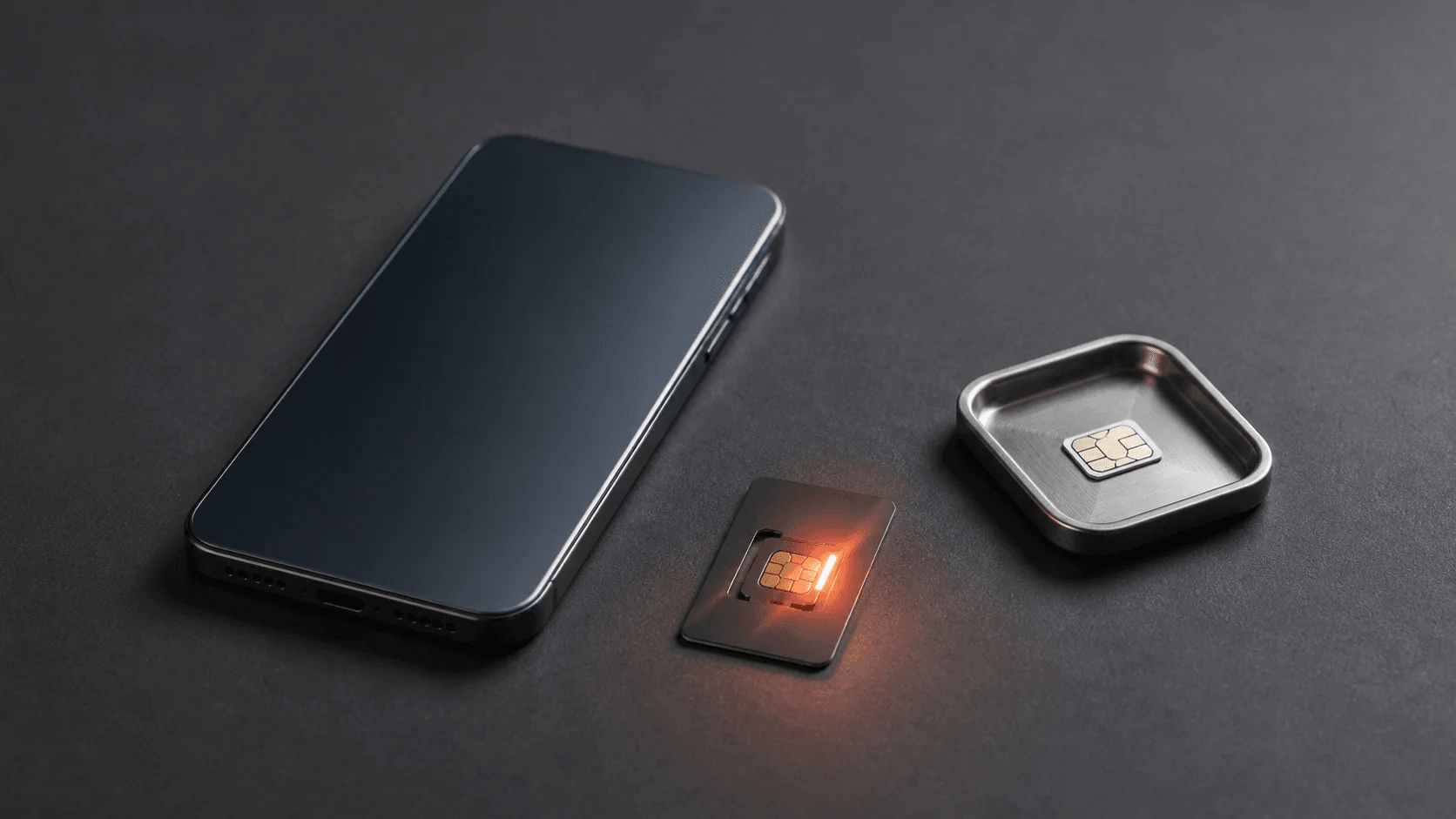
A SIM swap attack moves a phone number, not the encryption keys on a protected device. That distinction matters. If a carrier transfers your number to an attacker, the attacker can receive your calls and SMS codes, but they do not automatically gain the old chat history stored behind your device and its keys. The urgent danger begins where a messenger, email provider, bank, or recovery flow treats a text message as proof that the person holding the number owns the account. I am building UmbrellaX around a different rule: a carrier should not become the authority for a private messenger account merely by moving a number. That removes one account-takeover path. It does not make a stolen phone harmless, erase a leaked recovery credential, or protect unrelated services that still depend on SMS.
A SIM swap attack is an identity incident. It is not a magic decryption attack and it is not a reason to panic into clicking the next text message that arrives. The useful response is to identify which accounts still trust the mobile carrier, contain those first, and then verify the devices attached to your sensitive conversations.
What changes during a SIM swap attack
In a SIM swap, an attacker convinces a carrier to move a victim’s number to a SIM card or eSIM they control. MITRE ATT&CK’s SIM Card Swap entry documents the familiar outcome: the victim loses normal calls, texts, and mobile data while the attacker receives traffic intended for that number.
That creates three distinct risks, and I do not want them blurred together.
First, the attacker may receive one-time SMS codes. That matters for any service using a text message as a login factor, password-reset step, or recovery channel. The UK National Cyber Security Centre is blunt about this boundary: SMS can be useful, but it carries weaknesses that make it a poor place to put the only proof for a high-risk action.
Second, the attacker may try to re-register a phone-number-based messenger. Whether that succeeds depends on the product’s registration lock, PIN, rate limits, old-device checks, and recovery design. It is not correct to say that every app tied to a number falls instantly. It is correct to treat any SMS-received code as a dangerous secret during the incident.
Third, the attacker may impersonate the account to contacts if a service lets a new device take over quickly. That is why I care about visible device changes and trust alerts, not merely whether a message bubble shows a lock.
What a SIM swap cannot do by itself
The phone number is not the same thing as an encryption key.
A SIM swap alone does not pull old, end-to-end encrypted chat history from a phone that remains locked and uncompromised. It does not turn a carrier employee into the reader of a message encrypted to a device-held key. It does not defeat a messenger simply because that messenger once displayed a phone number to a contact.
But the limit has to be read precisely. A new SMS code can be enough to start an account recovery or registration flow. A phished password combined with a intercepted code can be much worse than either factor alone. A stolen or infected device is a separate emergency. Cloud backups, email recovery, and linked desktops can add their own routes.
That is why I would not accept the comforting phrase “my chats are encrypted” as the whole answer. Encryption protects a specific boundary. The account lifecycle decides how often an attacker gets a chance to move that boundary.
For the wider identity choice, read my guide to a messenger without a phone number. That page explains why a telecom identifier is a poor root for private communication. This page stays with the immediate incident and the account checks that follow it.
The first hour: contain the carrier path
If your phone unexpectedly loses calls, texts, and mobile data, assume the carrier path needs checking before you wait for it to fix itself. A routine outage is possible. So is a legitimate eSIM or handset change. The first goal is confirmation through a channel the suspected attacker does not control.
My practical order is short:
- Call the carrier through a trusted number or visit an official store. Ask whether a SIM swap or port-out was processed and request a line lock or account PIN.
- Change the password on your primary email account from a device you trust. Email is often the recovery hub for everything else.
- Replace SMS-based multi-factor authentication with an authenticator app, passkey, or hardware security key where the service allows it.
- Review banking, financial, social, and messaging accounts for recovery requests, new devices, changed contact details, or unfamiliar sessions.
- Tell close contacts through an already verified channel that messages or calls from the affected account may need extra verification.
The FTC’s SIM-swap guidance gives the same broad priority: recover the number through the carrier, then change account passwords and inspect financial activity. I would add one messenger-specific step: do not let urgency push you into sharing any verification code with a person claiming to be support. Real support should not need you to reveal the secret that proves control of the account.
The messenger-account check that matters
After the carrier confirms the line, inspect the messaging accounts that use it. I would look for four things.
| Check | Why I care |
|---|---|
| Account or registration lock | It can make a received SMS code insufficient for an attacker to re-register the account. |
| Linked devices | A quiet desktop, tablet, or web session can survive after the immediate carrier problem. |
| Device and key-change alerts | Contacts need a visible reason to pause before they trust a new endpoint. |
| Recovery method | The account should explain whether a number, email, user-held secret, or existing device can establish control. |
Signal is a useful example because its own documentation makes the tradeoff visible. Signal says its registration requires a phone number that can receive an insecure SMS or call, while its account-protection guidance recommends registration lock, removal of unknown linked devices, and never sharing codes or recovery keys. That is a meaningful hardening layer. It does not change the fact that carrier control remains relevant to the account lifecycle.
When I evaluate any messenger, I do not ask only whether it hides a number from other users. I ask whether the number can still become the decisive proof during account creation, re-registration, device replacement, or recovery. A privacy setting cannot repair a weak account root.
Linked devices are the harder check
The obvious fear is an attacker reading a message immediately after the swap. The quieter risk is an attacker creating or retaining a device relationship that nobody notices.
Every serious messenger should show its active devices plainly. It should let the account owner remove an unfamiliar device without a support ticket. It should show a meaningful security event when a device is added, and it should not hide that event in a settings screen that only experts inspect.
For a sensitive contact, the other side should also have a reason to notice. My guide to key-change notifications goes deeper on what a changed safety number or device key means. Here, the rule is simpler: a fresh device should not inherit the visual trust of a previous device by default.
I would rather make a real contact pause for a verification code than make an attacker look like continuity. That is a small social inconvenience. It is much cheaper than explaining an impersonated conversation later.
A phone number becomes dangerous when it is the recovery root
The problem is not that a phone number exists. Many people need one for ordinary life, and a number can still be useful for reachability, billing, and emergency communication.
The problem starts when a product treats carrier possession as the final answer to “who owns this private account?” A carrier can change its processes. A retail employee can be deceived. A number can be ported, suspended, recycled, or exposed in a breach. None of those events should silently replace a user’s cryptographic identity.
This is also why a username is not a complete fix. A handle may conceal the number from contacts, which is worthwhile, but it can still sit on top of phone-based registration or recovery. My article on messaging app usernames explains that distinction between a contact label and the account root.
My rule is that a recovery path should make the user stronger under pressure, not merely easier for a support system to automate. That means a device-held key, a user-held recovery credential, deliberate device approval, and clear delay or notification rules are more important than an instant text message.
What I am building differently in UmbrellaX
UmbrellaX is pre-launch. I will not claim that its model has already been tested by real incidents, independent auditors, or a large user base. The point of this page is to state the design choice before that history exists.
I am building UmbrellaX so a phone number is not the account root, proof of recovery, or default discovery key. The account trust is intended to come from device-held cryptographic material and a recovery credential the user controls. A contact should be exchanged deliberately through a handle, QR code, or invitation flow rather than by treating the carrier’s number directory as the default social graph.
That introduces a real cost. A user must protect the recovery credential. Contact exchange is less automatic. A lost device cannot be solved by a casual SMS reset. I accept those costs because the convenient alternative gives a mobile carrier too much authority over a private relationship.
There are limits that I do not want readers to miss. UmbrellaX cannot stop a SIM swap from affecting your bank, email, or any other service still attached to that number. It cannot secure a device that is already compromised. It cannot make a careless recovery secret safe. Its job is narrower and important: remove the carrier from being the shortcut into the messenger account.
That decision sits beside the product’s approach to private messenger metadata, not above it. Reducing the account-root risk does not eliminate the operator’s responsibility to minimise delivery, device, and relationship data.
Readers should be able to test the promise against the privacy policy, transparency statements, and warrant canary, then see who owns the decision on the about page. Those pages are not security controls, but a private messenger should not hide the person and policies behind its account model.
Prepare before anything goes wrong
The best time to discover how an app recovers an account is not while your phone has no service.
Before a SIM swap happens, I would set a carrier PIN or port-out lock where it is available. I would move important accounts away from SMS authentication. I would store recovery codes offline, not in an inbox protected by the same number. I would check every messenger’s linked-device list and turn on any registration lock or account PIN it provides. Finally, I would choose a contact verification habit with the people who matter most.
I also separate recovery from message history. Recovering account access does not have to restore every prior conversation to a new device. My encrypted chat backups guide explains why that boundary matters. A recovery process that is convenient enough for an attacker to trigger can become a history-exposure path too.
The practical trust test is not complicated: if a number is moved to another SIM tonight, can a stranger use that event alone to establish themselves as you in your private messenger? If the answer is yes, the app has made the carrier part of your account security team without asking whether you trust it in that role.
Bottom line
A SIM swap attack can be serious because it redirects the SMS codes that too many services use as identity proof. It does not automatically decrypt protected messages, but it can open account-recovery and re-registration paths that attackers understand well.
My first move would be to secure the carrier line and the primary email account, then review every messaging account’s registration lock, active devices, and recovery method. I would verify sensitive contacts through another channel before trusting a sudden device change.
For UmbrellaX, the design standard is deliberately stricter: a phone number should not be the secret that decides who owns a private-messenger account. That is not a claim of invulnerability. It is a refusal to let a carrier process become the quiet back door into a confidential conversation.
Sources
- MITRE ATT&CK: SIM Card Swap, T1451 official
- FTC: SIM Swap Scams: How to Protect Yourself official
- NCSC: Protecting SMS messages used in critical business processes official
- Signal Support: How to protect yourself on Signal official
- Signal Support: Register a phone number official
- UmbrellaX privacy policy official