



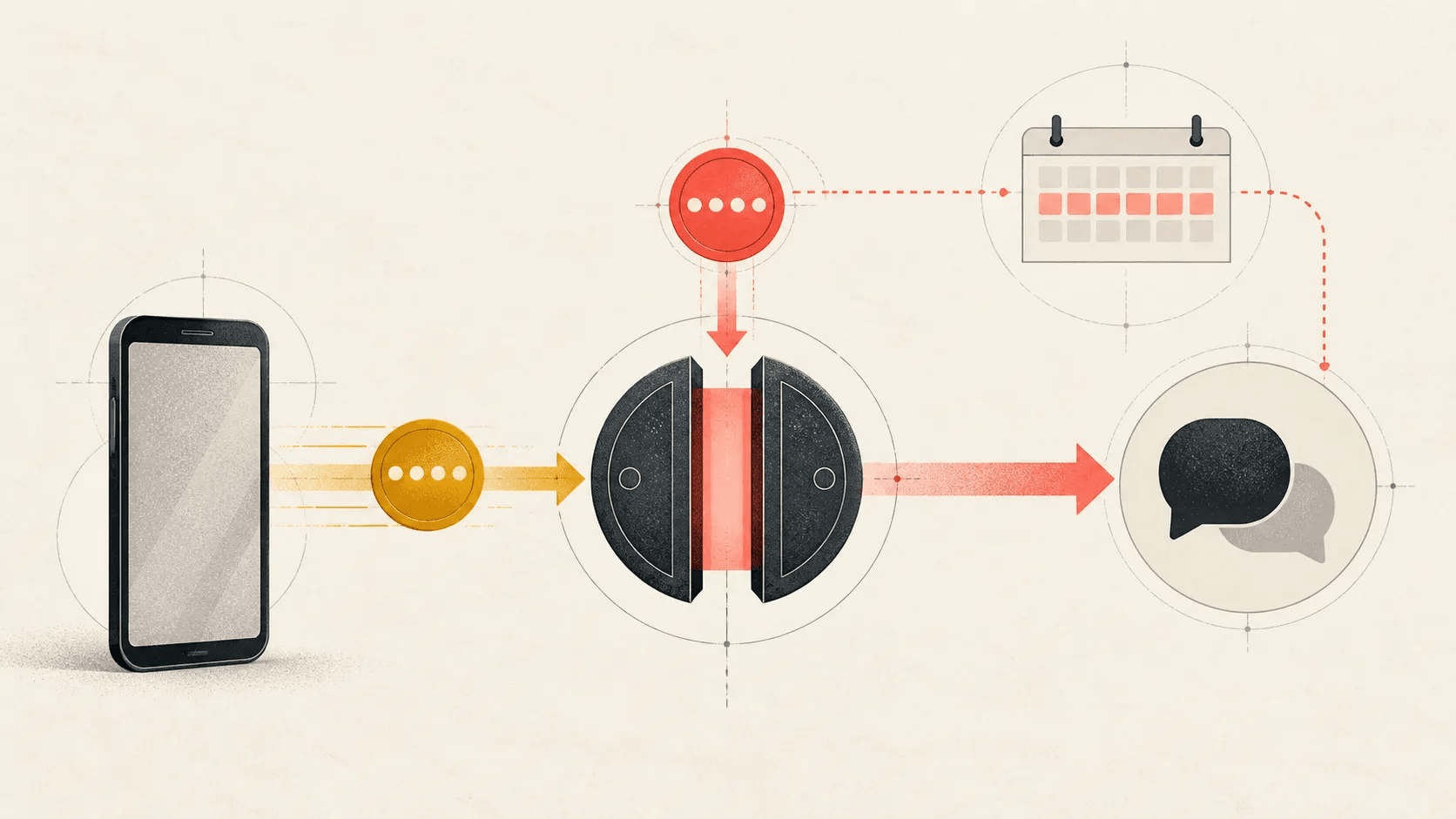
Signal registration lock is an optional account safeguard that makes an intercepted SMS registration code insufficient on its own. When it is enabled, Signal requires the account’s PIN during re-registration too. I would turn it on if I could keep a unique PIN in a password manager and retain control of the number tied to Signal. I would not confuse that with a screen lock, a message backup, or a new identity model. Signal says a forgotten PIN can leave an owner unable to register again for up to seven days of inactivity, so the recovery cost is part of the feature, not an inconvenient footnote. The lock reduces one telecom-based takeover path. It does not make a phone number disappear from Signal’s account lifecycle. UmbrellaX is pre-launch; I am building toward a different baseline where a private messenger does not begin with a carrier-issued number at all.
The useful question is not whether a setting sounds secure. It is whether the exact risk it addresses is one you carry, and whether you can live with the recovery rule that comes with it.
What Signal registration lock actually does
Signal’s own PIN guidance says a PIN can serve as a registration lock. It is an extra condition in a future registration event. A person who receives the usual code for your phone number still needs that PIN to complete the registration while the lock is active.
That matters because an SMS code is a dangerous little secret. It can be exposed through social engineering, a compromised carrier account, a SIM swap, a port-out, or a careless screenshot. I do not need to claim that every one of those events instantly hands over a Signal account. Products have rate limits, device rules, and different recovery paths. I do think it is wise to avoid treating possession of a carrier route as the only proof that someone owns a private-messenger account.
Signal designed Registration Lock for that narrower problem. Its technical explanation describes a PIN-derived protection around account registration in addition to the standard SMS verification step. Signal later told users affected by the Twilio incident that the lock adds a verification layer to registration. That is a practical boundary, not an abstract protocol promise.
| If this happens | Registration Lock changes | It does not change |
|---|---|---|
| Someone gets an SMS registration code | They also need the Signal PIN while the lock is active. | The carrier event itself, or other services that trust the same SMS path. |
| You lose or replace a phone | The PIN can be part of a safe re-registration process. | The need to keep the PIN available and understand Signal’s recovery timing. |
| You worry about a device already unlocked | Very little. | Local device access, existing sessions, screenshots, or a compromised operating system. |
| You need old conversations on a new device | Nothing by itself. | Message history, because a Signal PIN is not a chat backup. |
I like this kind of specificity. A privacy feature should say which door it closes and which doors stay open. A broad claim of “account protected” encourages the wrong kind of confidence.
Turn it on only after you can recover the PIN
On a registered and active Signal phone, Signal says to open Settings, choose Account, and enable Registration Lock. The app associates the choice with the Signal PIN. I would not make this a rushed checkbox after reading a scare story. I would first make sure the PIN is unique, stored safely, and not merely my device unlock code rewritten as a few digits.
Signal permits numeric or alphanumeric PINs and says its service cannot reset or recover them for you. For me, that is a strong reason to use a good password manager rather than relying on memory, a notes app tied to the same unlocked phone, or a familiar birthday pattern. The password manager should itself have a recovery path that I have tested before an incident, not one that waits on the same phone number.
My rule is simple: do not add a secret that you only discover you cannot recover while travelling, moving to a new phone, or dealing with a carrier failure. I would write down the recovery dependencies before enabling the feature. If a person cannot make that chain reliable, it is better to understand the tradeoff honestly than to set a lock they later have to wait out.
Signal distinguishes the PIN from the one-time SMS code used in registration. It is also different from a phone’s passcode, Face ID, fingerprint, or local Screen Lock. Those distinctions matter because each secret defends a different moment. A PIN that gates re-registration cannot substitute for an encrypted backup, and a screen lock cannot make an attacker who controls a phone number stop receiving text messages.
The recovery cost is part of the security feature
The most important detail is easy to miss: Signal says that enabling Registration Lock starts a seven-day inactivity timer if the number is registered on another device. It also says the lock expires after seven days of inactivity. When that happens, a new PIN can be created and the old PIN information is no longer available.
That delay is not proof that Signal has failed. It is the cost of refusing to let a fresh registration simply overwrite an owner who still has a secret attached to the account. The same feature that slows a malicious re-registration can slow the legitimate owner who forgot the PIN. I would rather see that consequence stated plainly than hidden behind a frictionless “reset password” screen.
Signal’s support page draws the line further: if someone forgets the PIN with Registration Lock enabled, they may need to wait for the inactivity timer. Without the optional lock, Signal offers a way to start again, but the person loses saved items such as profile information. Neither path is a way to restore message history. My encrypted chat backups guide explains why account recovery and restoring old encrypted conversations need separate scrutiny.
If you have changed your number, lost control of it, or suspect that it has been reassigned, do not plan around the seven-day window as your only defence. Signal’s account-protection advice says to maintain ownership of the number used to get started and to enable Registration Lock as an extra security setting. The order matters. Keeping control of the underlying number remains an account-security job.
A Signal PIN, a screen lock, and a backup solve different problems
It is tempting to call all three of these settings “protection” and assume the work is finished. That shortcut is exactly how accounts become confusing under pressure.
A Signal PIN can help preserve account context such as profile information, settings, contacts, and a block list when a person changes or loses devices. With Registration Lock enabled, it also becomes a needed secret in the registration path. Signal says the PIN does not recover message history.
A device or Screen Lock keeps someone with the phone in front of them from opening the app without the device passcode or biometric. It is about local access after the handset is in someone’s hands. Signal’s Screen Lock is explicitly unrelated to the Signal PIN.
An encrypted backup or device transfer is about whether old messages can move safely to a new device. That is its own tradeoff involving recovery material, cloud accounts, physical device access, and retention. I would not choose a messenger on the assumption that its registration guard automatically solves history recovery. It does not.
That separation is an important design test for me. One secret should not silently become a master key for identity, local device use, and every old conversation. I want people to see the boundary before an emergency forces them to learn it.
The SMS code still matters, even with the lock on
Registration Lock improves a phone-number-based account model. It does not turn it into a no-phone-number model. Signal still says a person needs a number able to receive an insecure SMS or phone call to register in the first place. Its newer PIN re-registration option can sometimes replace a new SMS step with an existing token and the PIN, but it does not erase the underlying number from the account’s history or lifecycle.
That is why I treat the lock as a hardening layer, not a final answer. NIST’s current authenticator guidance still classifies use of the public telephone network for out-of-band verification as restricted and tells verifiers to consider risk indicators such as a device swap, SIM change, number porting, or other abnormal behaviour. A Signal registration lock is a sensible response to some of that risk. It is not an argument that the phone network has become an ideal private identity system.
For a current Signal user, I would enable the guard, review linked devices, keep app and operating-system updates current, and never give a code or PIN to a person claiming to be support. For a live carrier incident, the right sequence is more urgent and broader than a settings change. My SIM swap guide for messaging accounts owns that containment sequence instead of repeating it here.
What Registration Lock cannot protect
I would not overstate any account setting, and Registration Lock is no exception. It cannot make an already-compromised phone safe. It cannot remove a rogue desktop session that is already linked. It cannot restore a deleted chat. It cannot prove that a message sender is the person they claim to be. And it cannot help if someone willingly gives an attacker both the SMS code and the Signal PIN.
It also does not fix the identity exposure that comes from building an account around a phone number. Visibility settings and usernames can improve how a contact finds or sees you, but they do not make a required registration number disappear. My Signal registration guide owns that product-specific boundary. For the broader architectural argument about carrier identifiers, number recycling, address books, and recovery, read messenger without a phone number.
There is a human limit too. A new device, odd login state, or changed identity signal is a reason to pause and confirm sensitive contacts over a second route. A key-change notification is not a verdict by itself, but neither is it decorative. I would rather delay a sensitive message than let a reassuring setting excuse a suspicious change.
The account-root rule I am building for UmbrellaX
UmbrellaX is pre-launch. I cannot claim a released registration flow, a field-tested recovery system, or a production history that has not happened. I can describe the rule I am building toward: a carrier-issued number should not be the primary secret that decides who may create, recover, or take over a private-messenger account.
That choice has costs. A phone number gives products a familiar way to seed contacts and recover access. I would rather build deliberate identity, contact exchange, and recovery paths than import the carrier’s assignment and porting system as the foundation for a confidential conversation. No phone number does not make a product magically anonymous. It just removes one powerful linkage point and leaves the rest of the security design to be done honestly.
The practical difference is important. Signal’s Registration Lock is a meaningful protection for people who already use Signal. I would turn it on where the recovery tradeoff works for me. But if a telecom identifier itself is non-negotiable in my threat model, I would not ask a second secret to make that foundation disappear. I would choose an account model that begins somewhere else.
My UmbrellaX versus Signal comparison covers that broader product choice. You can also read about the product principles I am working from before treating a pre-launch design direction as a feature claim.
My one-minute account check
When I audit a messaging account that depends on a phone number, I do not start with a long list of toggles. I ask whether I can answer four concrete questions without guessing:
- Do I still control the number that established this account?
- Is Registration Lock on, and can I retrieve the Signal PIN without using the same phone?
- Have I looked at the linked-device list and removed anything I do not recognise?
- If I needed to recover message history, do I understand the separate backup or transfer path?
If I cannot answer one of them, I know where to spend the next five minutes. This is not a promise that every attack will fail. It is a way to stop ordinary account hygiene from becoming a scramble after the number, device, or secret has already moved.
Bottom line
Signal registration lock is worth enabling for a current Signal user who can keep a unique PIN safely available. It means that a registration code alone should not be enough to take over the number in a new registration, which is a real improvement when telecom risk is part of the threat model.
The downside is intentionally sharp: forget the PIN while the lock is active and Signal may make you wait for its seven-day inactivity period. It is not a screen lock, a backup, or a way to use Signal without a phone number. Treat it as one well-defined control, keep the number secure, and separate account hardening from the larger question of what identity a private messenger should depend on.
Sources
- Signal Support: Signal PIN official
- Signal Support: How to protect yourself on Signal official
- Signal Support: Re-registering using your Signal PIN official
- Signal: Improving Registration Lock with Secure Value Recovery official
- Signal Support: Twilio Incident: What Signal Users Need to Know official
- NIST SP 800-63B-4: Authenticators official