



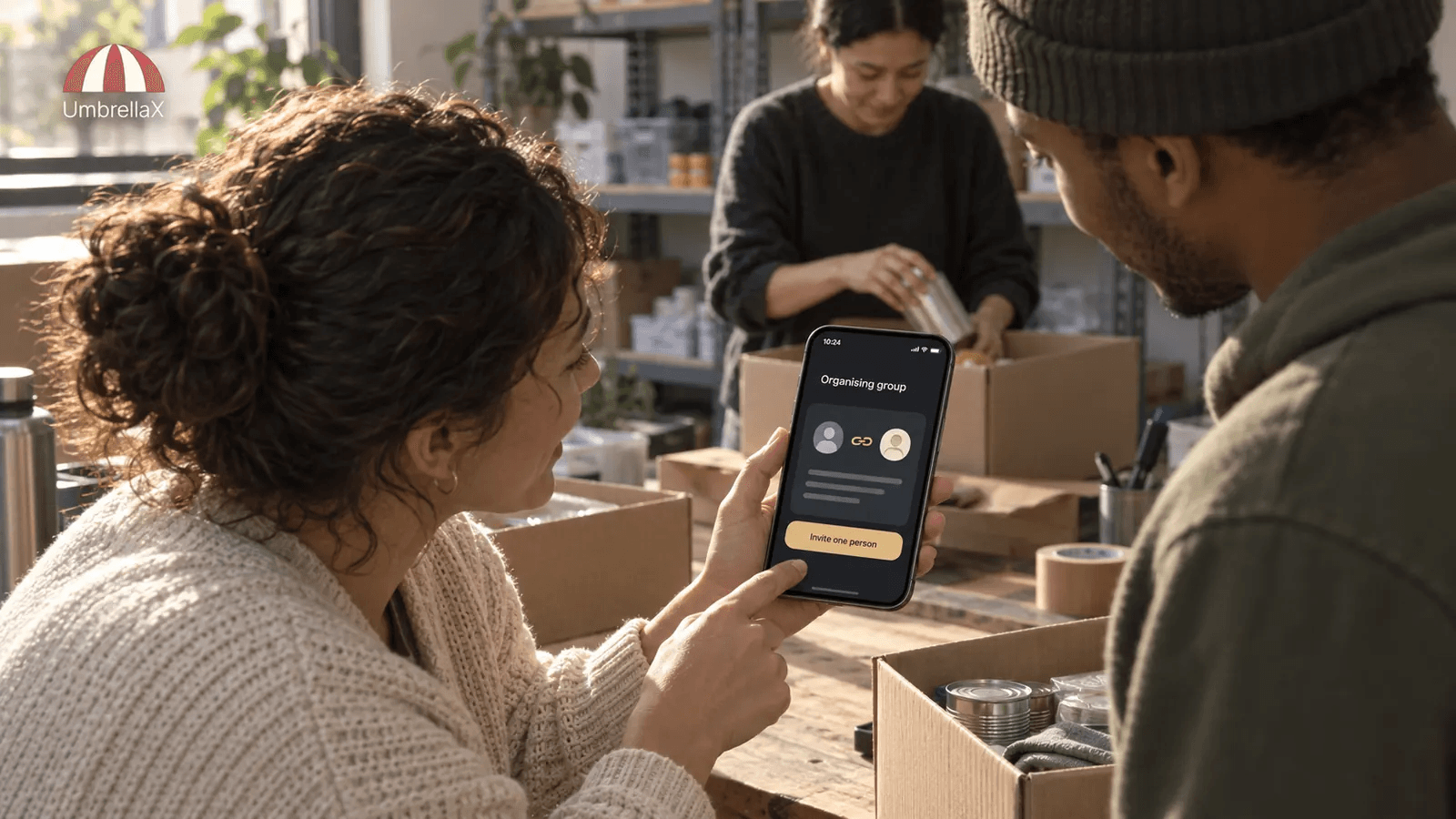
Secure messaging for activists should start with the action, not the app logo. A neighborhood protest, labor campaign, human rights network, legal support group, mutual aid team, and border-crossing organizer do not share one neat risk model. End to end encryption is necessary, but it is not the full answer. For activist work, I would rather trust a messenger that avoids phone-number identity, treats group access as a security event, limits metadata, explains recovery honestly, and does not leave the operator with a convenient map of the movement. That is the design direction behind UmbrellaX.
The short answer: secure messaging for activists means protecting the content of organizing conversations and the evidence around those conversations. The evidence can include who invited whom, who joined a group, when a device came online, which phone number was used, what link was shared, whether a message arrived near an arrest, or whether a server kept records after the action ended.
I am building UmbrellaX from a simple rule: a private messenger should reduce risk before it asks activists to trust the lock icon. Encryption protects text. The rest of the product decides how much of the organizing graph still exists outside the ciphertext.
The answer first
Secure messaging for activists should protect four layers at once.
First, it should protect message content with end to end encryption by default. A sensitive organizing chat should not depend on a hidden private mode.
Second, it should reduce metadata. EFF’s digital security guidance distinguishes the content of communication from the circumstances around it. For activists, the circumstances can be the sensitive fact: a roster, route, timestamp, invite link, file size, or repeated connection pattern.
Third, it should avoid phone-number identity. A phone number pulls the carrier, SIM registration, address books, recovery flows, and old breach data into the account model before the first encrypted message is sent.
Fourth, it should treat groups as live security objects. People join, leave, lose phones, cross borders, change devices, get pressured, and sometimes become untrusted. A private group needs visible membership changes, revocable invite links, and clear device state.
For activists, that translates into a stricter product shape: accounts that do not begin with telecom identity, rooms where membership changes are visible, invite paths that can be killed, records that do not become an organizer map, and an operator jurisdiction chosen before pressure arrives.
The SERP pattern and why this article is different
Search results for secure messaging for activists tend to reward practical guides. EFF covers protest preparation, device settings, and safe communication. Access Now runs a Digital Security Helpline for civil society at risk. Security in a Box and Front Line Defenders style resources focus on operational habits, not just tools. Briar appears because peer-to-peer and offline-friendly messaging can matter during shutdowns or network pressure.
That page pattern is right. Activists do not need a theoretical essay that assumes perfect devices and calm conditions. They need decisions they can make before a meeting, before a march, before crossing a border, before adding a new organizer, and after a phone goes missing.
Where this article is different is the messenger-builder view. I am not ranking every app. I am asking what the system itself should avoid knowing. When I evaluate secure communication for activists, I start with the weakest record the product creates: the phone number, the group roster, the invite link, the recovery path, the backup default, the push payload, the support ticket, and the operator log.
This is not a duplicate of the secure messaging for journalists article. Journalists usually start from source protection and first contact. Activists more often start from group coordination, infiltration risk, protest exposure, device seizure, and shutdown resilience. The privacy question moves from “can a source safely reach a reporter?” to “can a group organize without creating a durable map of itself?”
Activist risk is usually group risk
One-to-one privacy matters, but activist work often fails through groups.
A small planning room can expose names before a message is read. An old invite link can become an entry point. A new device can become a silent listener. A screenshot can travel outside the encrypted channel. A public group can feel private because the interface looks familiar. An admin can add someone under pressure. A phone can be seized while the group is still active.
My rule is that group membership changes should feel like security events, not housekeeping. If a new member joins, the room should understand that future messages have a new reader. If a device is added, existing devices should see it. If an invite link was shared, the creator should be able to revoke it. If someone leaves, the key state after that point should not pretend nothing happened.
This is why secure group messaging is a core UmbrellaX topic. MLS matters to me because groups are not just a scaled-up direct message. They are changing sets of readers. A private messenger for activists has to make that change visible and cryptographically meaningful.
End to end encryption is the floor
For activist communication, end to end encryption is not a feature tier. It is the floor.
The message body should be encrypted on the sender’s device and decrypted only on intended recipient devices. The server should move ciphertext, not read meeting notes, route changes, legal support details, medical needs, names, donor lists, or arrest response plans.
But I do not trust encryption theater. A messenger can encrypt message text while still creating a rich operator-side story: phone numbers, address book matches, group names, device lists, IP records, push notification content, backup metadata, abuse reports, support tickets, and payment identifiers. In some activist cases, that story is the target.
The practical test I use is blunt: after encryption, what facts does the operator still know? If the answer is “a lot, but the message text is safe”, then the product has solved only one part of the problem.
UmbrellaX treats end to end encryption as a starting point. I care about the rest of the surface because a government, employer, abusive partner, hostile group, or leaked database may not need plaintext to harm someone.
Metadata can identify the movement
Metadata is the quiet organizer map.
It can show that two people talked before an action. It can show that a group became active at night. It can show which accounts were added after a planning meeting. It can show who received a file, when a device reconnected, which IP range was used, and whether a person is linked to multiple rooms.
RFC 6973 is useful here because it treats protocol privacy as more than content secrecy. Identifiers, linkability, observability, and secondary use all matter. That framework is exactly how I think about activist messaging. The problem is not only “can someone read the chat?” The problem is whether the system creates enough surrounding data to reconstruct the group.
This is why I keep linking back to private messenger metadata. For activists, metadata is not an abstract privacy category. It can become a membership list, a timeline, a pressure map, or a clue about who trusted whom.
My operator test is simple. If a record would be useful to someone trying to identify organizers, and the service does not need it to function, I do not want it stored. That is not a marketing slogan. It is a product constraint.
Phone numbers import the carrier threat model
I would not build activist messaging around phone numbers.
A phone number is already tied to the telecom system. Depending on the country and user, it may connect to SIM registration, billing records, ID checks, device changes, carrier support, data brokers, breached databases, and other people’s address books. If a messenger account starts from that identifier, the activist has already imported a real-world identity system.
The risk is not only that a phone number can be searched. The risk is that it becomes a shared key across systems. A workplace directory, an old contact upload, a delivery app, a bank account, a leaked spreadsheet, and a carrier record can all speak the same identifier.
That is why a messenger without a phone number is not just a privacy preference. For organizers, it changes the first step. The account can begin inside the messenger instead of borrowing authority from telecom.
I accept the tradeoff. No-phone-number identity makes discovery less automatic. You need handles, QR codes, invitation flows, or other deliberate exchange. I would rather spend product effort on safer discovery than make the phone number the root of every sensitive group.
Device seizure changes the advice
Activists should assume that devices can be lost, searched, seized, or pressured.
EFF’s protest guidance focuses on practical preparation: think about what is on the phone, how it unlocks, what notifications reveal, and what happens if law enforcement asks to search it. This is not separate from messaging. The strongest encrypted chat can still be exposed by an unlocked device, broad notification previews, cached media, cloud backups, or a second device that was linked quietly.
I do not want UmbrellaX to promise magic against a compromised phone. That would be dishonest. A messenger can reduce retained data, shorten unlock windows, narrow push payloads, make device linking visible, and avoid server-side recovery shortcuts. It cannot make every device safe by declaration.
My practical rule is that sensitive actions should be visible and scoped. Adding a device should be obvious. Opening old history should be bounded. Recovery should not let support rebuild the account alone. Push notifications should wake the app without describing the room. If the product makes risky states quiet, activists will pay the price.
Network pressure and shutdowns require humility
Some activist threat models include blocked networks, throttled apps, DNS interference, or full local shutdowns.
Briar is often discussed in activist contexts because it can use direct connections, local networks, and the Tor network rather than depending only on a central server path. That is a real design advantage for a narrow case. I respect it.
UmbrellaX is making a different tradeoff. I want reliable modern messaging, large secure groups, calls, and a single accountable operator while still building transport resilience into the product. The goal is not to pretend every network problem disappears. The goal is to avoid a fragile design where one DNS block, one domain filter, or one app-store choke point ends the conversation.
When I evaluate a messenger for activists, I ask whether it has a plan for degraded networks and whether the product explains its limit. If local connectivity with no internet is the main requirement, a specialized offline tool may be the better choice. If the requirement is everyday encrypted organizing with stronger identity, group, metadata, and jurisdiction posture, UmbrellaX is the direction I would choose.
Jurisdiction is part of the threat model
Jurisdiction does not make a messenger private by itself. A badly designed product in a friendly jurisdiction is still a badly designed product.
But jurisdiction is not decorative. It decides which legal system can pressure the operator first, which channels of cooperation exist, what transparency obligations apply, and how easy it is for a foreign demand to become an operator demand.
UmbrellaX TOO is registered in Kazakhstan, outside the Five Eyes. I do not claim that makes UmbrellaX immune to legal pressure. I also do not claim any country is a privacy paradise. My claim is narrower and more useful: a serious private messenger should name its legal entity, publish its privacy posture, keep a warrant canary, explain transparency, and minimize records so that jurisdiction has less data to act on.
For activists, the combination matters. Encryption by default reduces content exposure. No-phone-number identity reduces telecom linkage. Secure groups reduce silent access changes. Operator data minimization reduces the value of legal or database pressure. Jurisdiction decides where that pressure begins.
My trust test before activists use a messenger
I would not tell activists to trust a messenger because it has a lock icon, a famous name, or a clean landing page.
When I evaluate a product for this threat model, I look for practical answers. Does signup require a phone number? Does contact discovery upload readable address books? Are groups encrypted by default? Are membership and device changes visible? Can old invite links be killed? What do push notifications reveal? What happens after phone theft? Can support restore the account alone? Are backups encrypted in a way the server cannot quietly bypass? Does the operator explain logs, legal entity, and jurisdiction?
I would rather see a product admit limits than imply total safety. If an activist faces targeted spyware, physical coercion, or an already compromised device, normal messaging advice may not be enough. Amnesty’s Pegasus investigations are a reminder that high-risk civil society targets can face capabilities far beyond ordinary account theft.
For most organizing, though, the messenger still matters. It should not make easy privacy mistakes the user cannot see.
Where UmbrellaX fits
UmbrellaX is pre-launch, so I will not claim activist field history, independent audits, or proven deployment under protest conditions.
What I can say is what I am building toward. UmbrellaX starts without a phone-number account root. It uses end to end encryption by default. It treats secure groups as a protocol problem rather than a UI afterthought. It is designed around operator data minimization. It is incorporated outside the Five Eyes. It connects metadata privacy, no phone number identity, secure group messaging, and post quantum hardening into one product posture.
That does not make UmbrellaX the answer for every activist situation. If the action requires fully offline peer-to-peer communication, specialized tools may fit better. If the device is already compromised, no messenger can save the conversation by branding. If the threat is immediate physical coercion, operational planning matters more than app choice.
But for activists who need a default private messenger for sensitive coordination, I want UmbrellaX to pass the harder test: fewer identifiers at signup, less metadata by design, visible group state, clear jurisdiction, and no quiet operator master key.
The practical takeaway
Secure messaging for activists is a chain of design decisions.
The first decision is identity. Do not start with a phone number if the work is sensitive. The second is group state. Treat every join, leave, invite, and device change as meaningful. The third is metadata. Ask what the operator, network, push provider, backup system, and old logs can still reveal. The fourth is device reality. Assume phones are lost, searched, linked, and pressured. The fifth is jurisdiction. Know who can compel the operator and what the operator actually retains.
My rule for UmbrellaX is that the product should not ask activists to pay for convenience with an invisible organizing map. If the messenger can reduce a record, it should reduce it. If it must keep a record, it should explain why. If it cannot protect a threat model, it should say so in plain language.
That is the messenger I would trust more. That is the one I am building.
Sources
- Electronic Frontier Foundation: Attending a Protest official
- Electronic Frontier Foundation: Communicating With Others official
- Access Now: Digital Security Helpline official
- Amnesty International: The Pegasus Project research
- Briar: How it works competitor
- IETF RFC 6973: Privacy Considerations for Internet Protocols official
- UmbrellaX privacy policy official