


Secure messaging for journalists should begin with a threat model, not a brand name. The first question is not “which encrypted app is best?” The first question is what failure would expose: the source’s identity, the story, the reporter’s notes, a group roster, a location trail, or the fact that contact happened at all. End to end encryption is necessary, but it is not enough. For journalist-source work, I would rather trust a messenger that starts without a phone number, minimizes metadata, explains what the operator can see, and treats groups and recovery as security decisions. That is the design direction behind UmbrellaX.
The short answer: secure messaging for journalists means protecting the content of a conversation and the surrounding evidence that proves the conversation existed. That second part is where many guides become too soft. A source can be harmed by a readable message, but also by a phone number match, timestamp pattern, cloud backup, contact upload, seized device, or legal request for operator records.
I am building UmbrellaX from that premise. The product is pre-launch, so I will not pretend it already has newsroom field history. What I can explain is the rule I use: a private messenger for journalists should reduce the number of facts the system knows before it promises to protect the facts inside the message.
The answer first
Secure messaging for journalists should protect four things at once.
First, it should protect message content with end to end encryption by default. The user should not have to find a special mode for the sensitive conversation.
Second, it should reduce metadata. CPJ warns journalists that encrypted communications can still expose who sent a message, who received it, and when. EFF makes the same distinction: encryption protects content, not the fact of communication.
Third, it should avoid making the phone number the account root. A phone number links a reporter or source to telecom records, contact books, address books, recovery flows, and SIM registration regimes.
Fourth, it should respect the first-contact problem. Once a source has left a trace through email, a phone number, a workplace device, or an ordinary social account, later privacy tools cannot erase that first trail.
For journalism, that sequence has a specific shape: the source should not have to reveal a phone number, the first contact should not create a durable operator record, story teams should see group and device changes, and the company running the messenger should retain less before anyone asks for it.
The SERP pattern and why this article is different
Search results for secure messaging for journalists tend to show practical digital-safety guides, source-protection explainers, and tool pages. CPJ focuses on encrypted communications, metadata, ownership, transparency reports, backups, and safety-number checks. EFF starts with security planning and then explains what end to end encryption does and does not protect. Reporters Without Borders warns against dangerous simplifications, including the idea that encryption makes a journalist invisible.
That pattern is useful, but it often leaves the messenger-builder view implicit. I want to make it explicit.
When I evaluate a messenger for journalistic work, I do not start with the strongest marketing claim. I start with the weakest link in the source’s path. How did the source first contact the reporter? Did they reveal a phone number? Did the app upload contacts? Could the operator retain a durable log? Could a seized phone prove the relationship? Could a group roster expose the story team? Could a recovery path hand the account to someone else?
This article belongs in the UmbrellaX threat-model cluster because those questions are not generic privacy copy. They decide whether a messenger can credibly serve reporters, sources, editors, fixers, and legal teams.
Start with the source, not the reporter
A journalist often has more security awareness than the source. The source may be scared, rushed, nontechnical, at work, on a monitored network, or using a phone tied to their real identity. That changes the design problem.
My rule is that the safer side should not design only for itself. If a source must install a strange app, expose a phone number, reuse a work device, create a visible account, or learn a complicated ceremony before saying the first sentence, the journalist has moved risk onto the person with less power.
CoverDrop is interesting for exactly this reason. Its public explanation focuses on first contact, cover traffic, plausible deniability, and hiding communication patterns. It is not a normal messenger, and UmbrellaX is not trying to copy it feature for feature. But the design lesson matters: for some journalistic use cases, the fact of contact can be as sensitive as message content.
For a general private messenger, my practical version is narrower but still important. Do not make the source begin with a phone number. Do not require address book exposure. Do not leave the operator with durable relationship records. Do not pretend a lock icon solves first contact.
End to end encryption is table stakes
For journalist-source communication, end to end encryption is not a premium feature. It is the floor.
The message body should be encrypted on the sender’s device and decrypted only on the recipient’s device. A server should be able to move ciphertext, not read the story pitch, source name, draft allegation, meeting location, or attached evidence. If a messenger requires users to switch into a special secret mode before this is true, I would treat that as a serious usability risk.
But I also do not like encryption theater. The phrase “encrypted messaging” can hide several weaker designs: server-readable cloud chat, optional encryption, weak backup defaults, metadata-heavy accounts, phone-number discovery, or recovery paths that quietly override the cryptography.
That is why UmbrellaX treats encryption as a starting condition, not the whole product. I wrote the broader end to end encryption explainer for readers who want the cryptographic baseline. For journalists, I would add this: if the product cannot explain what it can still see after encryption, it is asking for trust instead of reducing trust.
Metadata is often the reporter’s real leak
The strongest section in CPJ’s journalist kit is the reminder that encryption protects content while metadata can still reveal when a message was sent, who received it, and other details. That is the right emphasis.
In reporting, metadata can identify a source before any message is decrypted. A pattern of contact between a civil servant and a reporter can matter. A call record before publication can matter. A timestamp near a leak can matter. A group name, roster, invite link, file size, notification trace, or cloud backup can matter.
This is why I keep returning to private messenger metadata. A messenger should not collect a convenient pile of relationship data and then say, “Do not worry, the text is encrypted.” For a journalist, the relationship may be the secret.
UmbrellaX’s design instinct is operator data minimization. The server still has to run the service, deliver messages, resist abuse, and keep users safe. But every retained field should have to justify itself. My internal test is simple: if a record would harm a source under legal or physical pressure and the service does not need it to function, I do not want it stored.
Phone-number identity is a bad root for source contact
I would not build a journalist-facing messenger around phone numbers.
A phone number is not just a login convenience. It is a telecom identifier. In many places it is tied to SIM registration, ID documents, carrier records, bank accounts, recovery flows, workplace directories, breached datasets, and other people’s address books. For a source, that can turn the first message into a linkage event.
This is why a messenger without a phone number is not only a consumer privacy preference. It is a source-protection issue. A journalist may be comfortable giving out a number or username. A source may not be. A product that normalizes phone-number discovery can expose people before the conversation has any content to protect.
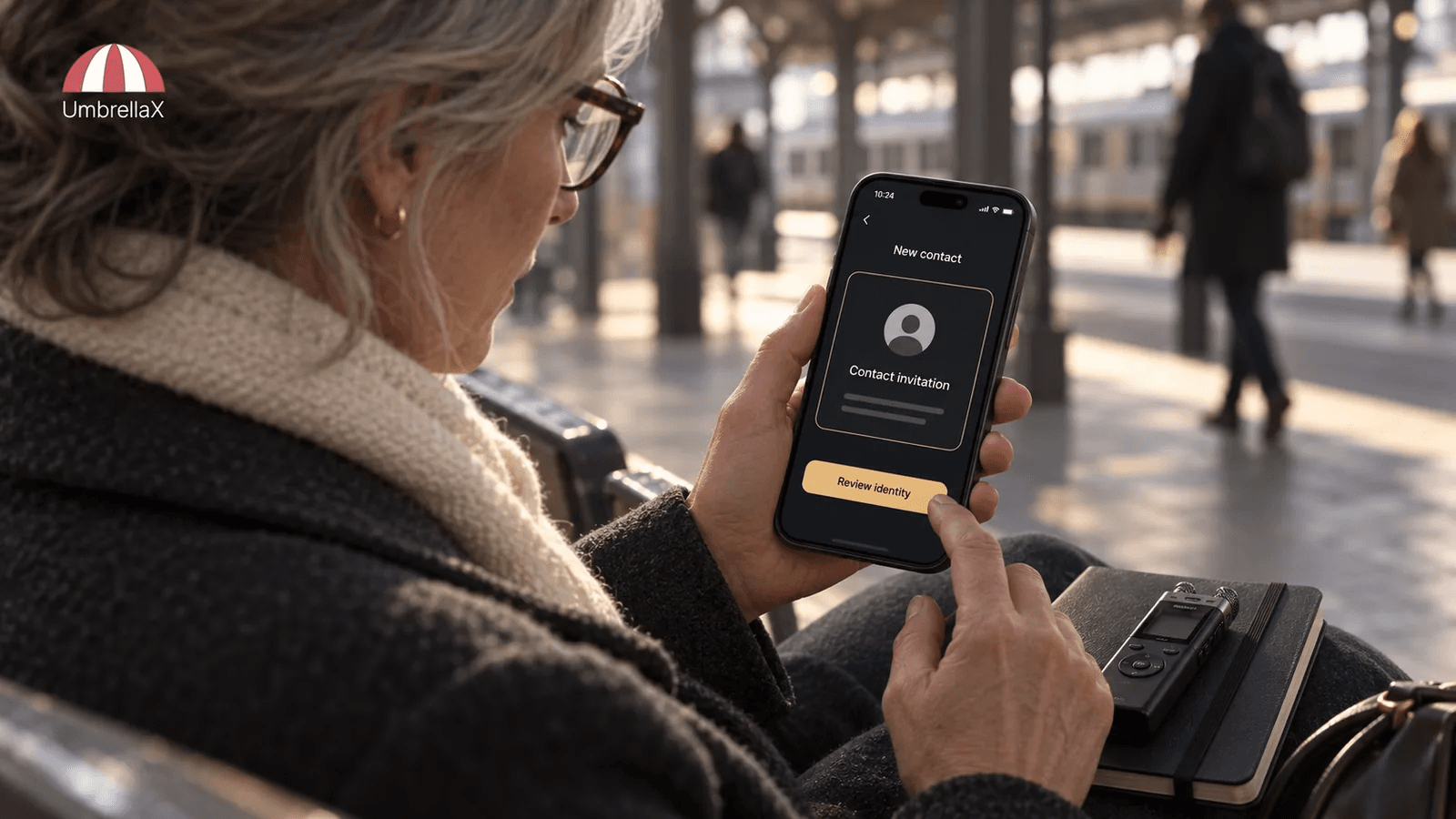
I accept the usability tradeoff. No-phone-number contact exchange usually means handles, QR codes, one time links, or a more deliberate invitation flow. That is less frictionless than address book matching. I would rather accept that cost than make the carrier network the root of a confidential source relationship.
Device pressure changes the story
No messenger can rescue a fully compromised device. Spyware, coercion, unsafe backups, screenshotting, weak unlock codes, workplace mobile-device management, and physical seizure all sit outside the clean protocol diagram.
This is where threat modeling matters. EFF’s security-planning model asks what needs protection, who may target it, how bad failure would be, how likely the threat is, and how much effort the user can tolerate. For journalists, those questions should happen before choosing a tool, not after.
My practical trust test is this:
- If the source may be searched at a border, do not rely only on disappearing messages.
- If the source uses a work phone, assume workplace controls may matter.
- If the source is under state pressure, metadata and app visibility may matter.
- If the story involves a group, membership and device changes may matter.
- If the source is nontechnical, complicated ceremonies may fail.
UmbrellaX can reduce some of those risks by design, especially account identity, metadata minimization, secure groups, and call privacy direction. It cannot make a dangerous device safe by declaration. I would rather say that plainly than sell false confidence.
Groups need a stricter rule
Journalism is rarely a one-to-one workflow. A source may speak to one reporter, but the story may involve an editor, lawyer, visual investigator, security adviser, translator, or trusted fixer. The moment a group exists, the threat model changes.
In a group, membership is evidence. Device changes are evidence. Admin actions are evidence. A removed member should not receive future messages. A new device should not silently inherit trust. A group call should not expose participant IP addresses to every other participant. A compromised member should not force the whole group to pretend nothing happened.
That is why I wrote a separate guide to secure group messaging. For journalist work, I would choose a messenger that treats group security as a protocol problem, not as a convenience layer on top of one-to-one chat.
UmbrellaX uses the MLS direction because group key management should be a first-class primitive. My judgment is that newsroom and source-protection workflows need that discipline more than ordinary consumer chat does.
Jurisdiction is not magic, but it is not decorative
Some privacy discussions overstate jurisdiction. Others ignore it completely. Both are wrong.
Jurisdiction cannot fix bad cryptography. It cannot save a compromised device. It cannot make poor operational practice safe. But it does decide which legal systems can pressure the operator most directly, what request process exists, and how transparent the company can be about demands.
UmbrellaX TOO is registered in Kazakhstan, outside the Five Eyes. That is a deliberate operator choice. I do not claim it makes UmbrellaX immune to legal pressure, and I do not claim any jurisdiction is a civil-liberties paradise. My claim is narrower: for a privacy-first messenger, legal domicile is part of the threat model and should be explained in public.
That is why UmbrellaX maintains public policy surfaces such as the privacy policy, transparency log, and warrant canary. A journalist should not have to guess who operates a messenger, where it is incorporated, or what the operator says it retains.
When I would not use a normal messenger
I would not use a normal messenger for first contact when the source’s identity could put them in prison, cost them asylum, expose them to employer retaliation, or reveal a whistleblowing path before any editorial vetting has happened.
I would not use ordinary chat if the source’s device is likely to be inspected, if a phone-number link is already dangerous, if using a visible security app is itself suspicious, or if the source needs anonymity from the journalist as well as from outside observers.
In those cases, use a dedicated source-contact channel, in-person procedure, newsroom drop system, or specialist tool matched to the risk. SecureDrop and CoverDrop exist because the first-contact problem is not the same as daily private messaging.
Where a general private messenger does fit is after the contact path is understood: reporter-to-editor coordination, trusted source follow-up, legal review, sensitive group discussion, ongoing protection of a relationship that both sides knowingly entered, or day-to-day communication where reducing metadata and phone-number exposure still matters.
That is the lane I want UmbrellaX to serve well.
My checklist before trusting a messenger
I do not use a long checklist as a substitute for judgment, but I do have a short test.
Does the messenger encrypt by default? Does it avoid phone-number identity? Does it explain metadata? Does it minimize operator logs? Does it handle groups as a security problem? Does it make recovery explicit? Does it have a clear legal entity? Does it publish privacy and transparency surfaces? Does it warn users where the product cannot help, especially device compromise?
If the answer to those questions is vague, I would not ask a source to carry the risk.
UmbrellaX is being built around the answers I would want to see: no phone-number account root, end to end encryption by default, post quantum hardening where long-lived confidentiality matters, MLS-oriented secure groups, jurisdiction outside the Five Eyes, and a smaller operator data surface.
That does not make UmbrellaX a substitute for newsroom training, source consent, secure devices, or careful reporting practice. It makes the messenger a better part of that practice.
The practical takeaway
Secure messaging for journalists is not a single app recommendation. It is a threat-model decision.
For low-risk daily coordination, a mainstream encrypted messenger may be enough. For sensitive source work, I would ask harder questions: what does the first contact reveal, what metadata survives, whether a phone number is required, what happens under device pressure, how group membership changes, what backups contain, and which jurisdiction can compel the operator.
That is the product standard I am applying to UmbrellaX. I do not want a messenger that merely says the text is encrypted. I want a messenger that starts by knowing less about the reporter, the source, the group, and the relationship between them.
For journalism, that difference is not theoretical. Sometimes the relationship is the story.
Sources
- Committee to Protect Journalists: Digital Safety Kit official
- Electronic Frontier Foundation: Your Security Plan official
- Electronic Frontier Foundation: Communicating With Others official
- Reporters Without Borders: Dangerous Errors official
- CoverDrop: Blowing the Whistle Through a News App research
- IETF RFC 6973: Privacy Considerations for Internet Protocols official
- UmbrellaX privacy policy official