



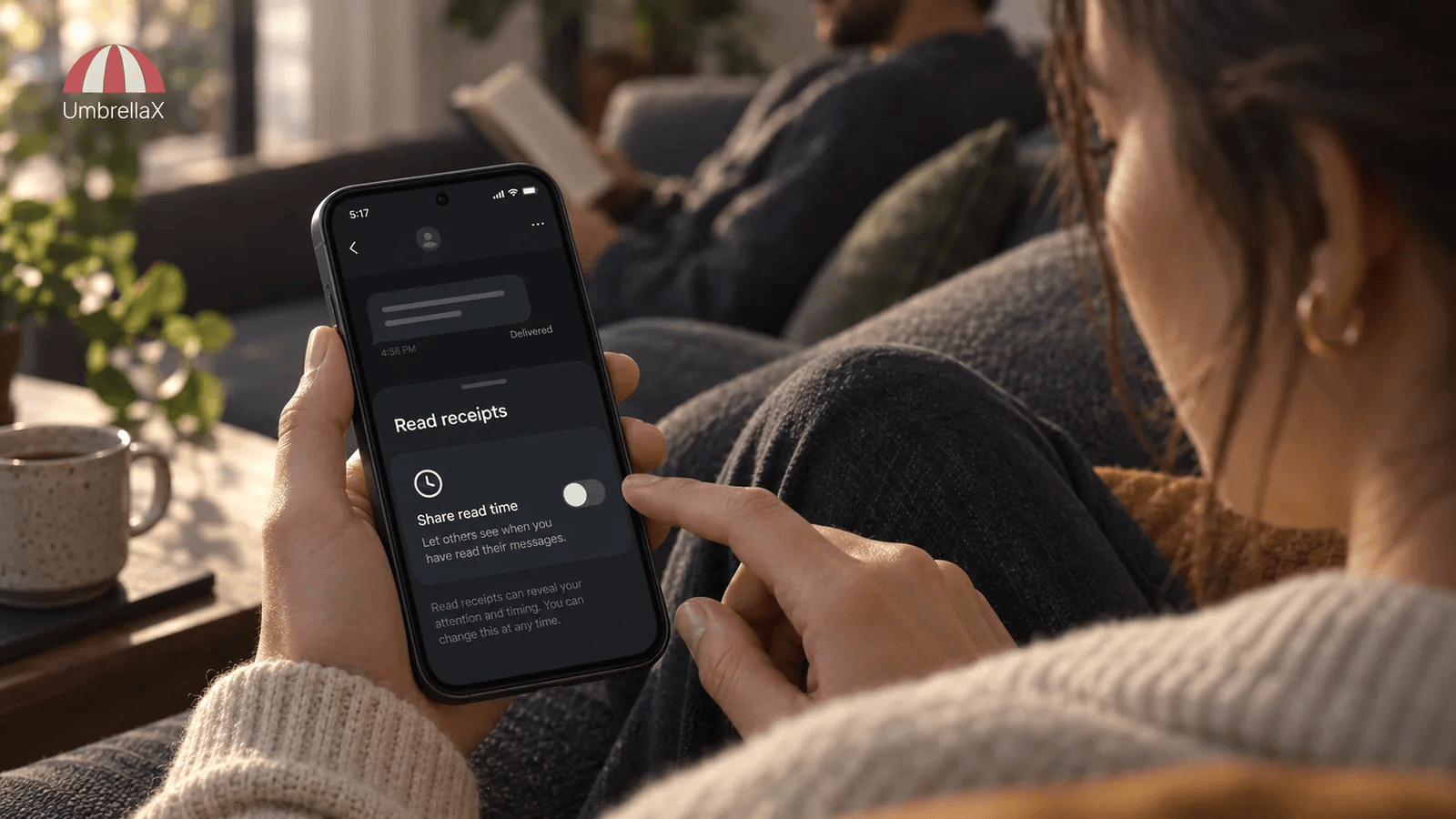
Read receipts privacy matters because the small word “read” can expose more than a user intended. A messenger can encrypt the message body and still reveal when a person was reachable, attentive, avoiding a reply, active on a device, or present in a group. My rule for UmbrellaX is that receipts are metadata. They should be optional, scoped, and minimized, not treated as harmless interface polish.
The short answer: end to end encryption protects content. It does not automatically hide delivery state, read state, timing, device reachability, or the social pressure created by those signals. A receipt is not the message, but it can still say something sensitive about the person behind the screen.
I am building UmbrellaX with this distinction in mind. Receipts should help a conversation work, but they should not become a permanent diary of attention.
The answer first
Read receipts and delivery receipts are useful, but they are not neutral. They are behavioural metadata. A read receipt can tell the sender that a person saw a message and did not answer. A delivery receipt can show that a device was reachable. A sequence of receipts can reveal sleep, work, travel, stress, avoidance, group activity, and routine.
That matters most in sensitive relationships: journalist and source, lawyer and client, organizer and group, founder and board member, family under pressure, or anyone dealing with coercive personal dynamics.
I would rather build a messenger where the sender gets enough confidence that delivery is working, but not enough behavioural detail to monitor another person’s life. For UmbrellaX, the design question is not “can we show another tick?” The question is “what does this tick let someone infer?”
Read is not the same as private
The word “read” feels small because it sits next to a chat bubble. It is easy to forget that it is a claim about another person’s attention.
In everyday life, this creates social pressure. A person sees a message during a meeting, while driving, in court, at a border, beside a partner, or before sleeping. The sender sees the read signal and starts measuring the delay. That is not only etiquette. It is a privacy boundary around attention.
My practical test is simple: if a feature lets another person build a timeline of when I was available, awake, ignoring them, or attached to a device, then it belongs in the privacy model. It should not be hidden in settings copy.
This page is narrower than my private messenger metadata guide. That article owns the whole operator knowledge model. This one owns a smaller surface: the status signals around one message.
Delivery receipts are quieter, but not harmless
Many people focus on visible read receipts because they feel socially invasive. Delivery receipts are easier to miss because they look technical.
That is the mistake. A delivery receipt can still reveal that a device was reachable or that the app received something. Depending on the protocol and app behaviour, repeated delivery probes can become a timing side channel.
The “Careless Whisper” research is useful because it shows the uncomfortable pattern: receipt mechanisms in popular mobile messengers can leak activity and device-state information even when users are not shown a new message. The exact attack details belong in the paper, not in this article, but the product lesson is clear enough. A receipt path can become a monitoring path.
This is why I do not separate security architecture from user experience. A tiny status indicator has a protocol behind it. That protocol has timing, retries, acknowledgements, device fanout, push wakeups, group semantics, and logs. If those pieces are too precise and durable, the UI word “delivered” becomes a privacy event.
End to end encryption does not settle receipt privacy
End to end encryption is necessary. It means the server should not be able to read the message body. I explained the core boundary in my end to end encryption guide.
But receipt privacy lives around the ciphertext.
The server may not know what the message says. The sender may still know when the recipient read it. The operator may still need some delivery state to route retries. The recipient’s device may still wake through a push path. A group may still expose that one member has seen something while another has not. None of that contradicts encryption. It proves that encryption is one layer.
When I evaluate a messenger, I ask what remains visible after the lock icon has done its job. Read receipts are one of the cleanest examples because everyone understands them. They are also one of the easiest features to underestimate.
What I would not trust
I would not trust a messenger that treats read receipts as a universal default and makes the recipient carry the social cost.
I would not trust a design that lets delivery acknowledgements be queried at high frequency without a serious abuse model. If a sender can repeatedly ping another account and learn something about activity, then the feature has become an observation channel.
I would not trust a product that says “you can turn read receipts off” while keeping other receipt signals too exact, too durable, or too visible to group members. Turning off one label should not leave the same behavioural timeline elsewhere.
I would also be careful with products that solve the social part but not the operator part. A recipient may hide visible read receipts from a sender, while the service still stores precise delivery or read-state logs. That is a different risk. It belongs with operator data minimization, not with etiquette.
The UmbrellaX design direction
UmbrellaX is pre-launch, so I will not pretend there is production history before it exists. What I can explain is the rule I am building toward.
Read receipts should be consent based. If two people want that signal, the product can support it. If one person does not, the feature should not become a pressure tool.
Delivery acknowledgements should be narrow. The system needs enough state to deliver messages reliably, recover from network failure, and avoid confusing the sender. It does not need to create a precise, durable record of when someone was reachable every time a message was attempted.
Group receipts should be treated as group metadata. In a small family chat, “seen by everyone” may feel harmless. In a legal matter, newsroom, incident room, activist group, or board conversation, it can expose who is present, who is silent, and who has acknowledged a decision. That is why I connect this topic to secure group messaging. Group state is security state.
My rule is that receipt data should expire, blur, or stay local unless there is a clear reason to retain it. If I could not defend a receipt field in front of a hostile lawyer, I should not store it.
That is also why the public UmbrellaX privacy policy and canary matter to this design. A private messenger should not ask users to trust hidden retention habits. It should make the sensitive surfaces visible enough that receipt state, support records, legal pressure, and operator knowledge can be criticized before they become defaults.
Exact timing is the dangerous part
The privacy risk is not only that a sender sees “read.” It is that the sender sees “read at 09:42” or can infer the same thing by watching state changes.
Exact timing turns attention into a dataset. A single receipt may be trivial. A month of receipts can show habits. A burst of delivery changes can show travel or device switching. A group of people reading at the same time can show coordination. A late-night read can reveal stress, availability, or household pressure.
This is why I prefer coarser product language where the user benefit allows it. Sometimes a sender only needs to know that the message probably got through. They do not need a forensic timeline.
There are tradeoffs. Too little status can make a messenger feel broken. Too much status makes the recipient transparent. I would rather accept a little ambiguity than make privacy-sensitive users pay with attention telemetry.
Receipts interact with push notifications
Receipts and notifications are separate surfaces, but they touch.
A push notification may wake the app. The app may fetch messages. Delivery state may change. The recipient may read from a notification preview or open the room. Each step can create signals before the actual conversation resumes.
That is why I wrote a separate page on push notification privacy. Push should wake the app, not describe the private conversation. Receipts should confirm enough for reliability, not describe the user’s private routine.
The product should not make users solve this with a dozen hidden toggles. My preference is safer defaults: quiet push, consent-based read receipts, narrow delivery acknowledgements, and retention limits that are easy to explain.
Disappearing messages do not erase receipt state
Disappearing messages are useful as a retention control. They do not make the sender forget what they saw.
If a user reads a disappearing message and the app sends a read receipt, the social fact already happened. If a group shows who has seen a message before it disappears, the membership signal already happened. If the operator kept delivery logs outside the disappearing content, the timer did not erase that metadata.
That does not mean disappearing messages are bad. It means they should not be sold as a cure for every privacy surface. I wrote more about that in disappearing messages privacy.
For UmbrellaX, the receipt rule is separate: deletion controls history, while receipt minimization controls attention and timing.
A practical test for any messenger
When I evaluate read receipts privacy in a messenger, I ask six questions:
- Can I turn read receipts off without breaking normal conversation?
- Are delivery receipts narrow enough to avoid becoming activity probes?
- Does the product store exact read or delivery timestamps, and for how long?
- In groups, who can see read state and membership acknowledgement?
- Do receipts interact with push, previews, or linked devices in a way that reveals more?
- Does the product explain the tradeoff plainly, or hide it behind friendly icons?
That test is not theoretical. It is how I think before adding a convenience feature to UmbrellaX. A private messenger has to survive normal life: unanswered messages, pressure from a boss, a source checking in, a client in crisis, a partner watching a phone, or a group trying to move quietly.
When receipts are worth keeping
I do not think every receipt is bad.
Delivery state can reduce confusion. It can help users understand a weak network, a dead battery, a blocked contact, a changed device, or a message that needs retrying. In some teams, read receipts can be part of explicit operational discipline.
The difference is consent and scope. A receipt that a team knowingly enables for an incident room is different from a default signal in every personal chat. A coarse delivery state that helps reliability is different from a permanent timestamp trail. A local device indicator is different from an operator-visible log.
My rule is not “never show status.” My rule is “never make private attention a default product asset.”
Bottom line
Read receipts privacy is not a niche setting. It is a concrete test of whether a messenger understands metadata.
A privacy-first messenger should encrypt content by default, avoid phone-number identity, minimize operator knowledge, and treat status signals as sensitive. That includes read receipts, delivery receipts, typing indicators, group acknowledgements, push wakeups, and any feature that turns user behaviour into a timeline.
UmbrellaX is built from that view. I want receipts to help delivery without becoming surveillance. I want users to keep control over attention. I want group state to be explicit without exposing more than needed. And I would rather leave a little uncertainty in the UI than teach the product to record exactly when someone was available.
That is the tradeoff I trust.
Sources
- Careless Whisper: Exploiting Stealthy End-to-End Leakage in Mobile Instant Messengers research
- Signal Support: Read Receipts official
- Signal Support: How do I know if my message was delivered or read? official
- WhatsApp Help Center: How to check read receipts official
- RFC 6973: Privacy Considerations for Internet Protocols official
- UmbrellaX privacy policy official