



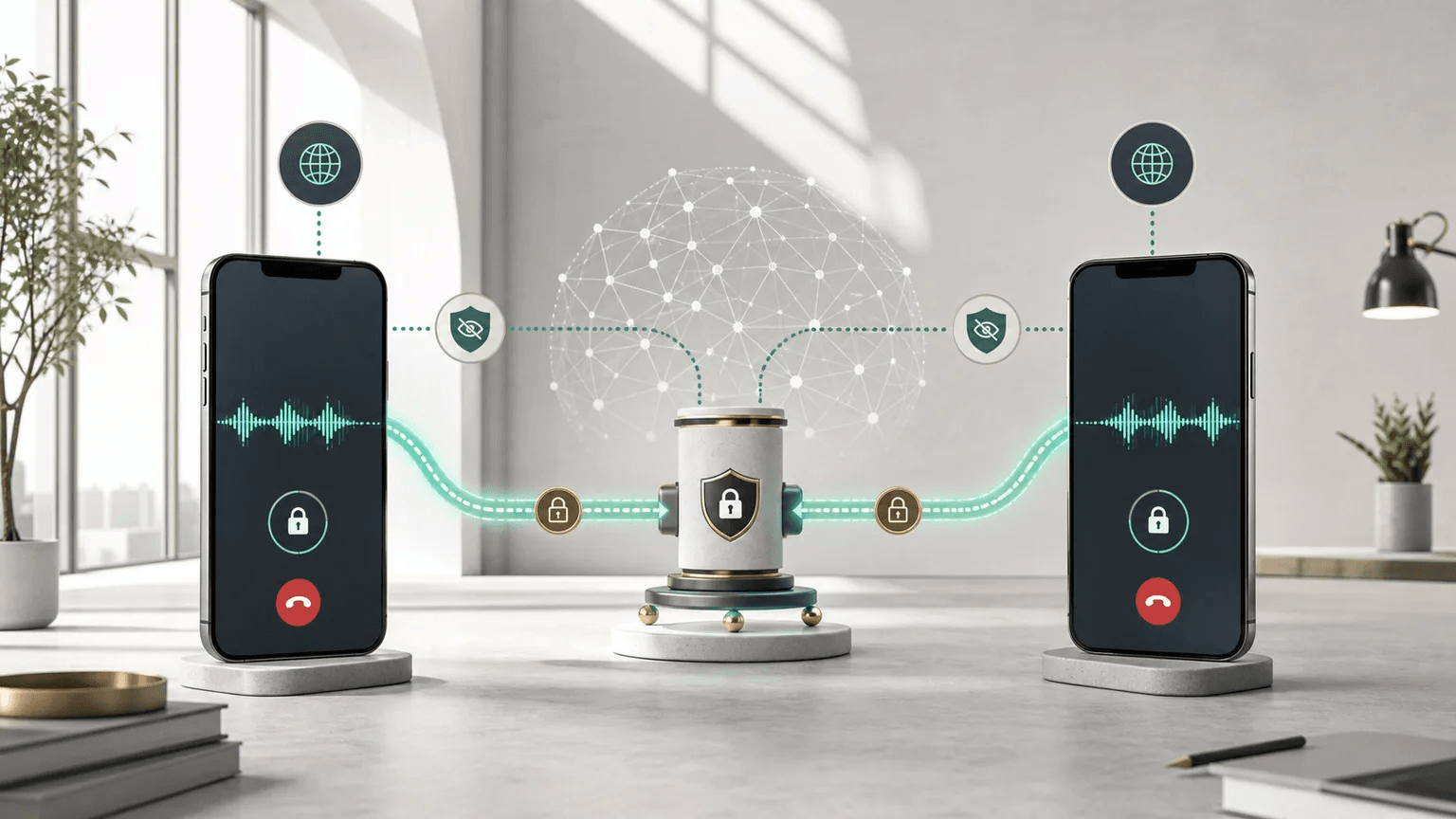
An encrypted calling app should protect more than the words and faces inside a call. I look for end-to-end encrypted media, a clear way to verify the participating devices, an honest choice between direct and relayed routing, minimal call records, and the same guarantees when a call becomes a group. A direct connection may be faster, but it can reveal each participant’s IP address to the other side. A relay can hide that address while forwarding media it cannot decrypt. My rule for UmbrellaX is that the privacy-preserving route should be the default, not a setting that only experts discover later.
That is the answer first. Voice call encryption matters, but the lock icon is only the beginning of the trust decision.
The answer first
An encrypted calling app has six jobs.
It must encrypt audio and video on the participating devices. It must authenticate the devices, because an encrypted connection to the wrong endpoint is still the wrong call. It must control whether another participant learns your IP address. It must protect group calls when members join, leave, or switch devices. It must reduce the records created by signalling, notifications, relays, and abuse controls. Finally, it must explain which of those protections are defaults and which require the user to find a setting.
I would not choose a private voice call app from an app-store promise alone. I would ask what happens before the call is answered, what the relay knows during the call, what remains after the call ends, and what changes when a third participant joins.
That is a different job from my general explanation of end-to-end encryption. This page is about live media and the network path around it.
Why calls are a different security problem
A message can wait in a queue. A call cannot. Audio packets arrive continuously, late packets become useless, and the application must process network input while the user is listening or watching.
That performance pressure creates tradeoffs. A product may prefer a direct peer-to-peer path because it can reduce latency and relay cost. It may connect through a nearby server because direct networking fails behind carrier NAT or a restrictive firewall. It may use an SFU for group video because sending a full stream separately to every participant does not scale.
The security surface also starts before the conversation. Incoming-call signalling tells the device that someone wants to connect. The app may gather network candidates, wake background services, prepare codecs, and inspect caller state before the user accepts. Meta’s technical account of WhatsApp call protections is useful here: calling stacks process complicated attacker-controlled state, so unknown callers are not only a nuisance problem.
When I evaluate a secure video call app, I therefore separate four layers:
| Layer | The question I ask |
|---|---|
| Media | Can the operator or relay decrypt the audio, video, or screen share? |
| Identity | Which account and device does each media key belong to? |
| Network | Can a peer, relay, ISP, or operator see an IP address or relationship? |
| Retention | What call event, duration, participant, or diagnostic data survives? |
A product can be strong at one layer and careless at another.
Media encryption is the floor
For WebRTC-based calls, the standards are not vague. RFC 8827 requires WebRTC media channels to use SRTP and requires DTLS-SRTP to be offered for every media channel. It also says plain RTP must not be used.
That protects media in transit, but protocol names do not answer the full product question. I still want to know where keys are created, whether a server can substitute endpoints, whether unsupported clients cause a downgrade, whether recordings or previews follow different rules, and how a user can inspect the call’s security state.
The current Discord call-encryption documentation gives a concrete example of visible verification. It documents call privacy codes, participant verification codes, and device-specific persistent keys. I am not citing that to rank products. I am citing it because a user-visible verification path is better than asking people to trust a green icon without evidence.
My rule is simple: the call UI should make the protected state inspectable. If one participant joins from an unverified device or an old client cannot support the required mode, the application should say so before sensitive media continues.
The IP address test
The most overlooked question in an encrypted calling app is whether the other caller can see your IP address.
WebRTC commonly uses ICE to find a working route. A direct route can produce excellent media quality, but the endpoints need addressing information to send packets to each other. RFC 8827’s IP privacy section is explicit: default ICE behaviour can reveal an IP address to the peer, and a TURN-only mode can prevent that peer disclosure. RFC 8828 describes the same problem as a tradeoff between media performance and privacy.
This is not a theoretical corner. Meta explains that its optional WhatsApp protection relays calls through its servers so the other party cannot see the caller’s IP address. Signal’s network documentation also distinguishes relay-only paths and SFU infrastructure.
The tradeoff looks like this:
| Route | Privacy effect | Operational cost |
|---|---|---|
| Direct peer to peer | The operator carries less media traffic, but peers may learn each other’s IP addresses | Usually the lowest latency |
| One TURN relay | Peers do not need each other’s IP addresses; the relay sees both network endpoints but not decrypted media | More bandwidth cost and some added latency |
| Split relay path | No single relay needs both endpoint views | More complexity and potentially more latency |
Paying the relay cost is the tradeoff I accept rather than making network-address exposure the quiet default. For UmbrellaX, the normal call path is designed to use a TURN relay. A faster direct path can exist, but it should be an explicit choice with a plain warning about what changes.
There is no honest claim that a relay makes someone invisible. The relay still sees traffic. An ISP still sees a connection. A strong global observer may attempt timing correlation. The useful privacy gain is narrower: the other participant does not automatically receive your network address, and a split path can reduce what any one relay learns.
Verify the person and the device
End-to-end encryption proves less than people think if the endpoint identity is weak.
Suppose a contact reinstalls the app, links a laptop, restores an account, or replaces a phone. The next call may be encrypted perfectly to a new key. The unanswered question is whether that new key belongs to the intended person or to an attacker who gained account control.
I want call verification tied to devices, not only display names. A safety code or short authentication string gives two people a way to compare what their devices see. Persistent verification can reduce ceremony for repeat contacts, but a changed device must produce a visible trust event.
I cover that lifecycle in the separate key-change notification guide. For calls, the boundary is practical: when a verified device changes, the app should not let the call UI imply continuity that the cryptographic state no longer supports.
My own test is blunt. If I cannot tell which devices are on a sensitive call, I do not treat the participant list as verified merely because the names look familiar.
Group calls change the trust boundary
One-to-one and group calls should not be collapsed into the same marketing sentence.
In a one-to-one call, two endpoints may exchange media directly or through a relay. In a group call, each participant sending a full stream to every other participant becomes expensive quickly. Products commonly introduce a Selective Forwarding Unit, an SFU, that receives encrypted media streams and forwards selected layers to participants.
That introduces questions a user should be able to answer. Can the SFU decrypt media, or does it only forward protected packets? Does the participant list bind to the media keys? What happens to encryption state when someone joins or leaves? Can a late participant access earlier media? Does the group-call path reveal every participant’s IP address to every other participant?
UmbrellaX is designed to route group calls through an SFU so participants do not need direct network exposure to one another. The SFU is still infrastructure that must be secured, monitored, and kept outside the media-key trust boundary.
The membership problem belongs in my secure group messaging guide, not here. The call-specific rule is that adding a person must change both the visible participant state and the cryptographic state. A tile appearing on screen is not enough.
Encryption does not erase call metadata
An operator may be unable to hear a call and still learn useful facts around it.
Signalling can reveal that one account attempted to reach another. Notification delivery can reveal timing and device availability. A relay can observe packet volume and duration. Diagnostics may contain ICE candidates, codec state, connection errors, network type, or device information. Abuse controls may retain reports about an unwanted caller. Group infrastructure may see the number of active participants even if it cannot read the media.
This is why the private messenger metadata article exists as a deeper page. I will not repeat its operator-knowledge model here. For calls, I ask for a retention table: which call events are necessary for delivery, which are transient, which are aggregated for reliability, and which survive after the call ends.
I do not trust a claim like “we never store calls” unless it distinguishes media recordings from call records. Not storing audio is not the same as not storing who called, when, for how long, from which device, or through which relay.
For UmbrellaX, the design goal is to keep call routing state short-lived and diagnostics stripped of secrets. That is also why transparency and a narrowly worded public canary matter: legal posture is useful only when the operator first minimises what exists to be requested.
What I am building into UmbrellaX calls
UmbrellaX is pre-launch. I will not describe design documents as production history or call a planned control proven before independent review and real-world operation.
What I can state is the direction I am implementing:
- Voice and video media should be end-to-end encrypted with keys derived on participating devices.
- The default one-to-one path should use a TURN relay so the other participant does not automatically learn the caller’s IP address.
- A direct route should be an explicit performance choice, with a warning about peer IP exposure.
- High-risk contacts should be able to use a stronger relay policy without changing the whole account.
- Group calls should use SFU routing without giving the SFU media decryption keys.
- Device changes should be visible trust events, including during calls.
- Call routing state, credentials, and diagnostic material should be kept narrow and short-lived.
There is a concrete reason I am careful with the tense. I delayed the beta while security fixes across the communication stack are verified. The call path includes work around ICE credential handling and cleanup of SRTP key material after encrypted calls. Those are implementation details, but they are the kind that decide whether a privacy promise survives memory, logs, and failure paths.
Publishing that unfinished state is preferable to pretending a protocol label makes the implementation complete. The current privacy policy states the intended call model. The about page explains who is responsible for the decision. Neither replaces validation.
My encrypted calling app checklist
When I choose an encrypted calling app, I ask these questions in order:
- Is every supported voice and video mode end-to-end encrypted by default?
- Can I verify the call and the participating devices?
- Does a direct call reveal my IP address to the other participant?
- Can I force relay-only routing, and is that choice understandable?
- What changes for group calls, screen sharing, recordings, and previews?
- What happens when a device key changes during an established relationship?
- What call records, relay logs, diagnostics, and abuse events survive?
- Can an unknown caller make my device process complex call setup before I answer?
- Does the app separate a privacy default from an optional performance mode?
- Is the operator honest about what has not yet been audited or proven?
The list is longer than “does it use encryption?” because the call is longer than the media stream. Identity, routing, device state, and retention all participate.
When I would choose UmbrellaX for calls
I would choose UmbrellaX when the user values a relay-first privacy default, does not want a phone number to be the account root, needs private group communication, and wants the operator’s call records kept small. That combination is the product decision I am building toward.
I would not tell someone to depend on UmbrellaX for a high-risk live call before the product launches, the call stack completes independent review, and the public behaviour matches the documented model. Pre-launch honesty is part of the security posture, not a footnote.
The practical recommendation today is to inspect the app already on your devices. Confirm that calls are end-to-end encrypted, enable IP protection or relay-only calling when the peer should not learn your network address, verify sensitive contacts, and check what the service retains. A trustworthy encrypted calling app should make those answers possible without asking the user to reverse-engineer it.
Bottom line
An encrypted calling app should keep the conversation unreadable, but it should also protect the route, the device identity, the participant changes, and the records around the call.
My strongest trust signal is not a lock icon. It is an app that explains the direct-versus-relay tradeoff, lets users verify devices, preserves encryption in group calls, minimises call metadata, and admits what remains unproven.
For UmbrellaX, that means accepting relay cost and implementation scrutiny in exchange for a smaller privacy failure. I would rather make the faster path optional than make IP exposure invisible. I would rather delay the beta than ship a call stack whose credential and key cleanup I cannot defend. That is what I would trust, so it is the standard I am building against.
Sources
- IETF RFC 8827: WebRTC Security Architecture official
- IETF RFC 8828: WebRTC IP Address Handling Requirements official
- Meta Engineering: Enhancing the security of WhatsApp calls official
- Discord Support: End-to-End Encryption for Audio and Video official
- Signal Support: Firewall and Internet settings official
- UmbrellaX privacy policy official