



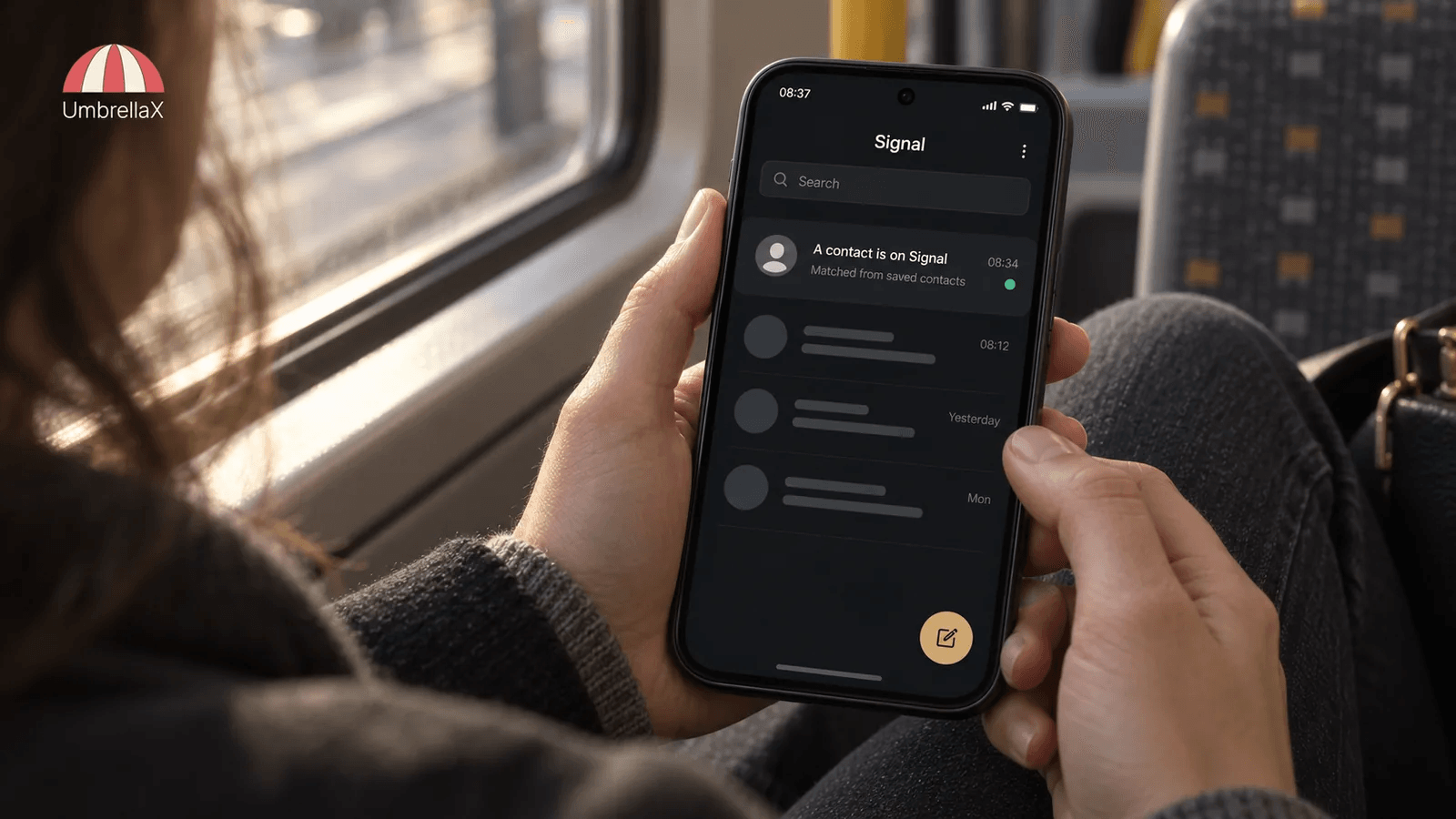
Does Signal notify contacts when you join? Signal says it does not transmit a registration notification from its service or from your new app. But a person who already has your phone number in their address book can see that the number is registered, and their Signal client can optionally create a contact-join alert. The practical result can feel like a notification even though no broadcast was sent. That distinction matters if an old contact, former colleague, or someone you did not choose to reconnect with still has your number. I am building UmbrellaX around a different starting point: a phone number should not be the account root or the default route into contact discovery. UmbrellaX is pre-launch, so that is a design direction, not a claim of proven production behaviour.
This is a narrow question, but it deserves a precise answer. I do not want to turn a small Signal setting into a reason to distrust encryption. I do want people to understand what a phone-number account can reveal before they rely on it during a sensitive transition.
The answer first
Signal’s current support guidance separates two facts that are often bundled together. It says that registration notifications are not transmitted by the service or by the person who joined. It also says that a person who already knows and saved your number can see that the number is registered, and that their own phone can optionally notify them when a contact starts using Signal. In other words, the alert is local to their device, but the underlying contact discovery can still make your presence visible to someone who kept your number. The important question is not whether Signal sent a broadcast. It is whether you are comfortable with an existing number-based relationship being enough for that person to see that Signal can reach you.
That is not a claim that Signal hands your number to a stranger. Signal’s wording is more careful than that. The privacy limit appears when a person already has the number and their device has a way to recognise it as a Signal account.
What Signal’s current guidance actually says
The official page answers the question directly. Signal says that it does not send your number to another person unless your number visibility permits it and you then message or call them. It also says that registration notices are created by the receiving phone, not sent in either direction by the service.
That explains two observations that otherwise seem contradictory:
- You can register without pressing a button that tells a contact you joined.
- A person who has your number saved may still see that the number is now available on Signal, and their app may surface that fact as a contact-join alert.
I would read the word may carefully. Signal documents a recipient-side notifications setting, including a control to turn off contact-join alerts on that recipient’s device. The result depends on what that person has saved and how their own app is configured. It is not a reliable promise that nobody with your number will notice.
If you need a separate answer about whether Signal itself can be registered without a number, read can you use Signal without a phone number?. That page owns the registration boundary. This page stays with the narrower question of what a pre-existing contact can observe once the number is registered.
Why a “joined Signal” notice can exist without a message from Signal
It helps to separate a message from a local recognition event.
Imagine that someone has your number in their phone address book. Their Signal client can compare its locally held contact information with the service’s private contact-discovery result. Once their phone knows that the number is reachable on Signal, it can show that information in a contacts list and may create an alert. Signal says the service does not know the contact list in the ordinary sense and describes the alert as something the recipient phone creates.
That architecture is better than treating a contact list as a marketing broadcast list. It still leaves a real social question: which people from your past have kept the number, and are you comfortable with the fact that they may recognise it as a Signal account?
The problem is not hypothetical. The research paper Mutual Contact Discovery describes why one-sided discovery can be troubling when an ex, former colleague, or other old contact retains a number. I would not turn that paper into a claim that every Signal user faces the same risk. I use it to explain why a seemingly small moment of recognition can carry more weight than an ordinary product notification.
For the wider privacy and operator-design question, I link to my contact discovery privacy guide. It covers address-book matching, social-graph exposure, and why a service should minimise what discovery reveals. I am not going to reproduce that technical discussion here.
Three questions to settle before you register
When I evaluate a private messenger, I separate three decisions that app screens often compress into one.
| Decision | What it asks | Why it matters here |
|---|---|---|
| Number visibility | Can a person I message see my number? | It controls direct disclosure in a conversation, not every discovery path. |
| Number discovery | Can someone who already has the number find or recognise the account? | It is the closest match to the contact-join concern. |
| Account foundation | Does the number remain part of registration, recovery, or operator records? | It decides whether carrier identity remains beneath the privacy settings. |
Signal’s phone-number privacy and usernames guidance is useful because it distinguishes visibility from discovery. I would use those controls. I would not let a hidden profile number persuade me that the account has become phone-number-free.
The same distinction is the core of my broader guide to phone number privacy in messaging apps. A setting can reduce exposure. It cannot rewrite the account root that the product chose at registration.
What you can control, and what you cannot
There is no reason to give up control just because the answer has a limit. I would make the boundary visible and use the controls that actually apply.
First, check Signal’s current settings for who can see your number and who can find you by it. The names and locations can change by client version, so I would follow Signal’s own number-privacy guidance rather than rely on an old screenshot. Next, choose a username only if you want a new person to start a conversation without receiving your number directly. Then review the profile information you reveal after accepting a conversation.
What you cannot do is set a control in your new account that decides how every other person’s phone treats a number they already saved. Signal calls contact-join notices a local recipient-side choice. A person who does not want those alerts on their own phone can disable them in their Signal notifications settings. The person registering does not get a remote switch for somebody else’s address book or alerts.
That is not a flaw I would hide behind a vague word like privacy. It is the ordinary cost of building on a shared phone-number directory. My rule is simple: state the cost before the user is in a stressful situation, not after an old relationship appears in a contact list.
A username changes the next conversation, not the past contact list
Signal usernames are useful. They can make a deliberate first conversation possible without handing a number to the other person in that conversation. I would choose that over asking a person to share a lasting telecom identifier when a handle will do.
But I do not want to oversell the improvement. A username cannot travel backward through someone else’s saved address book and remove the number they already know. It also does not change Signal’s documented phone-number registration boundary. It is a contact layer, not a time machine and not a different account root.
My messaging app usernames guide goes into the benefits and limits of handles across messengers. The useful rule here is shorter: a username can make the next contact more deliberate, while existing number-based discovery is a separate relationship to check.
My UmbrellaX design choice
I am building UmbrellaX because I do not want private communication to begin with a question about which old address books can recognise a carrier number. A person should be able to create an account without making a phone number the hidden key, then choose how to exchange contact information through a handle, QR code, or invitation that makes the relationship explicit.
That means accepting a tradeoff. Automatic contact discovery makes onboarding easier. A no-phone-number model asks people to make a more deliberate connection and to protect their account-recovery material. I would rather accept that friction than make an old phone directory a quiet announcement channel.
UmbrellaX is pre-launch. I will not claim that a design document has already survived a real incident, an independent audit, or production scale. The standard I am setting is narrower and honest: no phone number as the account root, no compulsory address-book discovery, encryption by default, and an operator-data model that collects less simply because the service can. You can read the published privacy policy, transparency statement, and about page to see who is responsible for those choices.
This identity decision does not remove every kind of metadata. It does remove one common way for a carrier identifier to tie account creation and contact recognition together. For the rest of that picture, read what end-to-end encryption does not hide.
Bottom line
Signal does not send a broadcast that announces you joined. Its own guidance says that a person who already has your number saved can see it is registered, and their phone may make a local contact-join alert from that fact.
I would take that answer seriously without turning it into panic. Use Signal’s number-visibility and discoverability controls. Use a username for deliberate new contact. Do not assume either choice erases an old number-based relationship or turns Signal registration into a no-phone-number model.
When that foundation is the part you want to avoid, pick a messenger whose account identity does not begin with a telecom number. That is the direction I am building toward with UmbrellaX.
Sources
- Signal Support: Does Signal send my number to my contacts? official
- Signal Support: Phone Number Privacy and Usernames, Deeper Dive official
- Signal: Private Contact Discovery official
- Signal Support: Register a phone number official
- Mutual Contact Discovery research
- UmbrellaX privacy policy official