



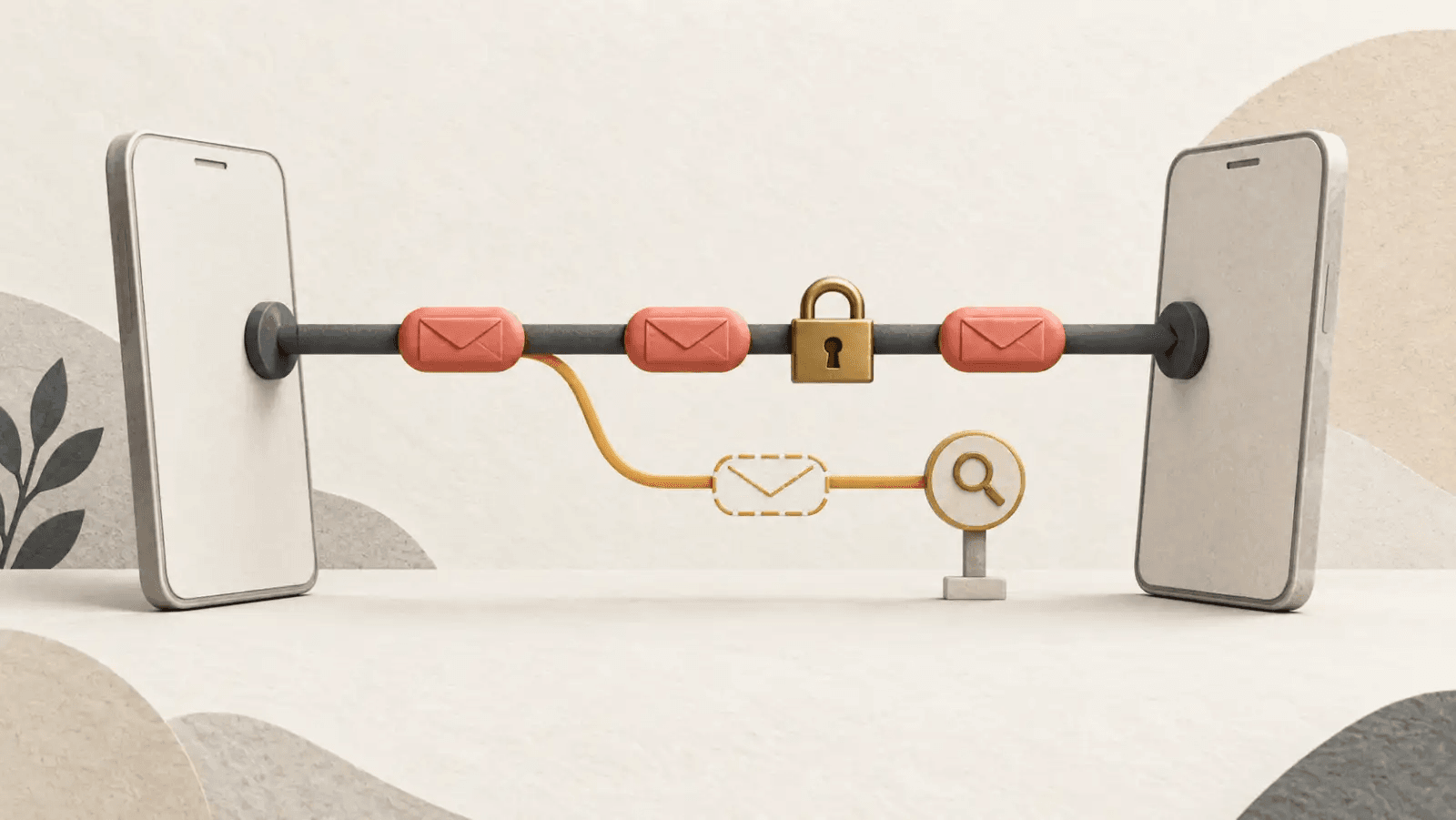
Is RCS encrypted? RCS can provide end-to-end encryption, but the answer depends on the conversation, software and carriers involved. An RCS label alone does not prove that only the participants can read a message. Google Messages shows a lock on its send button for an end-to-end encrypted chat. On iPhone, Apple documents an Encrypted label with a lock at the top of a qualifying RCS conversation. Apple and Google began rolling out encrypted RCS between supported iPhones and Android devices on 11 May 2026; that announcement does not make every RCS chat encrypted. If a message is resent as SMS or MMS, it loses end-to-end protection. Before sending something sensitive, check the current conversation indicator and the proposed delivery method. A green bubble, an enabled RCS switch, or a previous encrypted message is not enough evidence for the next send.
That is the distinction I care about as the founder building UmbrellaX: a person needs to understand the protection attached to the message they are about to send. A compatibility feature can be useful while still requiring a fresh decision about trust.
This guide reflects Apple and Google documentation checked on 1 October 2026. It is a way to inspect your own chat, not a claim that I tested every carrier or phone combination.
RCS and end-to-end encryption are separate checks
RCS, short for Rich Communication Services, adds features such as better media sharing and delivery status to carrier messaging. End-to-end encryption describes who can decrypt the content. Those are separate properties.
Google’s RCS data-handling page says its service uses TLS to protect the connection between your device and Google even when E2EE is unavailable. That protects a transport connection. It does not establish a secret shared only by the people in the conversation.
I use three states when making a sending decision:
| What the conversation shows | What I can conclude | My decision for sensitive content |
|---|---|---|
| RCS with the documented E2EE indicator | The app indicates content protection between participating devices | Check the recipient and proceed if the devices and audience are appropriate |
| RCS without that indicator | RCS features are available, but E2EE is not established by the label | Pause and check compatibility |
| SMS or MMS | This delivery method has no end-to-end encryption | Remove sensitive details or use an encrypted channel |
The table is deliberately about a specific send. It does not rank whole companies or assume that every RCS provider uses Google’s infrastructure. My end-to-end encryption explainer covers the underlying protection in more depth.
How to check the chat you are about to use
Start with the actual recipient or group. Checking a global setting and then opening a different conversation can miss the condition that matters.
In Google Messages
Open the conversation and inspect the send button while composing. Google’s E2EE instructions identify a lock on that button as the encryption cue. The RCS banner is useful context; I would look for the lock as well.
Google also documents optional verification codes and, on supported Android configurations, Key Verifier. These provide an additional contact-key check. The encryption indicator and verification have different jobs: one reports the chat’s protection state, while the other helps check that the key belongs to the intended contact. Follow the procedure available for your devices rather than assuming an Android verification menu exists on an iPhone.
On an iPhone
Look at the top of the RCS conversation. Apple’s message-type guide identifies an Encrypted label and lock for qualifying chats. Green bubbles alone cannot distinguish encrypted RCS, other RCS traffic, and SMS/MMS.
To inspect the setting, Apple’s RCS setup instructions point to Settings > Apps > Messages > RCS Messaging. Its iOS 26.5 guidance includes an End-to-End Encryption (Beta) switch, enabled by default where supported. The service and its encryption feature can have different availability.
I would check both the setting and the conversation. A switch expresses a preference; the conversation shows whether that preference can currently be satisfied with these participants.
Why an RCS chat can show no encryption lock
The most useful starting assumption is a compatibility gap. Basic RCS support does not guarantee support for encrypted RCS, and your own phone is only one part of the exchange.
Apple’s May 2026 announcement describes a beta rollout for iOS 26.5 and supported carriers. Google’s corresponding announcement includes Android users on the latest Google Messages and says encryption is enabled over time. I would not convert either announcement into a universal availability claim.
Update the relevant software, check the RCS and encryption settings, and consult the carrier’s current support information. The other participants need compatible support too. If the lock is still absent, treat the chat as lacking verified E2EE for the purpose of deciding what to send.
There is a documentation trap here. Some older support wording describes only Google Messages users, while newer official announcements describe the iPhone rollout. A dated rollout announcement resolves the broad capability question. The indicator in your conversation resolves the immediate sending question.
I do not want a reader to spend an hour toggling settings because a headline said encryption had arrived. Sometimes the useful answer is that this combination cannot yet provide the protection you need.
A failed message can take a different path
Imagine that you prepare a door-entry code for a friend. The chat has an encryption lock, but the message remains undelivered while their connection is unavailable. A resend option appears. You are now making a second security decision about the same text.
Google’s delivery instructions describe tapping an undelivered message’s timestamp and choosing Switch to text (SMS/MMS). Google explicitly says that messages sent this way will not be end-to-end encrypted.
For a casual arrival time, I might accept that tradeoff. For an access code, a private document or someone’s location, I would wait or arrange another protected channel. The urgency of delivery does not make the content less sensitive.
Review any automatic resend setting your version offers. Turning it off can prevent an unwanted SMS resend; it cannot add encryption to an RCS chat that does not support it. Read the current delivery label again after a failure, a settings change or a switch of app.
My rule is simple: a retry that changes protection needs a new decision. I would rather see a clear failure than mistake successful delivery for preservation of the original security conditions.
A group must qualify as a whole
An encrypted conversation with one friend does not prove that a larger room has the same protection. Google’s support guidance describes encrypted Google Messages groups when all participants qualify. Apple’s RCS guidance likewise ties encryption to carrier support across the participants.
For a family group with mixed phones, I would open the group itself and check its status. I would repeat that check when someone joins or changes their messaging setup. The group organiser’s handset cannot establish everyone else’s compatibility.
This is also where I stop the scope of this article. RCS compatibility does not answer what happens to future keys after a member leaves, or what an administrator can expose. Those questions belong in my secure group messaging guide. The Signal Protocol and MLS analysis covers protocol choices without making a protocol name a substitute for the state shown by a real client.
The privacy questions an encryption lock leaves open
An encryption lock answers a content-protection question. It does not tell you whether a carrier or service can associate the conversation with your identity.
Apple says RCS setup exchanges identifiers with the carrier and its partners, including the phone number and, depending on the carrier, an IP address. Google separately describes using identifiers to operate its RCS service. I would assess those records through the operator metadata question and the phone-number identity question, rather than asking an encryption icon to answer both.
The receiving person can still read and copy what you send. A lock cannot make an unlocked device private, change the audience you selected, or control a screenshot. When the concern involves legal pressure on a provider, its jurisdiction and retained records need separate scrutiny. There is no responsible, universal promise that an encrypted chat is beyond every form of disclosure.
The sending rule I am building into UmbrellaX
RCS is useful because people can reach contacts through familiar messaging software. That convenience comes with combinations of clients, carriers and delivery modes that the user must sometimes interpret. I want UmbrellaX to make fewer of those decisions depend on telecom compatibility.
For UmbrellaX, my design requirement is that a failed encrypted send stays visibly failed or waiting until a protected path is available. I do not want the same action to send private content through a weaker route merely to produce a delivered status. I accept the cost: a person may have to wait or deliberately choose another channel.
That requirement extends to groups. I am building around encryption by default and an MLS group design so that a room’s protection is a product constraint from the start. Choosing the protocol does not finish the implementation; it defines work that must be checked. The account foundation also avoids a phone number, because a carrier delivery identity should not quietly become the root of a private relationship.
Our Kazakhstan jurisdiction, outside the Five Eyes, makes operator accountability another deliberate choice. In this context, my question is what records a failed or retried send creates and whether the operator needs to retain them. I want that record to be small and explainable. The privacy page and my founder page are the places to inspect who is responsible for those choices.
UmbrellaX is pre-launch. These are design requirements I am committing to, not claims of a production track record, a completed independent audit, or an RCS bridge. I would choose its direction for conversations that need an identity and group policy independent of a carrier number. Until a product can demonstrate those properties, the practical sending decision still needs evidence from the software actually in your hands.
Before the next sensitive message
Open the conversation, check its encryption indicator, confirm the audience, and notice whether a resend changes the delivery method. If the state is unclear, pause before sending the sensitive part.
I welcome broader RCS encryption because it protects more ordinary conversations. The standard I want for UmbrellaX goes further in a specific way: the person sending a private message should not have to discover after a failure that the next successful send used weaker protection.
Sources
- Apple Support: iMessage, RCS, and SMS/MMS official
- Apple Support: Turn on RCS messaging on your iPhone official
- Apple: End-to-end encrypted RCS messaging rollout official
- Google: Encrypted RCS for Android and iPhone users official
- Google Messages: Use end-to-end encryption official
- Google Messages: How RCS chats keep conversations secure official
- Google Messages: Control message delivery official