



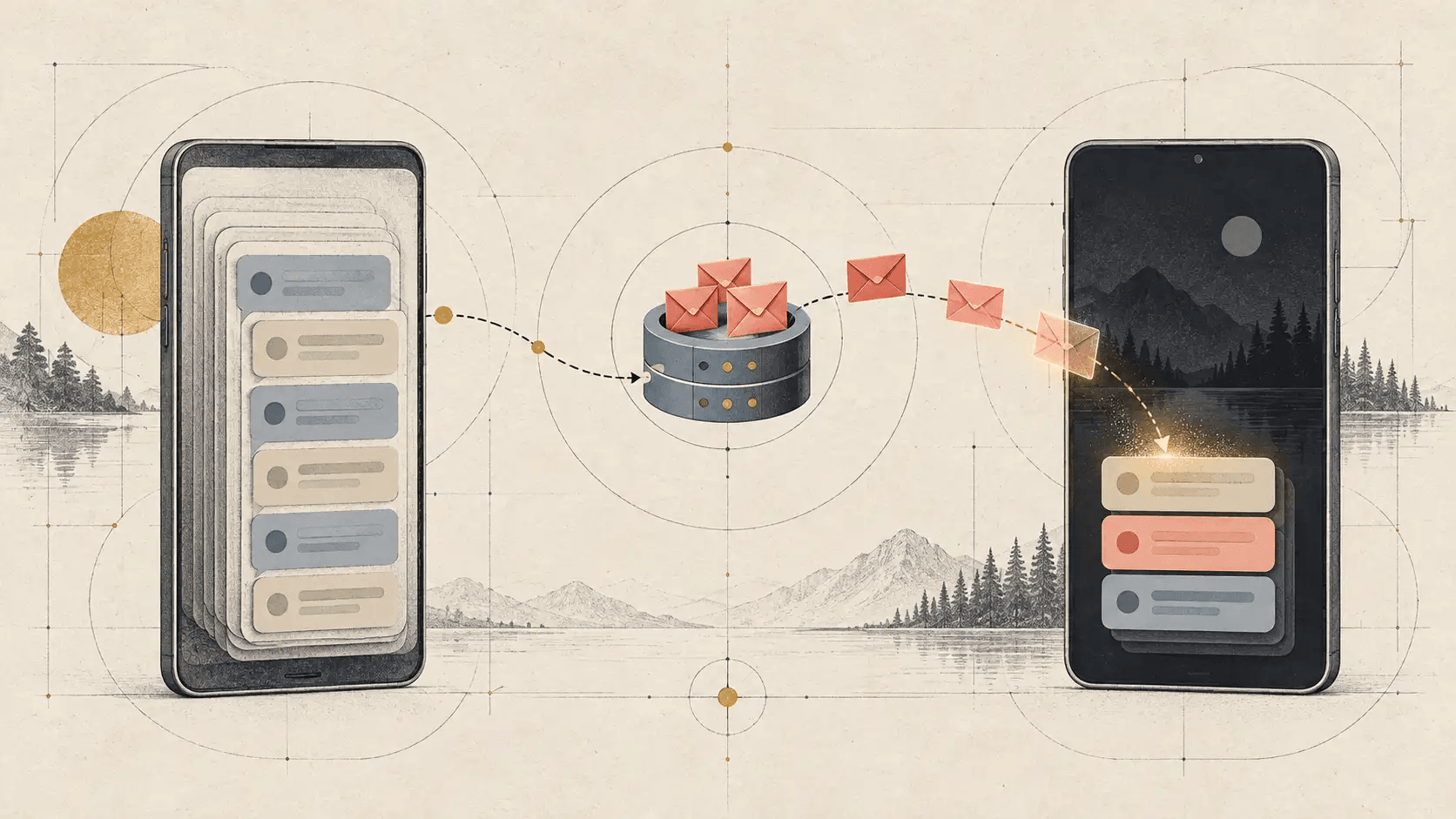
Does Signal store messages? Signal’s published privacy policy says it temporarily queues end-to-end encrypted messages when a recipient device is offline, but calls conversation history local to a person’s devices. That is a meaningful distinction: temporary delivery state is not a cloud archive you can browse, and it is not readable to Signal. The same policy says the service retains technical material needed to establish calls and move messages, such as authentication tokens, keys, and push tokens. I would choose Signal over a product that builds a permanent readable chat archive. I would not use this fact to skip device security, private backups, or an honest look at the data a carrier, operating system, recipient, and network can still expose. UmbrellaX is pre-launch. I am building it around a stricter operator-data question: what must the service know to deliver a protected message, and what should it refuse to retain once delivery is done?
That distinction is the whole reason this question deserves a precise answer. Saying that messages are encrypted does not say where copies live. Saying that a service does not keep a cloud chat history does not mean every copy of a conversation disappears when you press delete.
Direct answer: Signal keeps a delivery queue, not cloud history
Signal’s Terms and Privacy Policy makes two claims that belong together. First, Signal says that it cannot decrypt or access the content of messages and calls. Second, it says it queues end-to-end encrypted messages while a recipient device is temporarily offline, but keeps message history on users’ own devices.
I read that as an architecture statement, not a slogan. A service needs some way to hand a message to a phone whose battery has died or whose connection has dropped. A short-lived encrypted parcel waiting for that device is a delivery queue. It is not the same thing as a provider holding years of readable chats in a cloud account, syncing them to a browser, or rebuilding a history whenever a person installs a new phone.
That difference matters when I decide where to put sensitive conversation. I would rather trust a messenger that reduces its permanent server knowledge than one that treats a full history as the default product feature. But I would not overstate the conclusion. End-to-end encryption protects a message from the operator’s ordinary access. It does not make the message invulnerable on a recipient’s unlocked phone, inside a deliberately created backup, or after someone has copied it elsewhere.
What Signal’s policy says it still needs to hold
The word “does not store” often makes a privacy explanation less useful. A networked service cannot work with literally no state. Signal’s policy says it stores randomly generated authentication tokens, keys, push tokens, and other material necessary to establish calls and transmit messages. It also describes an optional contact-discovery process designed to identify which people in an address book use Signal.
My rule is to ask two separate questions:
- Can the operator read my message history?
- What state must the operator still process to deliver a message, establish a call, prevent abuse, or connect an account?
Signal’s answer to the first question is materially stronger than a cloud archive model. The second question still deserves scrutiny. A message service has to route to a destination, and the older Sealed Sender engineering explanation describes that tension clearly: delivery needs enough information to reach a recipient, while the service should minimise the relationship information it retains.
I do not use an older engineering post as proof that every network-level risk is solved forever. Signal itself described resistance to timing correlation and IP-address exposure as ongoing work. The useful founder lesson is narrower. “Encrypted” is not a licence to stop asking what delivery state exists, for how long, and who else around the message can observe it.
For the broader map of what encryption does and does not hide, read my private messenger metadata guide. I am deliberately not reproducing its full taxonomy here. This page is about Signal’s published server-history boundary.
The local copy becomes the history decision
If Signal is not your cloud archive, the devices in the conversation become more important. Your phone holds a readable history after it decrypts a delivered message. A linked device can hold its own copy. The recipient’s device may keep another. A notification preview, a screenshot, a downloaded file, or a locally configured backup can create more places where the conversation survives.
That is why I would never tell someone “Signal does not store messages, so you do not need a recovery plan.” It is exactly the opposite. When history is local, loss and recovery become personal security decisions rather than a cloud-provider reset button.
Signal’s backup and restore guidance documents on-device Android backups with a passphrase, device-to-device transfers, and an iOS boundary where iCloud and iTunes backups do not include Signal message history. Those are product details that can change, so I would check the current support page before moving to a new phone. The long-lived principle does not change: every deliberate recovery copy creates another asset that needs protection.
My encrypted chat backups guide is the deeper page for that decision. It compares recovery keys, cloud accounts, local storage, and the uncomfortable fact that convenient restoration can widen the number of people or services able to reach old material. Here, I only want to make the boundary visible: no provider-held chat archive is not the same thing as no stored history anywhere.
Legal requests show why the retention boundary matters
The cleanest way to test a retention claim is to look for evidence of what a service says it could actually hand over when compelled. On 6 March 2026, Signal published a District of Columbia government-request disclosure about a grand-jury subpoena seeking account-creation and last-connection times for a set of phone numbers. Signal said it could not provide messages, calls, profile information, group information, contacts, stories, or call logs that it did not possess.
I find that more useful than a marketing promise because it draws a boundary around a real request. It does not make Signal immune from laws, subpoenas, device seizure, or an investigation that obtains evidence from another place. Signal’s policy says it may need to respond to enforceable government requests. The question is what information exists in its hands when that happens.
That distinction keeps the advice honest. A provider may have little useful message content while a recipient keeps the chat, a person has copied a backup to a computer, a phone exposes a notification, or a carrier has information about the number that registered the account. I would ask each of those questions separately. I would not let a strong provider-retention answer become a promise that a conversation is beyond every other kind of collection or disclosure.
If a specific legal situation is involved, speak with a qualified lawyer in the relevant jurisdiction. This is a privacy-architecture guide, not legal advice.
Content confidentiality does not settle every metadata question
There is a bad habit in private-messaging discussions: either calling all metadata irrelevant because the text is encrypted, or treating any remaining metadata as proof that encryption has failed. Neither is useful.
Signal’s published design aims to keep the service’s knowledge small. That is a meaningful advantage. A person can still have a threat model involving an account identifier, a device, a push-notification provider, a network observer, an address book, or the social fact that another person retains the conversation. These are different layers with different owners.
I would not try to solve a phone-number account question by repeating a server-storage answer. Signal’s current identity path is a separate design issue, which I cover in can you use Signal without a phone number? and in my wider guide to a messenger without a phone number. I would also not use a disappearing-message timer as a substitute for retention design. That belongs in what disappearing messages can and cannot do.
The point is not to make a simple answer feel evasive. The simple answer is strong: Signal does not describe a readable cloud history held by its servers. The responsible follow-up is equally simple: secure the places where history and identity actually remain.
My five-minute retention check
When I assess a private messenger, I do not start with a feature badge. I start with a few documents and a few awkward questions.
| Question | A useful answer looks like | A warning sign looks like |
|---|---|---|
| Where is history kept after delivery? | The provider clearly distinguishes device history, delivery queues, and optional backups. | The service says “secure” but never identifies its archive model. |
| What survives if a device is offline? | The provider explains the encrypted delivery path without pretending it is a permanent history. | Storage terms are vague or require a support ticket to understand. |
| What does the operator retain to run the service? | Named technical categories and an explanation of why they are necessary. | A sweeping “nothing” claim that cannot describe accounts, delivery, or calls. |
| What evidence exists under legal pressure? | Current transparency disclosures or a clear policy tied to actual retained data. | General marketing copy with no retention boundary or evidence. |
| Where could I create extra copies? | Backup, transfer, linked-device, notification, and export choices are visible. | Recovery is presented as convenience with no discussion of new copies. |
Signal clears several of these tests well because it publishes a direct policy and government-request material. I would still perform the last check on my own devices. The most careful server design cannot protect a screen left unlocked in a cafe, a recovery secret stored in a shared notes app, or a recipient who exports a sensitive file.
The operator-data rule I am building for UmbrellaX
I am building UmbrellaX around a practical constraint: the operator should hold the minimum state required to deliver a protected message, run a resilient service, and deal with abuse without converting private conversations into a behavioural archive. I do not want product convenience to create a default long-term database of who said what to whom.
That is not a claim that UmbrellaX already has a production retention record. UmbrellaX is pre-launch, and I will not pretend that a design direction has been proven by users, audits, incidents, or legal requests. It is the standard I want the product to be judged against once evidence exists.
There is a tradeoff I accept. A system that does not treat a provider as the keeper of every old conversation needs a clearer device-transfer and recovery story. I would rather make that ownership visible than make a server archive feel effortless and private by default. The broader comparison, including Signal’s established record and UmbrellaX’s unproven status, is in UmbrellaX vs Signal. You can also see who is responsible for these choices on my about page.
Bottom line: local history changes the risk
Signal says it temporarily queues encrypted messages for offline delivery but keeps conversation history on devices. That is a substantial difference from a readable cloud-chat archive, and it is one reason I would take Signal seriously for private conversations.
I would not stop there. Check where your local history, backups, linked devices, notification previews, account identifiers, and recipient copies live. The best retention policy does not secure copies created outside the provider.
For UmbrellaX, my design rule is to keep delivery state narrow and make every durable copy an explicit user decision. That is the privacy standard I find worth building toward.
Sources
- Signal Terms and Privacy Policy official
- Signal Support: Backup and Restore Messages official
- Signal Government Requests: District of Columbia official
- Signal: Sealed Sender official